Landowner Counts 106 Cars Driving Past His Door to the Trailhead — Then His Neighbor Says Twenty Years of Graveling the Private Road Cost $20,000
Photo credit: AI-generated image created using ChatGPT. Illustrative only.
Wolf Pit Road looks like the kind of quiet mountain lane where you know every truck by the sound of its tires on gravel. But for the neighbors who live along it, the traffic to a beloved trail has started to feel less like “a few hikers” and more like a steady stream of strangers rolling past their mailboxes.
In Burke County, North Carolina, homeowners along the private road that leads to the Shortoff Mountain trailhead say the volume has gotten out of hand—enough that some want to cut off access entirely. The details, including the counts, the road work costs, and what the Forest Service is doing next, were reported in the original post.
When “a few cars” turns into a daily parade
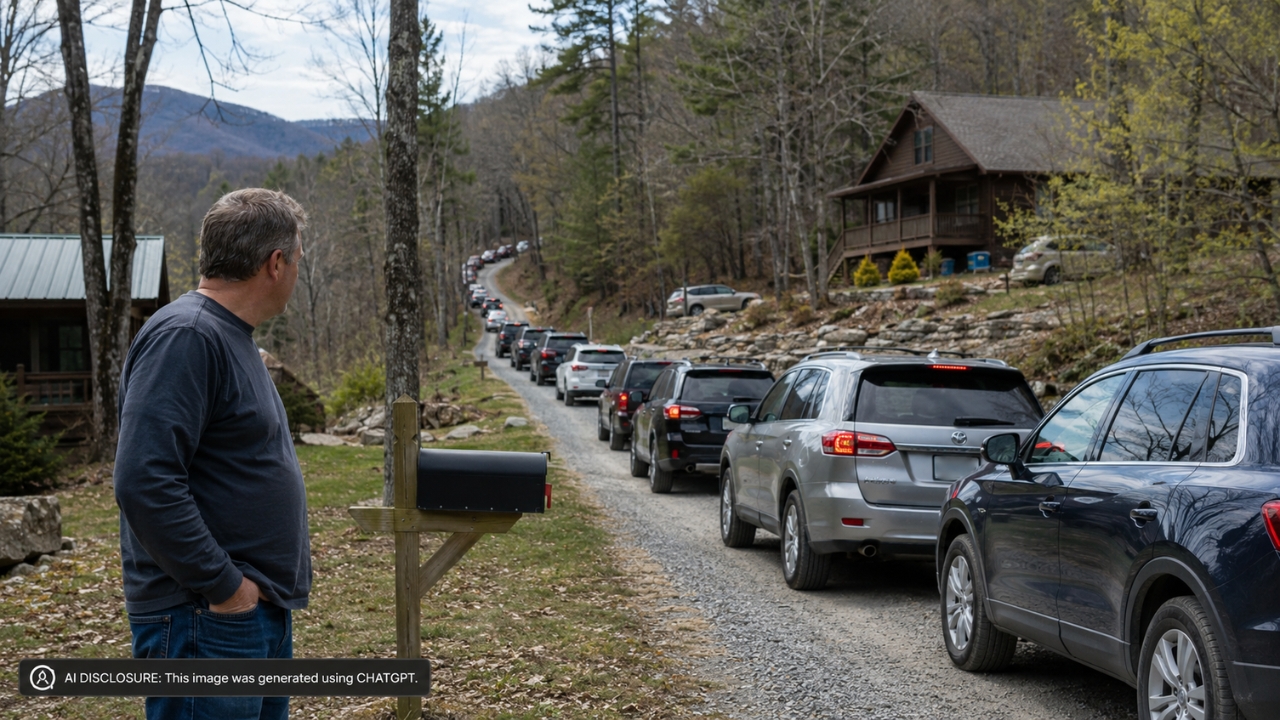
Ray Earnhardt lives along Wolf Pit Road, and he didn’t describe this like a minor annoyance. He described it like a line you can physically see forming—cars stacked from up the road to past his driveway.
At one point, Earnhardt said he counted 106 cars. In rural living terms, that’s not background noise. That’s dust, headlights through the trees, engines revving on grades, and the constant feeling that your front yard has become the shoulder of a public attraction.
Earnhardt also pointed out his property line stretches across the road, a detail that matters because hikers are using the road to reach the Shortoff Mountain trailhead in Linville Gorge. He posted a sign warning that the road is private and urging visitors to follow rules or risk losing access altogether.
The hidden bill: keeping a private road alive under public-level use
When a road is private, it’s not just a “nice-to-have” amenity. It’s infrastructure—one the homeowners become responsible for, whether they asked for the traffic or not.
John Hamer, another neighbor, said he has been maintaining the road that runs past his home for more than 20 years, even though most of the vehicles are headed for the trail. And he put a number on what that maintenance can look like when it gets serious: “Cost me $20,000 to gravel the road at one time,” Hamer said. “Nobody has ever given us a nickel for nothing.”
That’s the part that turns this from a simple “let people enjoy nature” story into a classic property-owner standoff. Trail access feels public. Road maintenance is painfully private.
It’s not just traffic—it’s behavior
If it were only slow-moving hikers, maybe the road could limp along. But one neighbor’s comment hints at the bigger headache: the way some drivers treat the place.
“We get some people to come up here that treat this as their own private dirt track,” Shane MacKinnon said. That phrase carries a lot without spelling it out—speeding on gravel, sliding around corners, throwing rocks, tearing up shoulders, making it harder to keep the road graded and passable.
Even if nobody is intentionally reckless, volume alone changes the feel of a place. More vehicles mean more opportunities for someone to park wrong, block a turnaround, drive too fast past homes, or ignore a sign because they assume “trailhead road” equals public right-of-way.
And once homeowners start feeling like they’re living next to an unstaffed recreation site, patience tends to run out fast.
The access problem: a trail people love, reached by a road people live on
Shortoff Mountain is popular for a reason. The report describes views in every direction, the kind of payoff that turns a local hike into a destination. But destinations create pressure points, and this one sits right on top of private property realities.
Hikers interviewed in the story didn’t hide what’s at stake for them. Some worry closing the road would make the hike “completely inaccessible” to people who can’t or won’t add extra miles just to reach the trailhead. Others voiced the broader feeling that nature should be open.
That’s an honest reaction. It’s also the exact mismatch that fuels these disputes: the public sees a mountain. The homeowner sees the only road to their house getting pounded by visitor traffic.
The U.S. Forest Service said it is working with private landowners to manage access to the trailhead and the parking area there. A surveyor with the Forest Service was spotted studying the area, which suggests they’re looking at boundaries and options rather than tossing out a quick fix.
What neighbors do when they feel cornered: signs, boundaries, and leverage
The sign Earnhardt posted is the kind of step homeowners take when they feel like they’re losing control of their own frontage. It’s not a friendly “please don’t litter” note. It’s a warning: follow the rules or access goes away.
That’s leverage, and it’s also a signal that the next steps can get messy. When a private road becomes the de facto gateway to a popular public experience, landowners start thinking in terms of liability, wear-and-tear, and what happens if emergency vehicles need access on a rutted, crowded stretch.
Even without anyone saying the word “lawsuit,” you can hear it in the subtext: if someone gets hurt, if a vehicle is damaged, if an argument turns into a confrontation in a driveway, who owns the problem?
And while hikers may see a closure as unfair, homeowners often see it as the only tool left when costs and stress keep stacking up.
The comment-section split: “nature is for everyone” vs. “who pays for the gravel?”
This is the kind of story that tends to sort people into two camps immediately. One side hears “private road” and thinks the answer is simple: respect the sign, slow down, stay out of yards, pack out trash, and don’t treat it like a racetrack.
The other side hears “trail access” and worries about a precedent where a popular hike becomes off-limits because the only convenient approach crosses private land. It’s not hard to imagine hikers arguing that public lands shouldn’t be functionally locked behind a gate—especially when the views are the reason people come in the first place.
But Hamer’s $20,000 gravel number is the kind of detail that changes the tone fast. People can debate ideals all day; fewer want to volunteer to bankroll road maintenance for hundreds of weekly visitors.
In real life, this usually ends up less about who’s “right” and more about whether an agency can create a workable access plan that doesn’t treat homeowners as unpaid road crews.
For now, the road is a pressure valve that’s starting to squeal: hikers want a straightforward way to reach a cherished trail, and homeowners want their private driveway-road back—quiet, maintained, and not worn down by 106 cars at a time. If the Forest Service finds a long-term solution that spreads the burden fairly, Wolf Pit Road might stay a gateway instead of a battleground. If not, the next sign people see on the way up may be the one that finally means it.
Like Fix It Homestead’s content? Be sure to follow us.