Homeowner Finds the Street Outside Her Door Is Private Land — Then the Owner Offers to Rent Her a Parking Space for $30 a Month
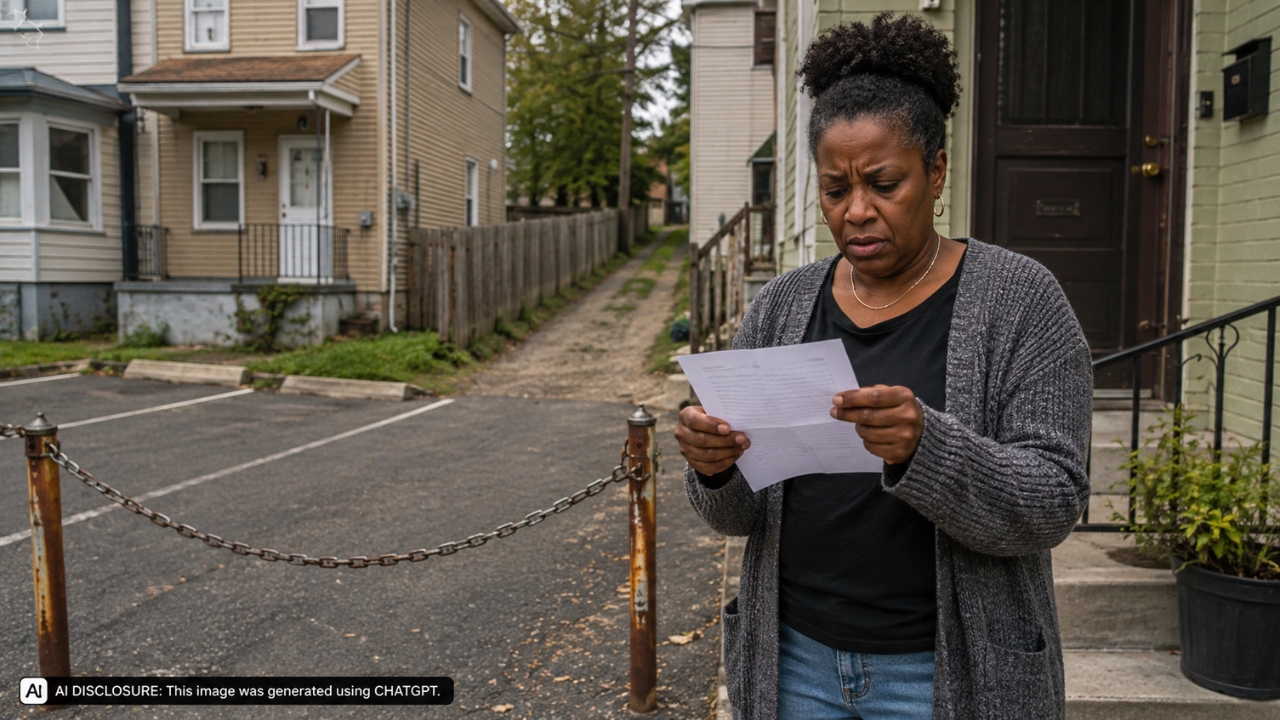
Photo credit: AI-generated image created using ChatGPT. Illustrative only.
Erica Riddick thought she knew what came with her front door: a street sign out front, a paved spot to pull in, and the normal little routines of homeownership—parking, trash day, waving at neighbors.
Then a letter showed up and basically said the “street” outside her house wasn’t a street at all. It was somebody else’s property. And if she wanted to keep using it the way she always had, she could start paying monthly for the privilege. The full details are laid out in the source report, but the day-to-day consequences read like a homeowner nightmare: no parking where you’ve always parked, no setting out bins where the city always grabbed them, and a weird new feeling that your address might be… more suggestion than reality.
A $1 house came with a “gold key” moment
Riddick’s story starts with one of those rare wins. In 1999, she bought her first home through HUD’s Dollar Homes program, paying $1. She remembers being at Cincinnati City Hall, hearing her name called, and getting a little wooden key painted gold—ceremonial, but meaningful.
The point of the program was stability: help first-time buyers and shore up neighborhoods. She took multiple homebuyer training classes, and she even bought a homeowner title insurance policy because she was trying to do everything “right.”
For years, it looked like it worked. Her Northside home had what looked and functioned like a public street in front of it: a paved area, a city street sign that said “Vandalia Avenue,” and the normal rhythm of city services. Garbage and recycling pickup happened there. Mail delivery happened there. Neighbors used it and parked there.
Then a new owner said, “That’s not a street”
The change came after Matthew Strausbaugh bought a nearby property at 4159 Dane Ave. That purchase included the land Riddick and her neighbors believed was Vandalia Avenue—the part they’d been using as the practical front access to their homes.
Strausbaugh sent a letter to surrounding property owners that did not mince words. “Some of the neighbors seem to think that there are easements or even a private drive called Vandalia on the land,” he wrote. “This is not true.” He said there were no recorded rights of way going back 125 years.
He also acknowledged the obvious: people had been parking there. His “friendly neighbor” offer was to let them keep parking free until the end of 2015, and then start charging starting Jan. 1, 2016: $1 per day or $30 per month per vehicle or trailer.
And if nobody wanted to lease parking? The letter said the lot would be barricaded from any use at all. Trash collection could keep happening there only if the lot stayed open; if it was blocked off, residents would need to move bins to their “easements of record.”
The practical fallout: parking, trash cans, and daily access
This is where the story stops being abstract and starts turning into a grind. Riddick says she can no longer park on Vandalia or leave her garbage and recycling cans there. The simple stuff that keeps a household running—where you unload groceries, where you put the bins, how visitors find you—became a daily hassle with a side of stress.
Even neighbor life shifted. Riddick said she doesn’t see people the same way she used to, because neighbors now use different access points to reach their homes (which still carry Vandalia Avenue addresses). That’s the sneaky part of property disputes: they don’t just change a map, they change how a block feels.
Riddick now uses a narrow, unpaved easement off Chambers Street to get to her home—an access route she says she didn’t even realize she could use until the dispute forced everyone to re-check what was actually recorded. She thought it was a driveway for an adjacent two-family home.
It’s hard to overstate how unsettling that is as a homeowner: the “front” of your home turns into a question, and you find out the backup plan is a skinny, unpaved path you never planned your life around.
City Hall got involved—then backed away
Riddick and some neighbors went looking for help where a lot of homeowners would: community council meetings and City Council offices. Cincinnati City Councilman David Mann introduced a motion (signed by multiple council members) directing city administration to take actions to ensure residents maintained access to their homes and that police, fire, and public services could still reach them.
But former City Manager Harry Black later wrote that the matter was “a private property dispute,” and said there wasn’t an obvious role for the city in resolving it. The letter pointed toward the option that makes most homeowners’ stomachs drop: legal action.
Underlying all of this is a reality many buyers don’t learn until it’s too late—Cincinnati has hundreds of private streets. They’re “very common,” according to Kelly Meyer, president of the Cincinnati Area Board of Realtors, and they show up even in newer developments. Owners are typically responsible for maintenance like repaving and repairs, and residents may get some services (like garbage pickup) but not others (like snowplowing).
Private streets can be workable when everyone agrees on rules and cost-sharing. They can also turn into a pressure point the moment ownership changes hands or someone decides the informal “we’ve always done it this way” arrangement is over.
Lawyers argued over access, and a judge picked a side
Several residents filed suit in June 2018. Their attorneys argued Vandalia Avenue should be treated as a street—at least enough of one that residents could keep using it as their primary way in and out.
The property owner’s lawyer, Steven Davis (representing MLS Homes, LLC, which Strausbaugh later transferred the property to), argued the land isn’t a street at all and the owner should be able to use it as private property. He compared it to a homeowner wanting to use a neighbor’s driveway simply because it’s more convenient.
One of the sharp points: whether this disputed land is the primary means of ingress and egress to the homes. Davis argued Riddick has access via the Chambers Street easement, even if it’s less convenient than the paved area she used for years.
Hamilton County Common Pleas Judge Patrick Dinkelacker ruled in favor of MLS Homes. Riddick is appealing, with oral arguments scheduled for Feb. 12 in the Ohio First District Court of Appeals.
MLS Homes, according to Davis, has other plans for the property, including some kind of multi-family residential development. So this isn’t just about letting a few cars sit there—it’s about what the land is worth when it’s not being treated as a “neighborhood front yard.”
The reactions: people kept coming back to paperwork and proof
This is the kind of story that makes homeowners immediately start mentally flipping through their own closing documents. Who owns the road? Is there an easement? Is it recorded? What does the title policy actually cover? What did the city “act like” was true versus what’s legally true?
The source report notes Meyer’s advice that Realtors can help buyers figure out private street ownership, rules of access, whether a managing authority exists, and how cost sharing works. That’s the unglamorous part of buying a house, but it’s the part that determines whether you’re living normally—or suddenly negotiating for the right to park outside.
There’s also the human reaction that doesn’t fit neatly into a checklist: the fear of being stuck. Riddick put it plainly when friends suggested she should just sell and move. “Would you buy a landlocked house?” she asked. The silence she described after that question tells you exactly how trapped it can feel.
Riddick did what first-time buyers are told to do—training classes, title insurance, trust the professionals—and still ended up fighting over the ground in front of her home. Now she’s living with the workaround access, the changed routines, and a court battle that’s deciding whether the “street” outside her door is something she can count on, or something she has to rent.
Like Fix It Homestead’s content? Be sure to follow us.