Rural Neighbors Find the 40-Acre Horse Farm Next Door Hosting Parties for Four Thousand People — Then They Sue Under a Covenant Limiting It to Horse Training
Photo credit: AI-generated image created using ChatGPT. Illustrative only.
You buy rural because you want quiet. Maybe you can hear frogs at night. Maybe the loudest thing on your road is a tractor, once in a while. So when the property next door starts acting like an event venue—with amplified music, traffic stacking up, and strangers cutting through yards—it doesn’t feel like “country living.” It feels like your home got relocated next to a festival gate.
That’s the reality neighbors describe on Scottland Drive in Orange County, North Carolina, where a nearly 40-acre horse farm inside Scottland Equestrian Estates has been accused of hosting massive parties. The details come out in the original post, which lays out how the dispute escalated from noise complaints into a lawsuit built around an old-school tool a lot of rural homeowners wish they had: a restrictive covenant.
The first sign was the traffic, not the music
The farm at 4505 Scottland Drive was built more than 20 years ago on a quiet cul-de-sac south of Mebane, just off Mebane Oaks Road near the Paws4Ever animal shelter. Neighbors say that calm rhythm changed over the last year after a new operator, F7 BlackStone Ranch, began leasing the land in 2024.
At first, “events” can sound harmless—trail rides, farm experiences, maybe the occasional gathering. But neighbors told county commissioners they were dealing with noise, heavy traffic, and people cutting across their yards. Those are the kinds of things that don’t stay theoretical. They show up as ruts at the edge of a lawn, tire marks where a car hopped a shoulder, and that unsettling feeling when you can’t tell who’s out there after dark.
Melissa DeRosier, who filed a lawsuit with her husband in April, described “really loud amplified music,” plus bands, DJs, “sound shows,” food trucks, and alcohol. That’s not a small wedding tucked into a barn. That’s a production.
When the road blocks, everything else gets scary
Rural roads don’t have the extra capacity suburban neighborhoods rely on. There’s no parallel street to route around, no spare shoulder, no second entrance. So when a queue forms, the road becomes a single point of failure for everyone who lives past it.
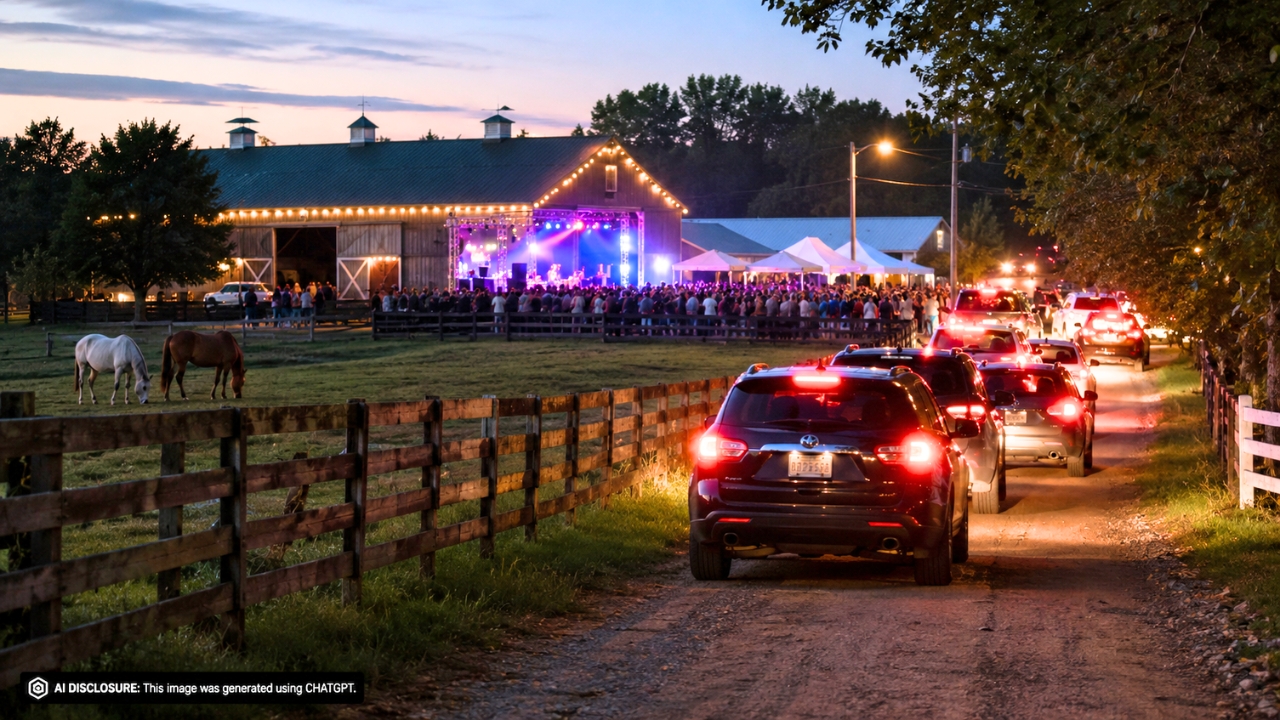
Orange County Commissioner Earl McKee said he saw it himself earlier this year: cars stacked up about a quarter mile. From inside a nearby home, he could hear conversations, yelling, music, and engines—motorcycles revving and ATVs, too.
The Orange County Sheriff’s Office shut down two parties at the ranch, according to spokeswoman Alicia Stemper. One was StarTime FieldFest on Feb. 27, which blocked emergency access. The second was an April 21 party with about 2,000 people, shut down after noise reports.
Blocking emergency access is the kind of detail that makes neighbors stop debating “annoying” versus “not annoying” and start thinking about what happens if somebody’s house catches fire, or a kid gets hurt, or an ambulance needs to get through.
The lawsuit leans on a covenant, not zoning
This is where it gets especially frustrating for rural homeowners: farms in North Carolina are exempt from local zoning, and state law allows agritourism as a way for “bona fide” farms to generate income. Orange County does limit farms to 12 large events per year and requires a rural special events permit.
But the bigger point neighbors keep running into is that counties have limited power to regulate what farms do. And the definition of “bona fide farm” can be loose enough that an event venue can claim it’s farm-adjacent.
Scottland Drive neighbors argue they have something many rural neighborhoods don’t: a protective covenant. They say it limits the property’s use to living on site or operating a “commercial horse breeding, riding, and a training facility.” Resident Jimmy Barbee told commissioners that covenant is a tool—one that could actually restrain the kind of large-scale party use they’re dealing with.
DeRosier and her husband’s lawsuit names James Montague, the owner of F7 BlackStone Ranch, and Sunrise International Enterprise LLC, described as a Chapel Hill landowner. Montague is also described as a Raleigh community developer with an option to buy the farm.
The farm says it pulled back on the biggest parties
Montague told The News & Observer by email that the ranch offers horses, trail rides, and farm-based experiences, and that larger events were added last year to support the farm financially. He declined to address specific allegations, but said the ranch recently ended “large, college-style field parties.”
He framed it as a pivot: keep the farm viable, but fit better with the surrounding community. He also said the larger events required invitations or tickets, had clear parking rules and security, and obtained ABC permits or licenses when needed.
Still, neighbors point to the real-world footprint: the noise that travels, the traffic that stacks, and the way private property starts getting treated like overflow parking. After an April 8 party described as the “Oil Spill,” a neighbor reported a damaged mailbox on April 9. Montague’s online post said that event attracted over 4,000 North Carolina A&T students.
Deputies were hired off-duty for parties on April 8 and April 23, according to Stemper. She said venues typically hire one deputy for every 100 attendees, and those deputies don’t enforce party rules or check IDs, but they can manage traffic and respond to offenses.
Her explanation was blunt: big groups, in the dark, with alcohol—too many things can go wrong, fast.
People aren’t just mad; they’re documenting
When homeowners feel cornered by something that keeps repeating—late-night noise, cars blocking roads, trespass across a yard—the reaction is often less shouting and more recordkeeping. That’s the vibe in how neighbors are approaching it publicly: 911 calls, speaking at county meetings, and leaning into whatever written restrictions exist.
At the commissioner meeting on June 16, Barbee described a neighborhood that doesn’t want to feel “under siege,” with roads blocked and families afraid “what happens after dark.” That language doesn’t come from one bad Saturday. It comes from the pattern.
And it’s not happening in a vacuum. The article points to a similar problem at Smokehouse Valley Farm in rural Cedar Grove, where 2,500 people attended a party that blocked emergency responders and neighbors. Charges against the venue owner were dismissed in April because prosecutors couldn’t prove certain allegations. The underlying lesson for homeowners is uncomfortable: even when something feels obviously unsafe, the enforcement path can be narrow.
That’s part of why this Scottland Drive fight is focusing on private covenants. Zoning may not be the lever. A deed restriction might be.
The ending nobody gets to control: living next to “maybe”
McKee said change likely has to come from the state, but he doesn’t expect action soon. He also acknowledged the tightrope: some farms may not stay viable without agritourism. Meanwhile, rural neighbors are left staring at a future where “farm” can mean anything from trail rides to a field party that swallows a cul-de-sac.
Montague says the ranch has stopped the biggest party-style events and is focusing on smaller, family-oriented farm activities. Neighbors, after a year of disruption and two shut-down parties, are betting a covenant and a court will carry more weight than promises.
In the meantime, everyone on that road still has to go to work in the morning, still has to get the trash to the curb, still has to wonder on a weekend night whether the next wave of headlights is just a few visitors—or another line of cars long enough to make the whole neighborhood feel trapped behind it.
Like Fix It Homestead’s content? Be sure to follow us.