Neighbors Find a New Bulkhead Built Across the Twenty-Foot Easement to the Bay — Then a Judge Orders Thirty-One Inches of It Cut Down
Photo credit: AI-generated image created using ChatGPT. Illustrative only.
The shortcut to the bay didn’t feel like something you could “lose” until it was suddenly blocked by new construction. On a bayside easement called Friends Way in North Beach on Long Beach Island, a group of neighbors said their deeded pedestrian access to Barnegat Bay got cut off by a newly built bulkhead placed right across the easement.
The dispute has been dragging on since 2022 and has now spilled into the appellate courts, even after a trial judge ordered a portion of the bulkhead cut down to restore access. Details of the ongoing legal back-and-forth are laid out in the source post, including what the judge ordered and why both sides are still fighting.
That “shared path to the water” wasn’t optional
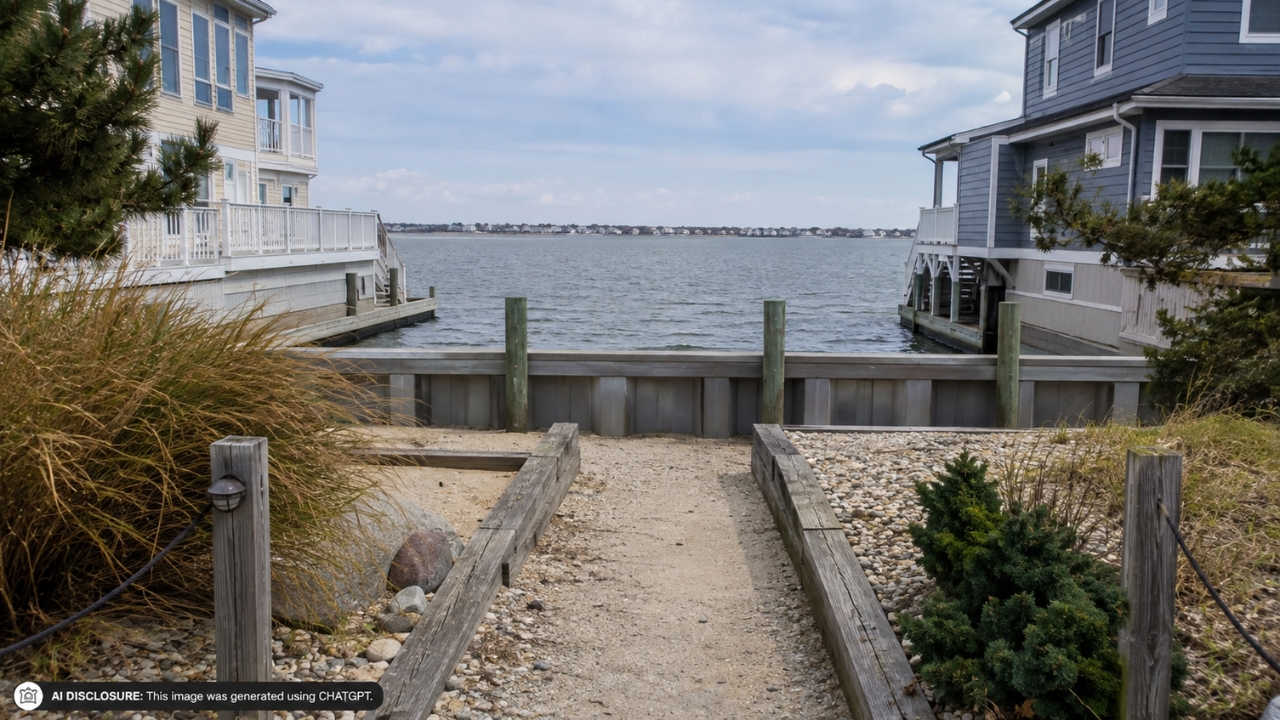
Friends Way isn’t just a casual walkway people cut across because it’s convenient. In the trial court opinion, it’s described as a 20-foot-wide easement running from Long Beach Boulevard to the bay, crossing over every lot that abuts Friends Way.
And it’s not a vague, informal agreement between neighbors. The opinion states the easement is required under local ordinance for the express purpose of providing private pedestrian access to the bay. In a shore community, that kind of access is a lifestyle feature, but it’s also a property right that people buy into.
So when the neighbors who brought the case said a bulkhead was built “across” that easement area, they weren’t treating it like a minor inconvenience. They framed it as the loss of something deeded and promised—access that was supposed to stay usable.
A new bulkhead goes up, and the easement becomes a dead end
According to the court document, the defendants—Michael and Margaret Uhrich and the William D. Martin Revocable Trust—own homes on the bay at the end of Friends Way. They constructed a new bulkhead that ran across the easement area at the terminus, where the path meets the bay.
The plaintiffs, a group of neighboring property owners and trusts along that same private easement, objected. Their claim was straightforward: the bulkhead wrongfully interfered with their easement rights by cutting off access to Barnegat Bay.
They didn’t just complain to each other over the fence line. They sued, raising claims that included interference with easement, unlawful obstruction, and tortious interference. In other words: this wasn’t about someone putting a planter in the way. This was about a hard structure and who gets to decide what “access” looks like.
The trial judge picked a very specific “fix”: lower 10 feet by 31 inches
After a three-day bench trial in mid-September 2025 and post-trial submissions, Judge Craig L. Wellerson of the Superior Court of New Jersey, Chancery Division, Ocean County ruled in favor of the plaintiffs. The court found that reasonable access to the bay had been denied and that the obstruction had to be reduced in height back to its prior elevation.
The December 15, 2025 order didn’t tell anyone to rip everything out and start over. Instead, it targeted a measured slice of the problem: 10 feet of bulkhead at the terminus of Friends Way had to be reduced in height by 31 inches, down to an elevation of 3.3 feet NAVD zero elevation.
The order even spelled out where the cut-down was to begin and end—starting immediately adjacent to the previously constructed Martin bulkhead and continuing for 10 feet toward the Uhrich property. That kind of precision usually shows you how closely the court tried to thread the needle: restore access without demanding a full demolition.
Access to the bay has been restored following the removal of the bulkhead in the easement area, per the court decision. But “restored” didn’t mean “resolved.”
Why the homeowners who built it say the court got it wrong
The defendants appealed, and their Notice of Appeal gives a peek at how they see the whole mess. The filing says Martin has owned his home since 1982, and the Uhrichs bought theirs in 2020. After purchasing, the Uhrichs had to replace an aging bulkhead.
According to the appeal notice, their builder recommended connecting directly to Martin’s newer, more stable bulkhead in the easement area. The Uhrichs agreed, and the new bulkhead was built across the easement area at the minimum height required by township ordinance.
Their appeal argues the trial court erred by requiring the bulkhead be lowered and that the court failed to address what they called uncontradicted expert testimony about rising sea levels and the dangers posed by lowering it. They also argue the court rejected state and municipal policy pushing for cohesive efforts to raise bulkheads and the land behind them to mitigate flooding.
Another argument: the trial court ordered the change without unanimous consent from all easement holders, and the defendants say the court knew some easement holders did not want it lowered. They also argue the court was wrong to conclude that lowering the bulkhead—without any additional means to enter and exit the water—was a “safe” condition the property owners were obligated to return to.
In further briefing described in the June 4 filing, the defendants also pointed to the New Jersey Department of Environmental Protection confirming a ladder could be installed on the waterward side of the bulkhead. They argue that even with that option on the table, the trial court still required lowering the bulkhead.
And then there’s the liability anxiety that keeps neighbors up at night: the defendants argue the trial court should have required the plaintiffs to indemnify and hold them harmless from consequences of lowering the bulkhead, and should have required proof of insurance for owners and tenants who use the easement area.
The neighbors who sued weren’t fully satisfied either
If you’re picturing a clean win for one side, it’s not that kind of story. The original plaintiffs also appealed—because they think the trial court didn’t go far enough.
They agree the bulkhead should be lowered to provide safe, reasonable access to the bay. But they’re appealing the finding that an opening of 10 feet across is sufficient. They want 15 feet of access instead.
They also appealed the trial court’s rejection of their request for punitive damages, arguing the defendants committed willful, continuous, and knowing violations of their property rights. That’s the emotional temperature you get when neighbors believe the other side didn’t just make a mistake—they made a choice and doubled down.
The practical homeowner lesson people keep circling back to: access vs. protection
This is the kind of property dispute that makes other homeowners instantly start thinking in checklists: surveys, old plats, deed language, easement dimensions, and photos from “before” anything was replaced. Because once heavy work like a bulkhead replacement starts, the argument isn’t only about what was built—it’s about what was there, what’s required by ordinance, and what “reasonable access” actually means on the ground.
It’s also a classic shore paradox: the same stretch of waterfront can be a route for pedestrians and a line of defense against erosion and flooding. The defendants’ appeal frames the lowered bulkhead as a safety risk in a world of rising water, while the plaintiffs frame the taller bulkhead as a physical wall across rights they’ve always had.
For now, the dispute is still alive in the Appellate Division. According to MaryAnn Spoto, communications manager for New Jersey’s Administrative Office of the Courts, the appeals filed this year have kept the case moving. The next set of briefs was due July 31, so the neighbors on Friends Way are still living with the same underlying reality: a “fixed” access point that is also a continuing fight.
On paper, the difference is 31 inches. In real life, it’s the kind of difference that decides whether a shared path feels like a shared asset—or a battleground at the end of the street.
Like Fix It Homestead’s content? Be sure to follow us.