Nantucket Homeowner Says the Neighbor Cut Down Fifty-Year-Old Trees for an Ocean View — Then Listed His House for Nearly $10 Million Touting ‘Sweeping Ocean Views’
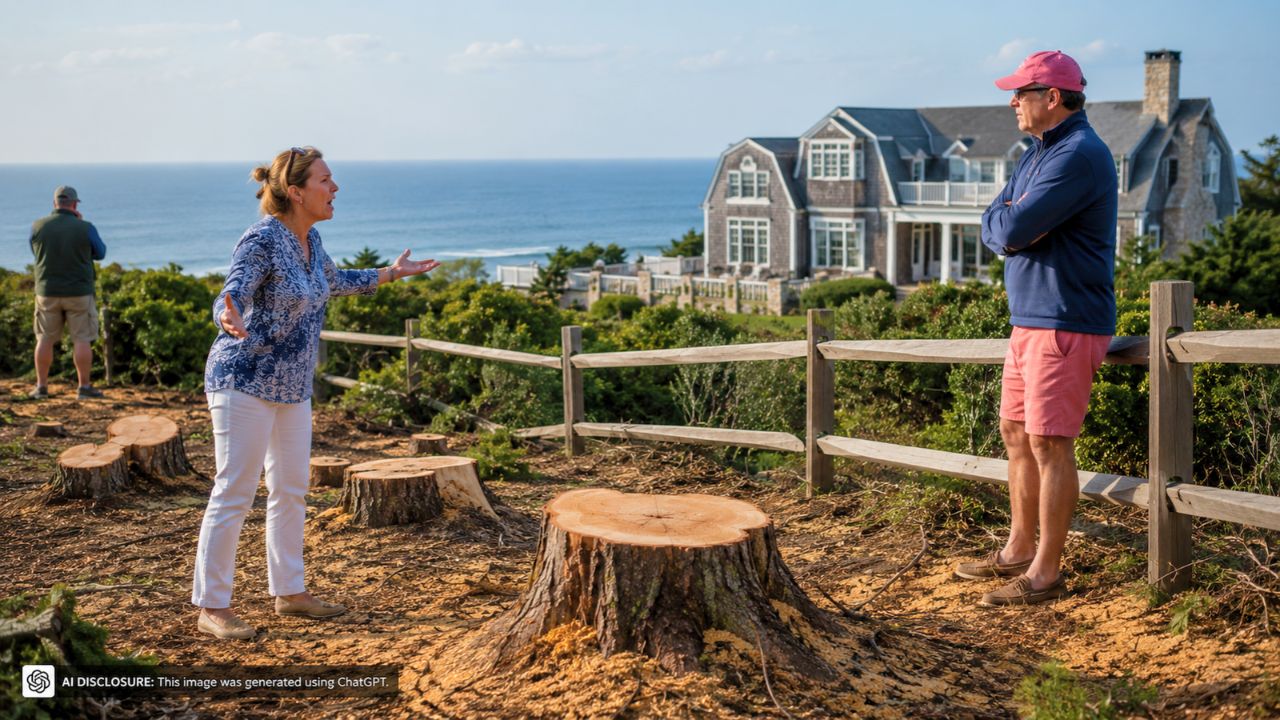
Photo credit: AI-generated image created using ChatGPT. Illustrative only.
On a place like Nantucket, a line of mature trees isn’t just landscaping. It’s privacy, shade, noise control, and the sense that your home is tucked away from the road and the neighbors. So when that green buffer suddenly looks “opened up,” it’s not the kind of change you chalk up to seasonal pruning.
That’s the gut of a new lawsuit out of Cisco, where one homeowner says her neighbor crossed onto her property and cut down decades-old trees to improve his own view—then turned around and listed his house for nearly $10 million advertising the scenery. The details are laid out in the source post, and it reads like the kind of property-line drama every homeowner dreads.
A privacy screen that took 50 years to grow
The plaintiff, Patricia Belford, owns 1 Tautemo Way. According to the lawsuit, her family planted and maintained a stand of trees starting in the 1970s—cedar, cherry, and leyland cypress—many of them over 30 feet tall.
For decades, that vegetation did the unglamorous work that makes a home feel livable: screening the house from Hummock Pond Road, softening road noise, providing shade, and creating a visual boundary between properties.
When trees like that disappear, it’s not like losing a shrub row where you can run to the nursery and “replace it this weekend.” You lose height, density, and time all at once. And the lawsuit claims the Belford property lost its only natural buffer to the road.
The cut that didn’t look accidental
According to the complaint, around February 22, Belford says her neighbor Jonathan Jacoby (who lives at 3 Tautemo Way) walked across her driveway to the south/southwest portion of her property and cut down more than 16 mature trees without notice or permission.
What makes this kind of accusation especially volatile is the location. The lawsuit claims the cutting wasn’t right on a fuzzy shared edge, but “many feet away” from the property line. In other words: not a “whoops, I thought that was mine” moment.
The suit alleges it was deliberate and done “with the specific purpose” of improving the ocean view from Jacoby’s home. If you’ve ever lived next to someone fixated on trimming “just a little more,” you can feel how quickly that turns into a boundary war—except here, the “trimming” is described as removing mature trees entirely.
Cleanup work, a landscaper’s statement, and a very awkward phone call
The account gets more specific with the involvement of a former landscaper, Krasimir Kirilov, who gave a voluntary statement to police. Kirilov said Jacoby admitted cutting down the trees on the Belford property and asked for help with cleanup.
Kirilov said he was finishing the cleanup when the Belford property manager, Matt Erisman, arrived and appeared unaware any authorized work was happening. Kirilov told Erisman what he was doing. Erisman, according to the summary, said he had no idea.
Then came the kind of moment that happens in real-life neighbor disputes: Kirilov called Jacoby and put him on the phone with Erisman. After Erisman’s phone call with Jacoby, Erisman told Kirilov he could leave.
That’s a small detail, but it paints a familiar picture—one party believing they’re smoothing things over in real time, while the other is standing there staring at missing trees and realizing this isn’t a simple misunderstanding.
From missing trees to “sweeping ocean views” in a listing
The timing is what’s turning this into a story people can’t stop talking about. After the alleged cutting, Jacoby listed 3 Tautemo Way for sale with J Pepper Frazier. The description says the home is “developed and situated to capture the sweeping views of the Atlantic Ocean, Hummock Pond, and the 780 acres of conservation land between Hummock Pond and Madaket.”
Belford’s claim is that the newly marketable ocean view exists because of the trees that were removed—and that the view wasn’t mentioned in a previous listing.
If you’re a homeowner reading this, you already know where the anger comes from. You can replace fencing. You can regrade a yard. But you can’t fast-forward 30 or 50 years of growth just because someone else wanted a better second-story sightline for resale photos.
The dollar figure isn’t just about trees—it’s about what the trees did
The Belford family is seeking more than $1.4 million in damages. The lawsuit says replacement cost alone exceeds $486,000, and that figure doesn’t include “historic value, loss of screening, increased noise, or reduction in overall property value.”
And that’s where tree disputes get brutally expensive. The tree itself is only part of the claim. The bigger loss is what’s now exposed: “full view from the street,” increased road noise, more light intrusion, less privacy, and a change in the character of the property that can’t be undone quickly.
The suit also notes the Belfords are in an assisted living facility off-island, which adds another layer. Properties still need caretaking, but when the owners aren’t physically there, it can be easier for an opportunistic neighbor to gamble that no one will notice right away—or that the pushback will be slower.
The complaint includes four counts the family wants a judge to rule in their favor on: trespassing, violation of Massachusetts’ tree-cutting statute (G.L. c. 242, §7), conversion, and intentional infliction of emotional distress. They’re requesting compensatory and statutory damages, treble damages, damages for emotional distress and punitive damages, and an order stopping further trespass.
Nantucket Police Lieutenant Angus MacVicar confirmed an investigation took place and said charges are pending against Jacoby.
The homeowner-playbook reactions: proof, paper trails, and property lines
Homeowners tend to have the same immediate thought when they hear a story like this: document everything, because “I swear those trees were on my side” isn’t enough once the stumps are ground out and the yard is cleaned up.
Even without a comment thread included in the source, this is the kind of dispute where people instinctively focus on the basics: surveys, dated photos, security cameras, written permission (or the lack of it), and multiple estimates that separate replacement costs from the harder-to-quantify losses like noise buffering and privacy screening.
The lawsuit itself leans into that idea, alleging Jacoby couldn’t provide “legitimate documentation of consent” and that the cutting was targeted to expand views from the upper story of his house. That phrasing matters, because it suggests intent—something that can change the stakes when damages are calculated under a tree-cutting statute.
Erisman, the property manager, summed up the emotional side in a way anyone who’s tended a yard for years will recognize: “much of what has been taken from the Belfords is irreplaceable, and it’s sickening.”
Jacoby’s attorney, Jim Merberg, did not respond to the outlet’s request for comment, according to the report.
For now, this is sitting in that uncomfortable space between the physical damage you can see from the street and the legal process that moves at its own pace. On the ground, the trees are already gone, the privacy is already changed, and the view—whether it was earned or taken—is already being used as a selling point.
Like Fix It Homestead’s content? Be sure to follow us.