Homeowners Fence a Yard to Protect $24,000 of Newly Replaced Air Conditioners — Then the Architectural Committee Sues and an Appeals Court Reverses the Ruling
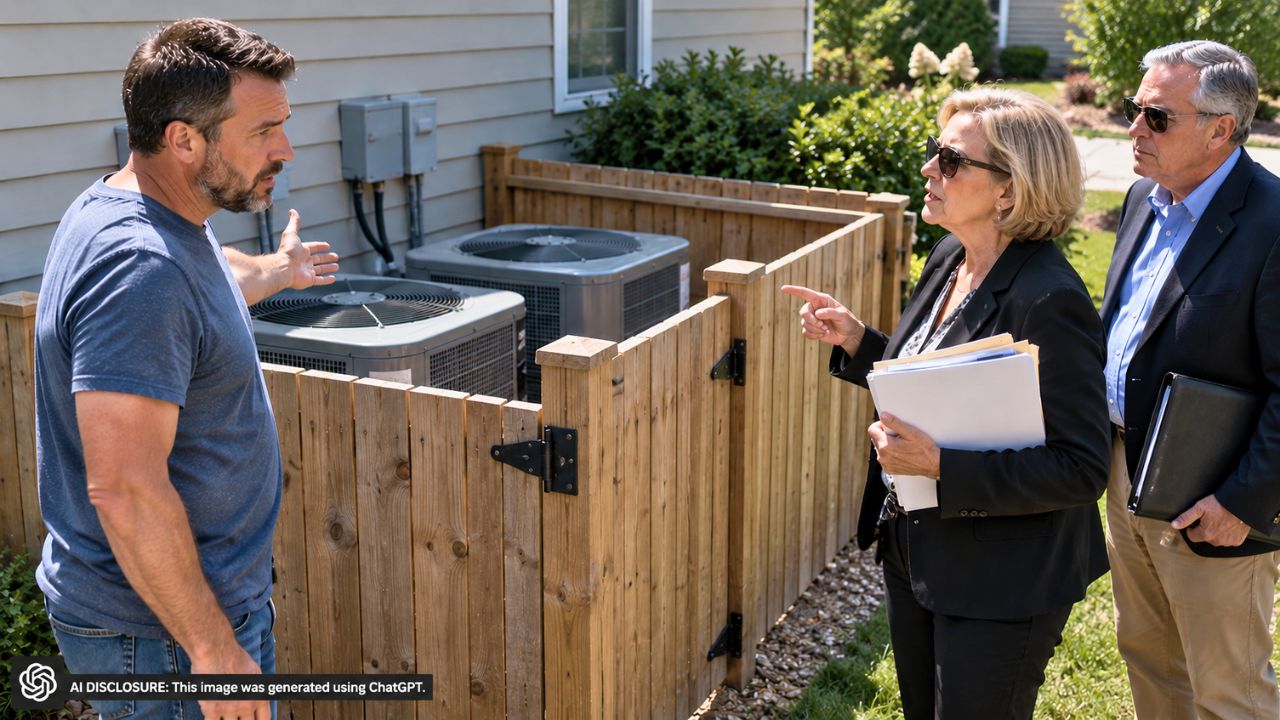
Photo credit: AI-generated image created using ChatGPT. Illustrative only
You buy a place, you start fixing things, and pretty soon you’re staring at the part of homeownership nobody puts in the listing: the rules that still apply even when someone swears there’s “no HOA.” For one Texas couple, that reality showed up as a fence dispute that snowballed into a lawsuit, a court order to tear down the fence, and a five-figure attorney-fee hit.
The case is laid out in the source opinion from the Texas Court of Appeals, Ninth District, involving Steven and Lacey Watson and the Davis-Woods Subdivision Architectural Committee in Polk County. What started as a practical “protect the yard and equipment” move turned into a legal fight over decades-old deed restrictions—and a newer Texas law that changed the outcome.
They weren’t trying to start a feud—they were trying to secure the property
The Watsons bought their home in 2021. Before closing, the seller told them there was no homeowners association, no maintenance fee, and no assessment. That’s the kind of reassurance buyers cling to, especially anyone who has heard HOA horror stories and wants to avoid them.
After moving in, they extended an existing fence so it enclosed a side yard and ran closer to the front corner of the house. The reasons weren’t abstract. Lacey Watson is a disabled veteran who uses a service dog, and the couple said the side yard created a flat, secure place for training because the backyard was hilly.
They also said the fence helped protect pool equipment and about $24,000 in newly replaced air-conditioning equipment. If you’ve ever priced HVAC work lately, you understand why someone would want a physical barrier around it—especially when “new” equipment is the stuff thieves look for.
The old restriction was simple, and the fence didn’t comply
The Davis-Woods Subdivision had restrictive covenants dating back to 1987. One of them was straightforward: “No fence may be erected nearer to the front property line than the rear of the dwelling house.”
The Watsons’ extended fence didn’t meet that placement rule, and both sides ultimately stipulated that the only violation being alleged was the fence’s location. This wasn’t a case where there were ten complaints and the fence was just one more thing. The fight was about where it sat.
The Architectural Committee told the Watsons to move it. The Watsons refused. From the homeowner side, you can see why: once a fence is in, moving it isn’t just “shift some panels.” It can mean new posts, new concrete, regrading, gate changes, and reworking how the yard actually functions.
Then it turned into court—fast and expensive
The Committee sued, asking for an injunction, declaratory relief, attorney’s fees, and enforcement of the deed restriction. And the trial court sided with the Committee.
The judge ordered the Watsons to remove the “offending” portion of the fence within 45 days. On top of that, the court awarded the Committee $17,677.67 in attorney’s fees and litigation costs, plus interest, with the possibility of more fees if the Watsons appealed.
This is the part that makes homeowners go cold. A fence dispute can quickly become a clock-and-checkbook problem: comply in a month and a half or face escalating legal pressure, all while paying out thousands of dollars to the other side.
The trial court’s reasoning centered on a newer Texas law—Texas Property Code § 202.023—that protects certain “security measures,” including a perimeter fence. The trial judge concluded that the Architectural Committee was not technically a “property owners association,” and therefore that statute didn’t apply.
The appeal came down to one big question: what is this “committee,” really?
The Watsons appealed, and the Beaumont Court of Appeals took a different view. The Committee argued the law shouldn’t apply because it called itself an Architectural Committee, not a property owners association, and because the Watsons hadn’t proven they actually needed the fence for security.
The appellate court rejected both arguments. First, it said what the organization does matters more than what it calls itself. The Committee was made up of subdivision property owners. It represented homeowners, enforced deed restrictions and liens, regulated landscaping and land use, and approved or rejected building plans and homeowner requests.
That lineup of powers and activities fit the statutory definition of a property owners association for purposes of Chapter 202. In other words: if you walk like an HOA and act like an HOA, you don’t get to dodge homeowner-protection laws by picking a different name for the letterhead.
The timing didn’t rescue the Committee, either. The fence restriction was old, but § 202.023 doesn’t only limit the adoption of certain restrictions—it limits enforcement. So even if the 1987 covenant still existed, the question became whether it could be enforced to stop a protected perimeter fence.
The court didn’t ask for a crime wave—it treated the fence as a protected security measure
At the trial level, the Watsons were criticized for not proving an actual security necessity—no showing that the neighborhood had a serious air-conditioner theft problem, for example. The appeals court said that was beside the point.
The statute identifies a perimeter fence as a protected security measure. It does not require homeowners to prove crime is happening or that the fence is desperately needed. The appellate court said the trial court had added a requirement that wasn’t in the statute.
There was still one more practical question: did this fence qualify as a “perimeter fence”? The statute doesn’t define the term. The court relied on ordinary meaning and another Texas appellate decision, treating it as a fence around the boundary or outer limits of property.
Under that definition, the Watsons’ fence counted. And because it counted, the Committee could not enforce the deed restriction in a way that prohibited it.
The financial whiplash: the teardown order vanished, and the fee award collapsed
Once the appeals court held the Committee couldn’t prohibit the fence, the injunction ordering removal couldn’t stand. The order requiring the Watsons to remove the fence within 45 days was reversed.
The Committee’s attorney-fee win also fell apart. Because the Committee was no longer the prevailing party, the appeals court reversed the $17,677.67 award and rendered judgment that the Committee take nothing on those fees.
The Watsons aren’t automatically awarded their own fees under the restrictive-covenant fee statute, because they didn’t file the original enforcement action. But both sides requested declaratory relief, and Texas’s Declaratory Judgments Act can allow attorney’s fees that are “equitable and just.” The appellate court sent the fee issue back because the trial judge hadn’t determined a reasonable fee amount for the Watsons.
The opinion also discussed Fair Housing Act theories involving Lacey’s disability and service dog, but the fence dispute ultimately turned on Texas Property Code § 202.023. The case now heads back down with the central fence fight resolved in the homeowners’ favor and the money question still hanging in the air.
For anyone who’s ever extended a fence just to make a yard usable—protecting equipment, creating a safe run for a dog, trying to keep expensive upgrades from becoming a target—this one reads like a reminder that “no HOA” doesn’t always mean “no rules,” and that in some states the law has started pushing back when those rules collide with basic home security.
Like Fix It Homestead’s content? Be sure to follow us.