Homeowners Find the Neighbor’s Shed Sitting in the Middle of the Twelve-Foot Alley They Use as a Driveway — Then a Court Orders It Removed
Photo credit: AI-generated image created using ChatGPT. Illustrative only.
A twelve-foot alley can feel like a private driveway when you’ve used it for years. You back in, haul lumber, drag trash cans, and it’s just… there. Then one day the map changes, the alley becomes “yours,” and you realize the neighbor’s shed is parked right in the middle of the space you thought you had.
That’s the practical mess at the heart of an Ohio dispute that ended with a court order to move the building. The details are laid out in the source post, involving neighbors Susan Slentz and others on one side and Hasington LLC on the other, after the Village of Minerva vacated an alley and split it between adjoining owners.
A driveway-alley turned into a property line overnight
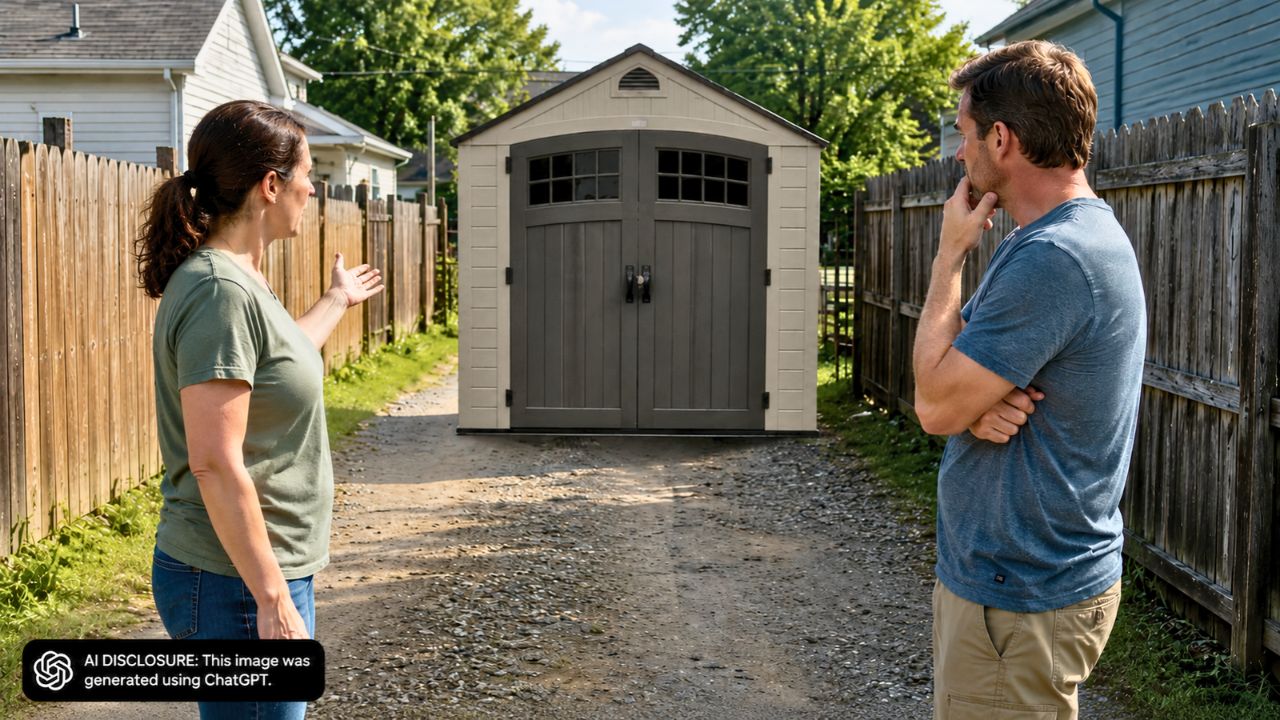
The alley wasn’t some theoretical strip on a deed. People used it. Hasington’s tenants used it like a driveway, and the shed had apparently been sitting out there for some time, roughly centered in the old alley.
Then, in June 2023, the Village of Minerva vacated the 12-foot-wide alley and transferred ownership—six feet to each adjoining landowner. Suddenly, the shed wasn’t just “in the alley” anymore. Part of it was now sitting on land that belonged to the Slentz side.
If you’ve ever dealt with tight parking, shared access, or that one neighbor who treats common space like storage, you can already feel where this goes. A structure that was tolerated (or ignored) when a village technically owned the ground became a trespass issue the minute the deed changed hands.
Once the alley split, the shed stopped being “everybody’s problem”
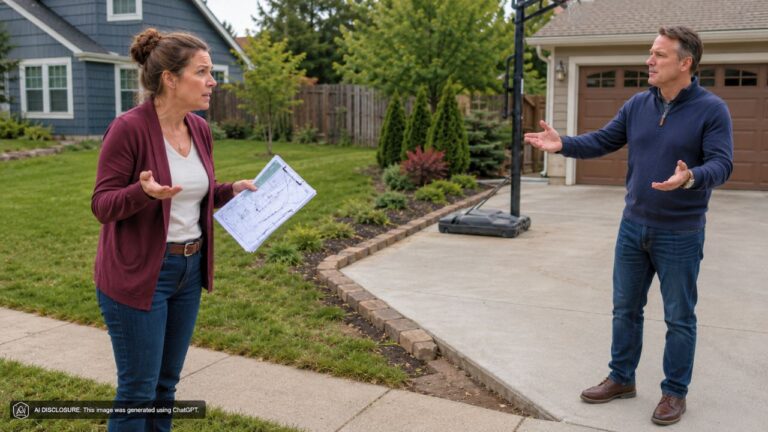
After the land transfer, the Slentz parties demanded the shed be removed. They weren’t asking for a new fence line or a painted stripe. They wanted the building off their newly acquired six-foot strip.
Hasington didn’t just shrug and hire a crew. The company fought back, and the standoff escalated into court. In November 2024, the Slentz parties sued for trespass and ejectment and asked for an injunction requiring removal of the shed.
Anyone who’s watched a neighbor dispute go from tense conversations to certified letters knows the turning point: once one side feels like they’ve got a clean legal claim to land, letting something slide starts to feel like giving it away. Especially when it’s a physical structure you can’t unsee every time you pull in.
The defense: “We’ve been there long enough”
Hasington’s main argument was a familiar one in property fights: prescriptive easement. In plain terms, it’s the idea that if someone openly uses land in a certain way for long enough—without permission—they can sometimes gain a legal right to keep doing it.
Hasington also raised an “unclean hands” defense, pointing to an alleged threat by the neighbors to cut the shed in half. (If you’ve ever heard people vent about solving boundary disputes with a sawzall, this was that energy making it into a court filing.)
But the prescriptive easement angle was always going to run into a calendar problem. In Ohio, the use generally needs to be open, notorious, adverse, and continuous for at least 21 years. And there was an even bigger hitch: the alley had been owned by the village until June 28, 2023.
The clock couldn’t start while the village owned the alley
This is where homeowner logic and legal logic line up more than people expect. Lots of folks think, “That shed’s been there forever, so it must be allowed.” But “forever” doesn’t help if the landowner during that time was the government.
Ohio law generally doesn’t allow a prescriptive easement to be acquired against land owned by a government or political subdivision. So even if the shed had been sitting there for decades, those years couldn’t be counted while the village still owned the alley.
That meant the earliest possible start date for the 21-year prescriptive period was June 2023—when the Slentz parties actually gained ownership. The neighbors filed suit a little over a year later. The appeals court concluded there was no factual scenario where Hasington could reach the required 21 years, so the prescriptive easement claim couldn’t succeed.
On the “unclean hands” argument, the court wasn’t persuaded either. Even if the threat to cut the shed in half happened, the court said it didn’t block summary judgment for the neighbors.
A side drama: the owner was also the attorney, and the schedule got messy
This case had another real-life wrinkle: Hasington LLC was owned by attorney Hwa Lumley, and she represented the company herself at trial. That kind of setup can be efficient—until life happens.
Lumley told the court she would be in Korea for IVF treatment for several months. The trial court initially built an extended schedule around that, including an October 2025 deadline for summary judgment motions.
When the medical treatment took longer than expected, Lumley asked for an indefinite delay or another 120-day continuance, arguing she didn’t have her normal legal resources overseas and had difficulty handling the litigation. The trial court refused to delay things further, and the appeals court agreed, noting she could have hired outside counsel and that the court wasn’t required to pause the lawsuit indefinitely.
That part lands close to home for anyone who’s ever tried to juggle a property dispute while working, traveling, caring for family, or dealing with medical realities. Courts can accommodate, but they don’t hand out open-ended timeouts—especially when the core claim can’t work under the law.
The reactions you hear in any property-line fight
Even without a comment thread attached to the case record, the practical reactions are predictable because this is one of those homeowner disputes that repeats across towns. People tend to split into two camps.
One camp says, “Get it surveyed, get it in writing, and don’t touch the structure.” That’s the documentation-first mindset: deeds, vacated-alley paperwork, measured lines, photos, and a clean paper trail before anyone moves so much as a shovel of dirt.
The other camp focuses on access and daily life: “If that alley is the driveway, how are you supposed to use it with a shed in the middle?” Because beyond legal ownership, there’s the reality of trucks, trailers, emergency access, snow removal, and the basic ability to pull in without threading a needle.
The court’s decision essentially validated the first camp’s approach: the ownership changed, the shed ended up on the neighbors’ land, and the law didn’t provide a shortcut for keeping it there.
In the end, the Ohio Seventh District Court of Appeals affirmed the trial court’s judgment ordering Hasington to remove the shed. It also upheld the refusal to grant another lengthy continuance.
For the homeowners who gained six feet of alley, it means getting their strip back—on paper and in real life. For the owner of the shed, it means the kind of expensive, disruptive fix nobody wants: moving or rebuilding a structure that might have felt “settled” for years, but was never actually safe once the alley stopped being public ground.
Like Fix It Homestead’s content? Be sure to follow us.