Homeowners Learn a New Survey Puts Part of Their Yard on the Neighbor’s Land — Then He Digs Up the Encroachments and Installs a Vinyl Fence
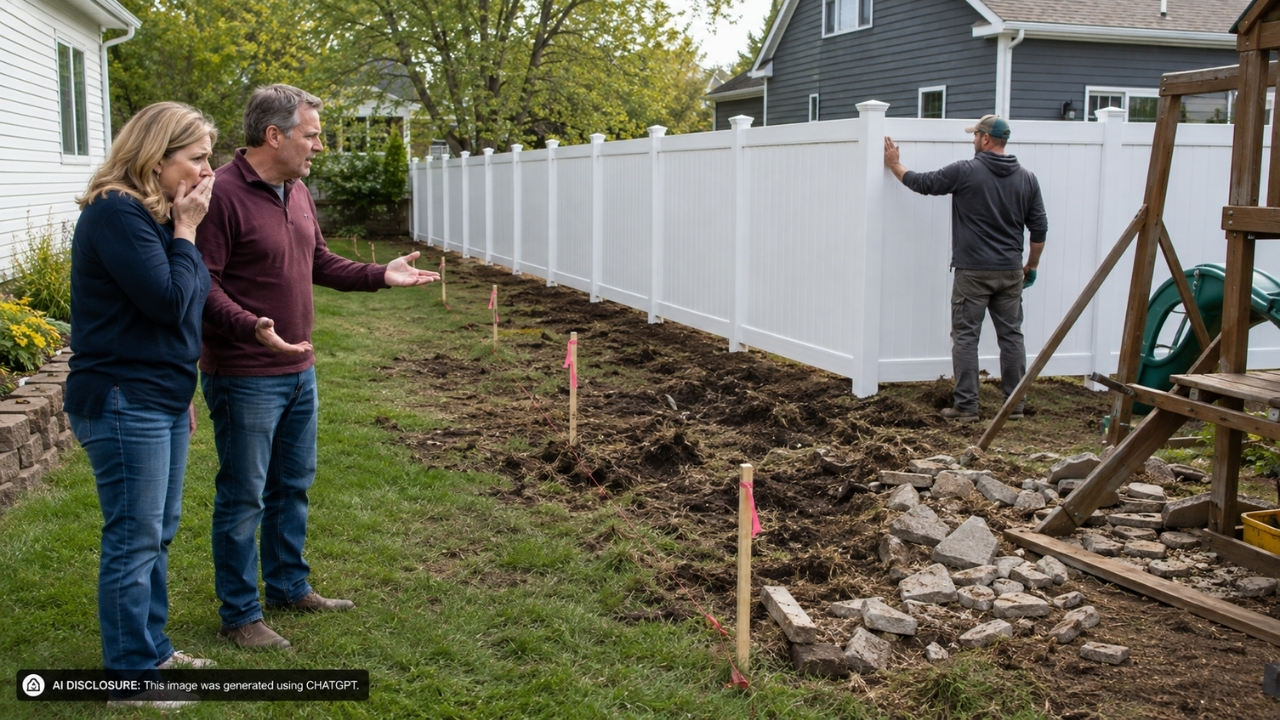
Photo credit: AI-generated image created using ChatGPT. Illustrative only.
It’s the kind of neighbor surprise that makes your stomach drop: you’ve mowed it, planted it, set up the kids’ stuff on it, and treated it like your yard for decades—then a survey comes back and says part of it isn’t yours.
That’s what unfolded on Pine Hill Avenue in Johnston, Rhode Island, where long-time homeowners Raymond and Debra Desrochers ended up in a property-line fight with their newer neighbor, Luigi Micheli III. The details come from the court decision, and it reads like a classic “old handshake agreement meets modern survey stakes” story—complete with yard improvements getting dug up and a vinyl fence going in.
A yard that “always” had a boundary… until it didn’t
Raymond Desrochers bought his home at 38 Pine Hill Avenue back in 1985. Next door, the property at 36 Pine Hill changed hands over the years, and Micheli bought it in 2011.
For a long time, the yards had what felt like a natural divider: a row of hemlock trees. To a lot of homeowners, that kind of tree line becomes the mental property line—especially if nobody challenges it and everybody maintains their side.
Raymond testified that when he was developing his property in the 1980s, the then-neighbor (George Cioe) basically told him everything on Raymond’s side of the hemlocks was his to use. So Raymond treated it that way: grass, regular lawn maintenance, landscaping stones, a basketball area, a playset, gardening, and even storing construction equipment.
The survey changed the tone overnight
In 2013, a survey was done, and it showed the uncomfortable part out loud: some of the Desrochers’ improvements—specifically including a playset and construction equipment—were sitting on Micheli’s deeded property, not on the Desrochers’ lot.
This is where property disputes tend to go from polite to personal. A tree line is one thing. A stamped survey with stakes and lines is another.
After discovering the encroachment, Micheli started installing a fence. The record also describes him digging up the encroachments, then moving forward with a vinyl fence, and sending formal notice disputing the Desrochers’ claim that they’d gained ownership through adverse possession.
For the Desrochers, it wasn’t just about a few feet of lawn. It was a direct challenge to decades of routine: where they’d put recreational space, where they’d stored things, and where they’d assumed the yard ended.
“We thought it was ours” versus “we let you use it”
When the Desrochers sued in 2016, they weren’t asking for permission. They were asking the court to declare that they’d already become the owners of the disputed strip through adverse possession—basically, that their long, obvious use had ripened into legal ownership.
On paper, their day-to-day use sounded like what people picture when they hear adverse possession: open, obvious, continuous, and exclusive maintenance like it was your own. The trial judge even found that they satisfied most of those elements.
The sticking point was the one that tends to blow up “friendly neighbor” arrangements: hostility. Not hostility like yelling over the fence—hostility in the legal sense, meaning the use wasn’t by the owner’s permission.
And that’s where Cioe’s testimony mattered. Raymond’s version was essentially, “I didn’t ask permission; I believed the tree line was the boundary.” Cioe, however, testified (and especially in an earlier deposition) that he had given Raymond permission to use the land, including as a play area. If the use was permissive, it usually can’t become adverse possession.
The first court tried to split the yard down the middle
The trial judge made a Solomon-style call. He concluded the Desrochers did not adversely possess the portion running along the old hemlock line, but he did find they had adversely possessed a portion beyond the end of the tree line—near where the playset and equipment-storage area were located.
That kind of outcome makes sense emotionally, but it also sets up a bigger problem: now you’re arguing over two different strips, under two different theories, with two different sets of “proof” (stumps, stones, photos, memories, survey markers).
Both sides appealed. Micheli argued, among other things, that the disputed land wasn’t identified precisely enough. The Desrochers challenged the parts they lost.
The Rhode Island Supreme Court: permission can expire when the neighbor sells
The Rhode Island Supreme Court zeroed in on something homeowners rarely think about when they accept a casual “sure, go ahead” from a neighbor: the permission may be personal to that neighbor—and it may not automatically carry over to the next owner.
The Supreme Court said the trial court missed an important legal distinction under Rhode Island precedent. If Cioe gave permission, that permission would normally defeat adverse possession. But when the owner sells the property, that permission generally terminates with the sale—at least when the new owner doesn’t know about it.
That mattered here because Cioe sold to the Biziers before Micheli owned the property, and the evidence indicated the Biziers didn’t know about any supposed permission arrangement. That means the Desrochers’ continued open use after the sale could have become “hostile” to the new owners, starting the clock in a way the trial judge didn’t fully account for.
Still, the Supreme Court didn’t hand the Desrochers the land. Instead, it sent the case back for more detailed fact-finding—both on whether the use was actually hostile after ownership changed, and on exactly how much land was at issue beyond the hemlock line.
The reactions were predictable: “survey first” and “get it in writing”
Even without a comment section attached to the decision, this is the kind of dispute where homeowner reactions tend to cluster around the same practical instincts.
One camp sees Micheli’s side: you buy a property, you get a survey, you discover your land is being used, and you act—because if you don’t, you could eventually lose that strip. Fence installation becomes less about aesthetics and more about stopping the clock.
The other camp sees the Desrochers’ side: a tree line boundary can feel as real as a deed line when it’s been treated that way for decades. People build routines around it. A playset isn’t something you move on a whim, and neither is a basketball area or landscaping work.
The shared lesson homeowners tend to repeat is blunt: if a neighbor is using your land (or you’re using theirs), casual permission and vague understandings are fragile. Sales happen. Memories change. And the first time someone drops a survey on the table, the tone changes fast.
The Desrochers and Micheli are now stuck in the worst part of a property-line fight: the in-between stage where the yard has already been physically disrupted—encroachments removed, a vinyl fence installed—but the legal boundary of “who owns what because of decades of use” still isn’t fully settled.
For anyone watching from their own back deck, it’s a reminder that the most expensive part of a yard upgrade isn’t always the materials. Sometimes it’s discovering, years later, that the ground under it wasn’t yours on paper—and your neighbor is ready to prove it with stakes and a fence line.
Like Fix It Homestead’s content? Be sure to follow us.