Landowner’s Only Way Home Is a Path Across the Neighbor’s Property — Then He Locks the Gate and Lays Logs and Ropes Across the Trail
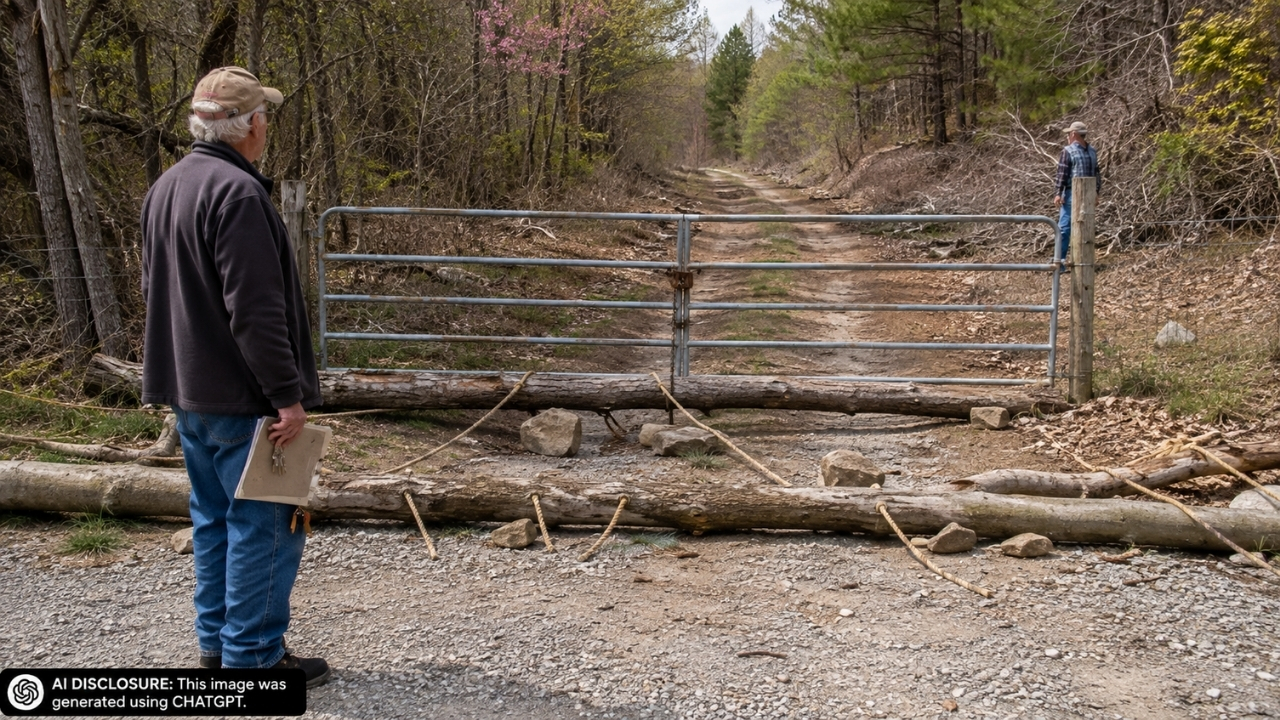
Photo credit: AI-generated image created using ChatGPT. Illustrative only.
There’s rural-property drama, and then there’s “your only way to your own land runs through someone else’s gate.” In Franklin County, North Carolina, that’s exactly what came to a head when a newer neighbor started locking up access and physically blocking a long-used trail with logs and ropes.
The dispute ended up in court, and the appeals decision reads like a reminder that a driveway doesn’t have to be paved and posted with a sign to become a real, legally protected right. In the discussion, the North Carolina Court of Appeals backed a lower-court ruling that the access route had effectively been “earned” over decades of use—long before the neighbor who locked the gate ever bought the property.
A dead-end road and a path that kept going
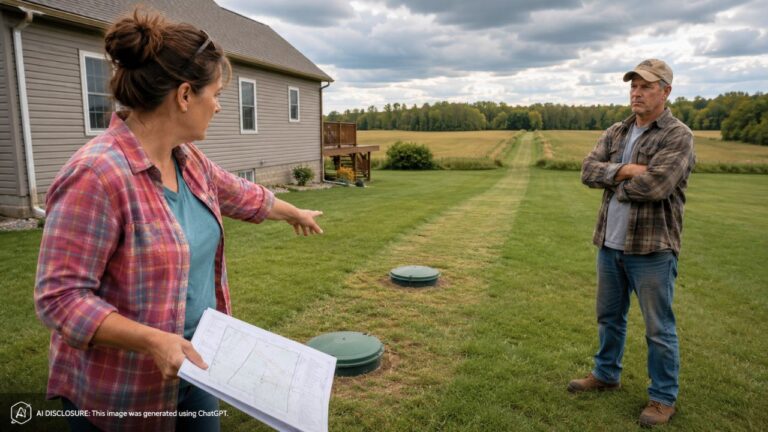
Peggy P. Alston (who lives in Alabama) owns five adjoining parcels in Franklin County. Getting to them wasn’t complicated in theory: you take Roy Tharrington Road to where it ends, then continue on an existing pathway that crosses the neighboring property before reaching Alston’s land.
In practice, that kind of setup is always one sale away from trouble. People buy rural land for privacy, hunting, quiet, and control—then discover that control comes with someone else’s tire tracks running right through it.
Alston said she’d used the path for as long as she could remember, going back to before she married in 1959. She and her husband eventually owned all of her parcels, and even though they didn’t live there full-time, they visited over many years. After her husband died in 2021, she became the sole owner.
It wasn’t just “family using the trail”
This wasn’t a case where someone wandered across a neighbor’s field once in a while and called it an “access road.” The record described decades of regular use tied to how rural land actually functions: forestry work, hunting leases, and timber removal.
Starting in 1998, a forestry consultant named Fred Hampton used the route annually to inspect the property and to do forestry work as needed. Logging trucks also used the pathway over the years to haul logs off Alston’s land—big, heavy equipment that doesn’t sneak by unnoticed.
Then there was the hunting lease angle. In 1998, Alston allowed Steve Tharrington to hunt on her property. He later became president of the Community Gun Club, and in 2012 the club entered into a hunting lease with Alston. That lease required the club to maintain the access route.
And they did. The evidence described hauling rock, installing pipe, digging drainage ditches, bushhogging the route, and trimming limbs to keep trucks and vehicles moving through. That kind of work is the homestead version of putting your name on it—visible, physical, expensive effort that says, “This road matters, and we’re treating it like it’s ours to use.”
New neighbor, new gate, and a trail that suddenly “wasn’t allowed”
Lloyd W. Jacox bought the neighboring property in 2018. For a while, nothing in the court record suggests a blow-up. But after Jacox moved onto his property in 2023, the tone changed fast.
Trying to stop Tharrington from crossing, Jacox began locking a gate and placing logs and ropes across the pathway. On paper, that might sound like a simple boundary-setting move. On the ground, it’s the kind of thing that strands people—especially when it blocks the only practical route to reach multiple parcels.
If you’ve ever dealt with rural access, you can picture the immediate consequences: foresters can’t check timber, trucks can’t haul, hunters can’t get in, and the landowner can’t reliably reach her own property without an argument at a gate. That’s not just inconvenient. It can mean missed seasonal work, delayed maintenance, and a constant low-grade fear that you’ll get cut off again the next time you show up.
Alston filed suit in August 2023, asking the court to recognize either a prescriptive easement or an implied easement. In July 2025, the trial court ruled for Alston, identifying the easement as the pathway beginning where Roy Tharrington Road ends and continuing across Jacox’s property to hers.
The court treated the maintenance like a neon sign: “This is a right”
Jacox appealed, arguing Alston hadn’t proven the elements needed for a prescriptive easement and that the route’s location, width, and scope were too vague to enforce. North Carolina law generally requires open and notorious use, hostile or adverse use, continuous use for at least 20 years, and a route that can be identified with enough clarity to know what’s being claimed.
There’s also a big starting presumption in cases like this: if you use someone else’s road, the law often assumes it was permissive unless you can show otherwise. In everyday terms, courts don’t want every friendly neighbor favor turning into a permanent property right by accident.
But the details here made it harder to call “just neighborly.” The hunting club’s work—rock, pipe, ditches, bushhogging, limb trimming—was a key piece of evidence because it was visible and ongoing. It looked like upkeep done under a claimed right of access, not a one-time courtesy.
The appeals court also stressed that “continuous use” doesn’t mean daily use, especially for rural land that isn’t a primary residence. Periodic visits by the owner, plus repeated use by her agents and invitees—foresters, hunters, and logging trucks—could still add up to continuous use given the nature of the property and the purpose of the access.
“Permission” came up—but too late to undo what already existed
Jacox tried a different angle too. Members of the Tharrington family had given the Community Gun Club permission to use and hunt on neighboring land from 2016 through 2018. Jacox pointed to that as proof the route was used with permission, not “adversely.”
The appeals court didn’t bite, because the easement had already ripened before any of that. The judges pointed to 1995 through 2015 as a clean, uninterrupted 20-year period of adverse use. Once a prescriptive easement exists, a later landowner can’t erase it by reframing future use as “permitted.”
In other words: if a property right has already been created by long, qualifying use, it doesn’t vanish because a new owner buys the land and decides they don’t like it.
Jacox also argued the judgment didn’t clearly identify the easement’s location. The appeals court disagreed, noting the trial judge tied it to the pathway extending from the end of Roy Tharrington Road and referenced maps and exhibits showing the route. The decision also noted aerial maps from 2010 and 2013 depicting the roadway and its continuation toward Alston’s property.
Width and scope weren’t left hanging, either. The historical pattern showed it had been used as a road for ingress and egress, including ordinary vehicles, forestry workers, and timber-hauling trucks. The court treated those long-standing uses as the practical definition of what the easement allows.
The reactions were predictable: “Document everything, because gates turn into lawsuits”
Even without a comment thread attached to the opinion, this is the kind of property fight that usually draws the same hard-earned advice from homeowners and landowners: don’t rely on handshakes, and don’t wait until the gate is locked to gather proof.
When access is the issue, people tend to focus on tangible documentation—old aerials, maps, dated photos, maintenance receipts, and witness history. And they’ll tell you that the “maintenance” piece matters more than most folks realize: if you’ve been the one hauling rock, cutting back limbs, and keeping the road passable year after year, those visible improvements can become the backbone of your claim when a neighbor says, “You were only crossing because I was being nice.”
In the end, the North Carolina Court of Appeals affirmed the judgment in full. Alston keeps the prescriptive easement along the long-used pathway, and Jacox can’t defeat it by locking a gate or throwing obstacles across the trail. For anyone living on land reached by an old road nobody ever wrote down, it’s a sharp illustration of how quickly “that’s how we’ve always done it” turns into a fight—and how much the past can matter when the gate finally swings shut.
Like Fix It Homestead’s content? Be sure to follow us.