Cattle Owners Watch a Dam and Berms Rise on the Adjoining Fifty Acres — Then Their 126-Acre Pasture Floods and the Damages Are Cut to $175,000
Photo credit: AI-generated image created using ChatGPT. Illustrative only.
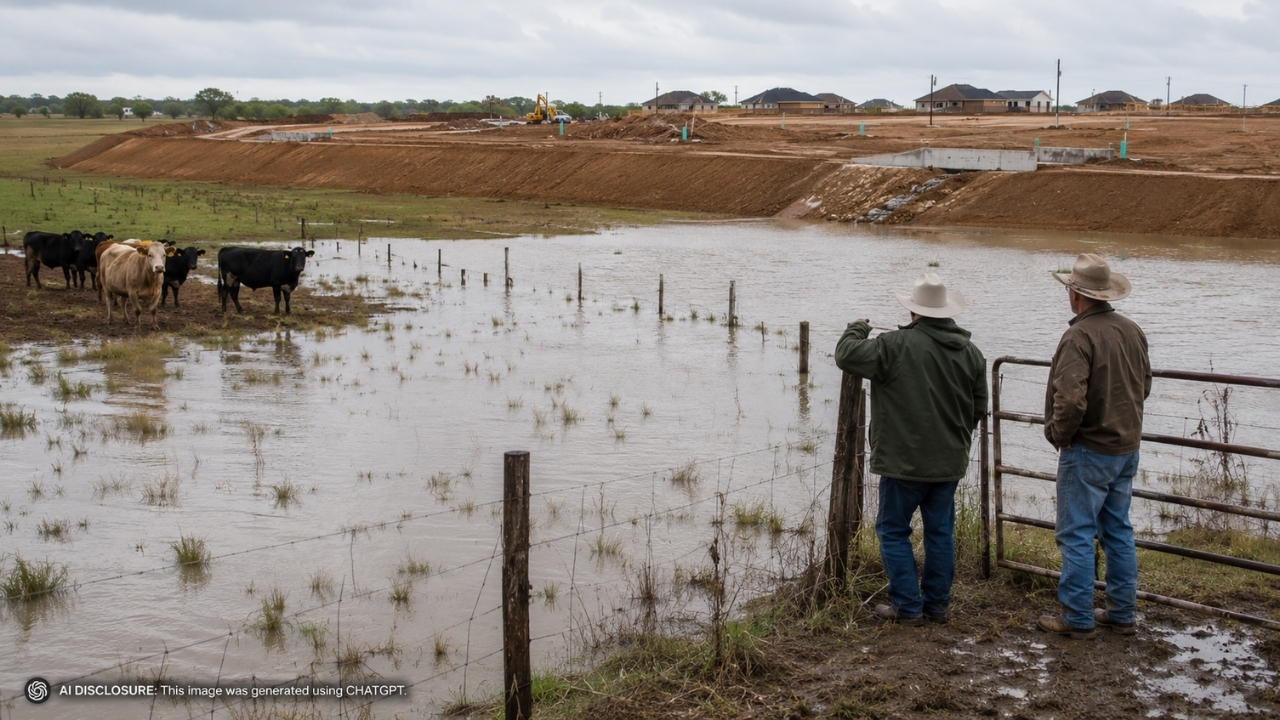
You know the feeling when you can see a problem being built in real time, but you’re not sure how much you can say—or how bad it’ll get until the next big rain. That’s the kind of slow-motion dread that set in for Clay and Lacy Kolle on their 126-acre cattle property in Victoria County, Texas, when development started next door.
On the adjoining 50 acres, David and Valerie Kucera—through K&K Inez Properties, LLC—began developing a residential subdivision. As part of that work, a dam and berms went up, and the Kolles said the construction changed the natural flow of a creek. The dispute eventually turned into a courtroom fight that made it all the way to the Texas Supreme Court. The ruling (and the property-drama details) are laid out in the court’s opinion.
The day the water stopped behaving like it used to
Country properties have their own normal: low spots that get soft, ditches that carry runoff, creeks that rise and fall. People who run cattle learn that rhythm fast, because pasture conditions are your whole operation. When the Kolles claimed the dam and berms altered drainage, they weren’t describing a minor inconvenience—they were pointing to a change in how water moved across their land.
According to the case summary, the Kolles believed the new structures changed the creek’s natural flow and caused flooding on their property. That’s the sort of damage that doesn’t stay contained. Flooding hits fencing, gates, feeding access, usable acreage, and the day-to-day ability to rotate animals the way you normally would.
From “neighbor issue” to lawsuit, fast
The Kolles didn’t bring just one complaint. They sued under several theories, including a claimed violation of the Texas Water Code, trespass, and both intentional and negligent private nuisance. That mix tells you how they framed the problem: not just “water came over,” but “somebody changed the land in a way they shouldn’t have, and it crossed the property line.”
A jury ultimately sided with the Kolles and split responsibility among the parties tied to the development: David Kucera at 40%, Valerie Kucera at 20%, and K&K Inez Properties at 40%.
Then came the money questions—always the most stressful part for homeowners and landowners, because it’s where “damage” gets converted into numbers that rarely feel fair to either side.
The jury’s numbers looked big—until the appeals changed the math
The jury awarded $175,000 for the decrease in the property’s market value. On top of that, the jury also awarded $210,000 for past loss of use and $40,000 for future loss of use. In plain terms, that’s not just “your land is worth less,” but also “you lost the ability to use it the way you used to.”
The jury also found gross negligence by David and K&K and hit them with exemplary damages (punitive damages). That’s the punishment money that’s supposed to deter the behavior, not just pay for the harm.
But the case didn’t end there. The intermediate appeals court removed the $250,000 in loss-of-use damages, reasoning that if the injury is treated as permanent, those particular damages aren’t recoverable in the same way. So the economic damages left standing were the $175,000 tied to diminished property value.
That shift matters because once you start subtracting categories of damages, everything downstream changes—especially punitive damages, which in Texas are capped by statute.
The one part the developers couldn’t wiggle out of: remove the obstructions
There was also a permanent injunction—something landowners pay close attention to because it’s about physical change, not just checks. The trial court ordered the Kuceras to remove obstructions to the natural drainage of water, including the dam and berms.
And here’s the detail that makes this feel less like abstract legal wrangling and more like real property consequences: that injunction wasn’t challenged on appeal. In other words, regardless of the later fights over money, the court-ordered fix—removing the blockage to natural drainage—stayed in place.
For anyone who has watched water carve new paths across a field, that’s the heart of the whole dispute. You can argue over dollars for years. But the land still floods until the drainage is corrected.
Why the Texas Supreme Court cut back the punitive damages
The biggest Texas Supreme Court question wasn’t whether the Kolles proved their flooding case. It was how Texas’s exemplary-damages cap works when multiple defendants share responsibility for one injury.
The developers argued that the punitive cap should be calculated based only on the portion of economic damages attributable to each defendant—not on the total $175,000 award. The Texas Supreme Court agreed.
Here’s how it played out with the jury’s responsibility percentages. With $175,000 in economic damages remaining, and David Kucera and K&K each found 40% responsible, that meant $70,000 in economic damages was attributable to each of them. Texas law allows a cap based on twice the economic damages, but it also has a $200,000 alternative floor. So the maximum exemplary-damages award against David was $200,000 total, and the maximum against K&K was also $200,000 total.
That’s why the earlier exemplary awards didn’t survive. The existing judgment had David paying $400,000 in exemplary damages and K&K paying $500,000, and the Supreme Court said those exceeded the statutory caps. The case was sent back so the trial court could adjust the exemplary-damages awards to comply with those limits and also reconsider whether the capped amounts might still be constitutionally excessive.
The side argument: trying to point at county drainage work
Another familiar move in property fights is trying to widen the blame: “It wasn’t just me, the county did work too.” The Kuceras tried to name Victoria County as a “responsible third party,” arguing county drainage work contributed to the flooding.
The Supreme Court upheld the trial court’s decision to keep the county out. The Kuceras had some evidence that county actions may have affected water flow, but they didn’t produce evidence that the county actually violated an applicable standard of care. The court’s point was blunt: calling the county’s actions “imprudent” isn’t the same as proving negligence.
The Court also rejected a double-recovery argument. Even though the jury found liability under multiple legal theories (nuisance, trespass, Water Code), the jury only awarded each category of damages once, rather than stacking the same damages multiple times.
In the end, the Kolles kept the core win: the $175,000 for diminished property value and an injunction requiring removal of drainage obstructions. But the punishment part—the big scary exemplary numbers—got brought down to what Texas law allows per defendant.
If you live next to raw land that’s turning into “improvements,” this case reads like a warning you can hear over the sound of equipment. Water doesn’t care about lot lines, and courts can order a fix even while everyone argues about how much the harm is worth. The hard part is that by the time the legal system finishes its math, the land has already lived through the flooding.
Like Fix It Homestead’s content? Be sure to follow us.