Landowner Has Used the Same Deeded Easement Since 1983 — Then a Court Says He Already Litigated Its Width and Cannot Ask Again
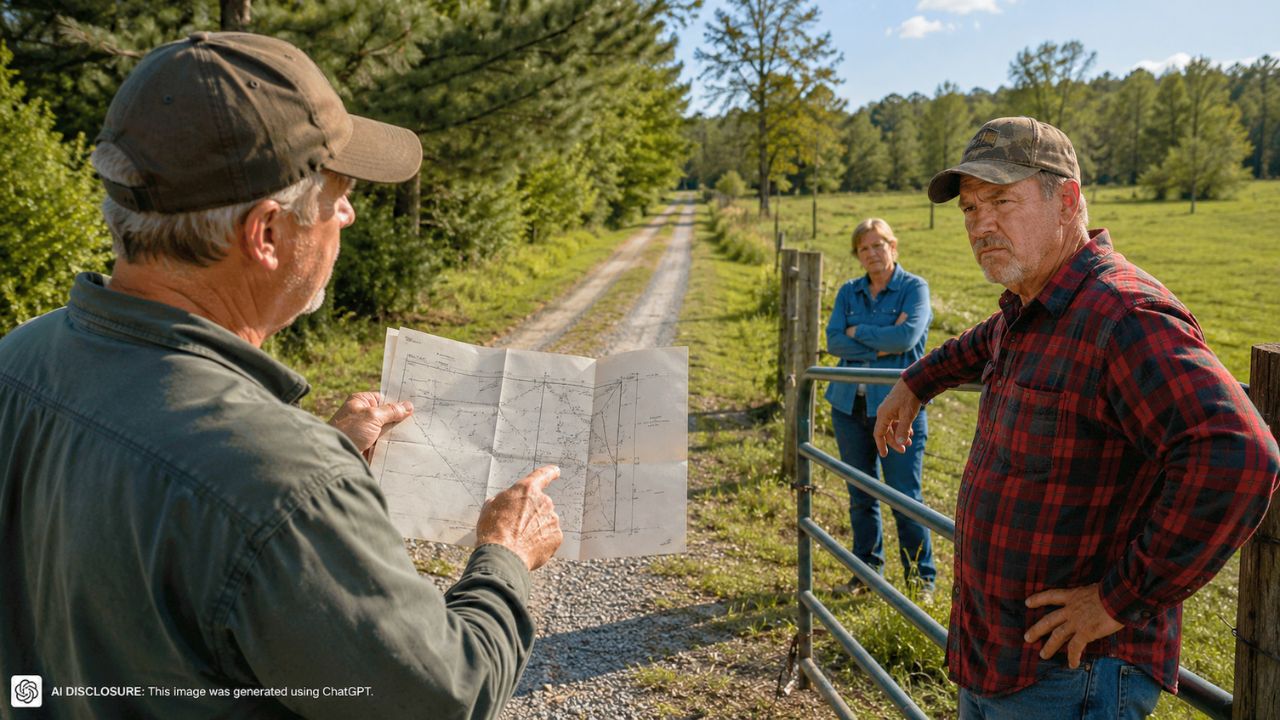
Photo credit: AI-generated image created using ChatGPT. Illustrative only
If you’ve ever relied on an old farm fence and a “we’ve always used it this way” handshake history, this Arkansas property fight will feel uncomfortably familiar. A landowner said he’d been using the same deeded access route since the early 1980s—until a court told him he couldn’t come back decades later and ask for a wider version of that easement, because he already had his shot.
The details come out of the court opinion, which reads like rural living in fast-forward: gates, cattle, gravel roads, a meandering fence line, and a strip of land that can be 50 feet wide in places depending on where you measure.
A deeded roadway, a locked gate, and a lawsuit that never settled the “width”
L. Drennan Parks bought an L-shaped tract in Washington County back in 1983. The same deed that conveyed his property also gave him a right-of-way across what later became his neighbors’ land—described as an easement “over and across the existing roadway” leading toward a county road.
That phrase sounds simple until someone starts acting like it’s their road. In 1998, Parks sued neighbor Steve Henderson, claiming Henderson interfered with the easement by closing and locking the gate where the route met the county road and by feeding cattle in a way that brought them onto the right-of-way.
Henderson pushed back with a counterclaim saying the easement language had been inserted through fraud or mistake and should be set aside. The case ended in a 1999 consent judgment: Henderson couldn’t unreasonably close or lock the gate or feed cattle near the easement, and Parks was allowed to improve the roadway with gravel or similar surfacing.
But here’s the detail that came back to bite later: nobody pinned down how wide the easement was.
Decades later, the same easement turns into a “make it 30 feet” fight
Fast-forward more than 20 years. Parks went back to court again, this time asking for a declaration that the right-of-way should be 30 feet wide, not just limited to whatever vehicle tracks the Hendersons supposedly wanted him to stay within.
The Hendersons attacked that part first, arguing Parks couldn’t reopen it. Their point was straightforward: Parks already sued over interference with the same easement in 1998–99, and he could have addressed the width then.
The trial court agreed, and so did the Arkansas Court of Appeals. The doctrine at play is res judicata—once you’ve litigated a matter (or could have litigated it) involving the same subject between the same parties, you don’t get endless attempts until you find a better angle.
Because the earlier lawsuit dealt with this exact easement and alleged interference with its use, the court said the width question belonged in that earlier dispute. Parks cannot now get a ruling that the easement is 30 feet wide.
The fence line that wandered 1,700 feet (and created a strip up to 50 feet wide)
The easement wasn’t the only flashpoint. The bigger, more personal homestead problem was a strip of land between the surveyed boundary and an old fence line sitting farther north.
This wasn’t a neat, straight fence either. It meandered for about 1,700 feet toward the county road. Since it didn’t match the survey line, the width of the “in-between” strip changed depending on the spot—up to about 50 feet at the widest point.
Everyone agreed the fence existed when Parks bought his property in 1983. Parks testified that the seller, Bill Carpenter, showed him the line at the sale and treated the fence as the boundary. Parks said they continued treating it that way for 12 years, until Carpenter sold the adjoining land (north and east of Parks) to the Hendersons in 1995.
And according to Parks, the Hendersons didn’t challenge it for years either—even after they had a survey in 2000 showing the fence was not the deed line.
Small maintenance turns into a big claim when the fence comes down
Property line fights often don’t start with lawyers. They start with chores. Parks said he acted like the strip was his: he built a locked gate into the fence, repaired and improved the fence, bulldozed parts of the area, bush-hogged and mowed it, cleared an old cabin area, planted flowers near the cabin and gate, placed tall posts and boulders around the gate, and hunted deer there regularly.
That sort of use matters because the law looks at what people actually did over time, not just what a map says. Parks claimed neither Carpenter nor the Hendersons objected while he was doing all of that.
Then things changed in 2016. Parks said Steve Henderson tore down part of the fence. Parks demanded it be replaced. Henderson allegedly said he would—but didn’t.
By November 2021, Parks filed suit. He wanted the fence recognized as the legal boundary through “boundary by acquiescence,” and later added adverse possession as a second theory for ownership of that strip.
The judge dismissed too early, and the appeals court hit reset on the fence dispute
The boundary-by-acquiescence and adverse-possession claims went to a bench trial in February 2024. Parks was the only witness during his case-in-chief. When he finished, the Hendersons asked the judge to dismiss for insufficient proof.
The trial court did dismiss. But the Court of Appeals said that was the wrong move at that stage.
In a nonjury trial, when a defendant asks for dismissal after the plaintiff’s evidence, the judge is supposed to view the evidence in the light most favorable to the plaintiff, give it its strongest probative force, and avoid making credibility calls right then. The question isn’t whether Parks proved everything beyond doubt; it’s whether his evidence could support a ruling in his favor.
The appeals court said Parks cleared that low bar on both claims. For boundary by acquiescence, Arkansas law doesn’t require a written agreement; a long pattern of treating a fence as the line can be enough. Parks testified Carpenter identified the fence as the boundary in 1983 and that this was honored for years, including after the Hendersons bought the adjoining property.
On adverse possession, Parks testified to years of open, continuous use: fencing, gating, mowing, bulldozing, planting, and controlling access. He also had color of title and paid taxes on property contiguous to the disputed strip. The appeals court stressed it was not deciding he owned the land—only that the case shouldn’t have been tossed before the Hendersons even put on their evidence.
So the easement-width issue is over for good, but the fence-line ownership fight is alive again on remand.
The homeowner takeaway people keep circling back to: you only get one clean shot
Homeowners following cases like this tend to react the same way: document early, don’t wait for the “big blowup,” and treat surveys, photos, receipts, and written agreements like they’re part of the tool kit. A fence repair and a gate lock feel like weekend projects—until they become the proof a judge uses to decide who acted like an owner.
The other reaction is the one this case underlines in bright ink: if you’re already in court over an easement or access route, that’s the time to nail down the details you’ll care about later. In Parks’s case, the court said he could not come back decades after a consent judgment and ask for a 30-foot width when the earlier case could have handled it.
Now the dispute heads back to the trial court with the fence strip still up in the air. Parks may yet convince a fact-finder that the old fence became the true boundary—or that he acquired the strip by adverse possession. But on the easement width, the door is closed, and it’s closed because the first lawsuit could have answered it.
Like Fix It Homestead’s content? Be sure to follow us.
- Man Says He Found Out the Fence He Paid For Wasn’t Actually on His Property
- Woman Says Her Neighbor Started Taking Mulch From Her Delivery Pile Before She Could Even Spread It
- I made Joanna Gaines’s Friendsgiving casserole and here is what I would keep
- What Caliber Works Best for Groundhogs, Armadillos, and Other Digging Pests?