Landowner’s Brother Finds the Neighbors Had Her Sign Over a Pump House and Dock on Her Own Land — Then a Court Upholds Both Easements
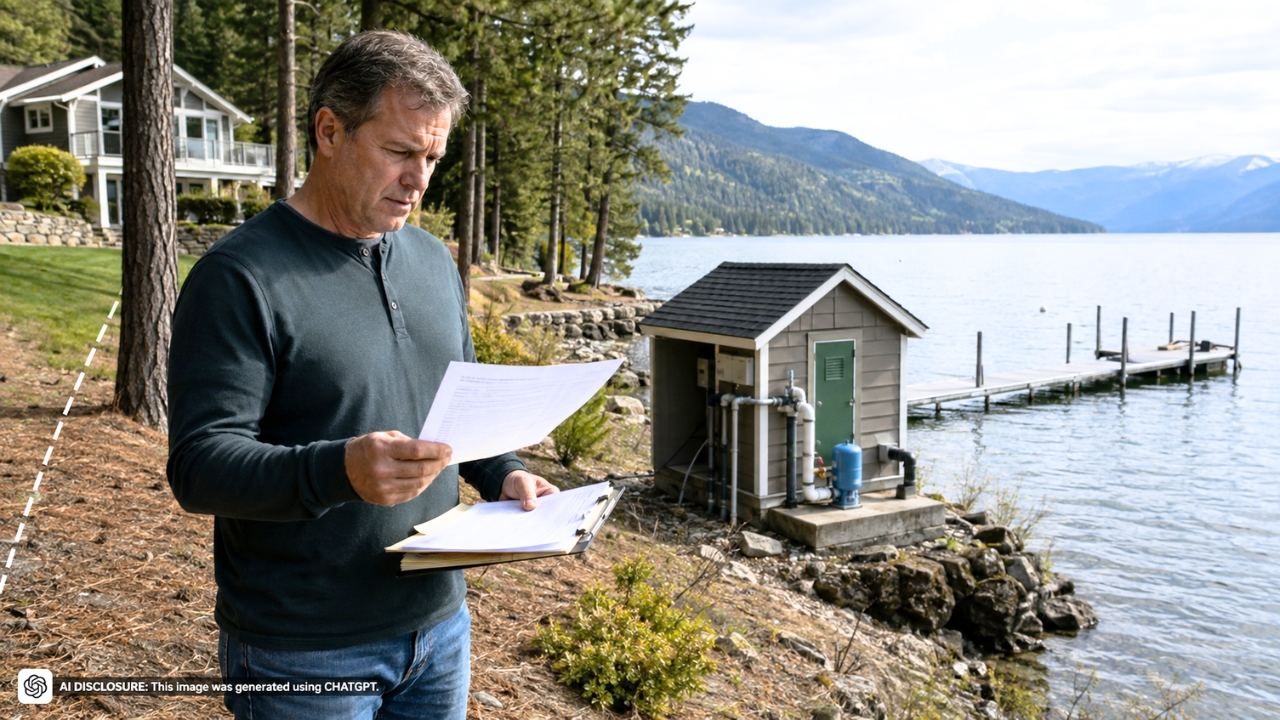
Photo credit: AI-generated image created using ChatGPT. Illustrative only
It started the way a lot of lake-property headaches start: one family member checks on an older relative’s place and realizes something on paper doesn’t match what’s on the ground. In northern Idaho, an 84-year-old waterfront owner ended up with two recorded easements benefiting her next-door neighbors—one for a lake pump house and waterlines, and another for a shared dock—both running with the land and binding future owners.
But the signing happened while she was living in a skilled nursing facility after a welfare check found her alone, weak, and struggling. Her nephew, acting as power of attorney, went to court to unwind what had been done. The neighbors appealed after losing at the trial level. In the end, the Idaho Court of Appeals decision in the discussion explains why the trial court’s summary judgment stood.
A quiet lake lot, a neighborly arrangement, and then the paperwork
The properties sit in Hope, Idaho, on Lake Pend Oreille. The landowner (Diane Burke Walker) had direct lake access; the neighbors (Jeffrey and Janice Baugh) were just to the south and didn’t have the same shoreline setup.
Walker used her home more like a vacation place, while the Baughs lived there year-round. That kind of setup can work fine for years—someone nearby keeps an eye on the place when it’s empty, and friendships form because you’re sharing weather, wildlife, and whatever the lake throws at you.
Then May 2023 hit. After Walker stopped responding to calls and texts, friends and family requested a welfare check. She was found at home with no food and was described as too weak to stand. She was admitted to a skilled nursing facility.
The signatures happened at a nursing facility
About five weeks after she arrived at the facility, on June 12, 2023, the Baughs drove roughly 140 miles to visit her. During that visit, they had Walker sign two easement documents. They also had her signature notarized by a notary they found at the facility.
The first document—titled “Easement for Lake Pump and Waterlines”—gave the Baughs permission to build a pump house on Walker’s property, install a pump drawing from the lake, and run waterlines. It wasn’t framed as a one-way benefit: the agreement said both parties could use the water, and it split up costs (Baughs paying initial infrastructure; each side maintaining their service lines; future pump-house and pump maintenance shared equally).
The second document—titled “Dock Easement”—gave the Baughs permission to build a dock on Walker’s property for shared access. The Baughs would pay initial construction, and after that, maintenance and repair would be shared equally. It also laid out use: each side could dock one boat overnight, and the Baughs could install a boat lift on their side of the dock.
Both easements included the kind of clause that makes buyers and heirs go cold: they ran with the land and bound successor owners, regardless of how title was obtained. The pump house and pump were built. At the time the lawsuit was filed, the dock had not been built yet.
“Wait, she signed what?”: the power-of-attorney steps in
Walker’s nephew, E. James Burke, held her power of attorney (the opinion notes his POA status wasn’t disputed). When he discovered the recorded easements, he contacted the Baughs through an attorney and asked them to sign releases.
Burke’s letter claimed Walker didn’t have the mental capacity to grant the easements when she signed and set a deadline for returning “Release of Easements.” He also offered a practical compromise: if the releases were signed, he would execute a valid easement for the lake pump and waterlines. In other words, he wasn’t saying “no” to everything—he was saying “not like this, not signed like that.”
The releases were not returned, so Burke sued to cancel and rescind both easements. His claims included incapacity, undue influence, unconscionability, and unjust enrichment.
Medical decline, a property-value hit, and a case decided on paper
Burke moved for summary judgment after the Baughs didn’t respond to discovery on time (they later blamed staffing issues at their attorney’s office and got extra time). For homeowners reading this, summary judgment is the moment where the judge can decide there’s no real factual fight needing a trial—no “we’ll hear both sides later.” It can be over fast if one side comes in with evidence and the other side doesn’t.
Burke backed his motion with affidavits, including one from a psychologist, Dr. Jameson Lontz, who evaluated Walker at the facility in March 2024. Dr. Lontz noted poor orientation to time and confusion about how long she’d been there. On the easements, Walker remembered signing “some papers,” but couldn’t recall the year, and when asked about June 12, 2023 specifically, she said she had “no recollection whatsoever about that date.”
Dr. Lontz’s conclusion was blunt: in his expert opinion she was incompetent at the time of his exam, was incompetent on June 12, 2023, and wasn’t expected to regain competency—meaning permanent oversight by Burke as POA.
Burke also submitted an affidavit from a local real estate agent, Becky Freeland, who said shared lake features like a dock and pump house destroy the privacy that waterfront buyers pay for, and would devalue Walker’s property by about 50 percent. The assessor’s notice valued the property at $1,242,015, so that claimed impact wasn’t small money.
The district court granted summary judgment for Burke, finding Walker lacked capacity or, alternatively, that she was under undue influence. It also ruled against the neighbors’ counterclaim for unjust enrichment and treated the other claims as moot. Then the court awarded Burke attorney fees and costs.
On appeal, the neighbors couldn’t just “disagree”—they needed evidence
The Baughs appealed, arguing there were genuine issues of material fact and that Burke’s evidence wasn’t enough to shift the burden to them. They also argued Burke didn’t address every claim in the complaint, and they challenged the attorney fee award as exceeding statutory limits.
The Court of Appeals wasn’t persuaded. A key line in these fights—especially when someone is trying to unwind signed and recorded property rights—is that the nonmoving party can’t survive summary judgment with conclusory statements. If one side brings in admissible evidence (like medical observations and expert opinion) and the other side doesn’t counter with depositions, affidavits, or discovery responses that create a real dispute, the court can decide the case without a trial.
In the hearing described in the opinion, the Baughs did not challenge the psychologist’s qualifications as an expert witness and didn’t file a motion to strike his evaluation. Their position was essentially that the report shouldn’t be enough to prove incapacity or undue influence. The appellate court agreed with the district court: Burke made the showing, and the burden shifted. The Baughs didn’t meet it.
So the summary judgment was affirmed.
The homeowner takeaway people keep circling back to
When a property dispute involves an older owner, a hospital or nursing facility, and new recorded documents that permanently affect land use, people tend to focus on the same practical pressure points: who arranged the paperwork, who selected the notary, what condition the signer was in, and whether there was independent advice involved.
And on the pure property side, the easements here weren’t a minor “walk across the corner” kind of thing. A pump house and a dock are physical installations with ongoing maintenance, access needs, and the kind of neighbor friction that doesn’t stay polite once there’s money and contractors involved.
The messy part is that none of this looks dramatic when it’s just paper being signed in a quiet room. The drama shows up later, when the family member reads the recorded documents and realizes the land has effectively been permanently shared. In this case, the courts accepted that the signing shouldn’t stand—and the neighbors’ appeal didn’t change that.
Like Fix It Homestead’s content? Be sure to follow us.