Beachgoers Find Two Gates Padlocked Across the Public Path for Twenty-Five Years — Then the Coastal Commission Fines the Homeowner $2.4 Million
Photo credit: AI-generated image created using ChatGPT. Illustrative only.
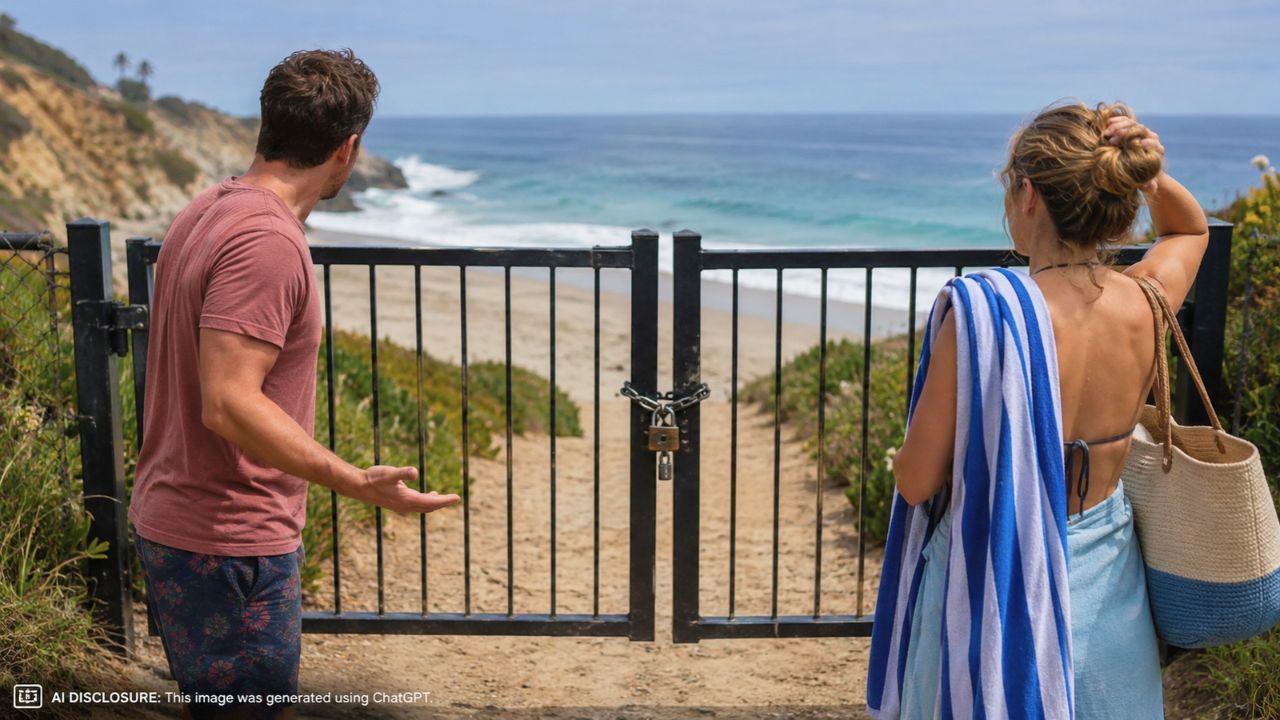
You know that feeling when a “public path” looks public right up until you hit a padlock? In Carlsbad, beachgoers say that’s been the reality for years along a stretch by Buena Vista Lagoon—two gates, both locked, cutting off what the California Coastal Commission views as legitimate coastal access.
Now the standoff has turned into a full-blown homeowner nightmare: a $2.4 million fine, a lawsuit, and a property-rights fight that’s been simmering since the late ’90s. The details are laid out in the source post, and it reads like the kind of “small thing” that becomes a life-consuming dispute because nobody agrees on who controls what.
Two locked gates and a path that never really stayed “public”
The property belongs to homeowner John Levy, who bought the land in 1998 and built an estate he calls “Levyland.” According to the Coastal Commission, the beach access problem is simple: there are two routes across the property area that could get the public to the sand, and both have been blocked by gates that have “been mostly closed for a quarter of a century.”
One route is a road leading toward the beach along the property line—owned by a neighboring homeowners association. The other is a foot trail on Levy’s land that runs along the lagoon. In the commission’s view, closing those gates violates the terms of Levy’s coastal development permit and blocks the public from the shoreline.
This is the kind of thing that sounds minor when you’re reading it—just open a gate, right? But on the ground, gates are never “just gates.” They’re boundaries, liability questions, neighbor relationships, and a constant source of “who said you could do that?”
The permit fights started early, and they never really stopped
Californians are used to hearing that “nearly all beaches” are public, but what trips people up is how you get there. The Coastal Commission can require property owners to provide access across their land in the Coastal Zone, and that’s where Levy and the commission diverge.
Levy says his permit requires “lateral access,” meaning beach visitors can enter from adjacent shoreline areas. The commission argues that doesn’t solve access for disabled beachgoers and says Levy must provide access from the street—Mountain View Drive—across the property.
Once you’re in that kind of disagreement, everything becomes leverage: what the permit meant then, what it should mean now, and whether the public has been denied something they were promised. And when years pass, every locked day turns into a bigger number.
“Open the gate” vs. “I don’t have the authority to remove it”
The commission’s enforcement counsel, Rob Moddelmog, put the agency’s position bluntly at an October hearing. He said Levy could have avoided the long conflict by simply complying—opening one gate, removing a padlock from another within easements, and removing development from a wetland buffer.
Levy’s response is basically: it’s not that simple because of property rights and easement questions. He says he installed the gate on the road with permission from the HOA, but now he needs the HOA’s permission to remove a gate that sits on the HOA’s land. That’s the kind of detail homeowners instantly recognize—today’s “sure, go ahead” becomes tomorrow’s “absolutely not,” especially when the stakes are high.
Then there’s the foot trail. Levy agreed to give the city of Carlsbad an easement over the footpath so visitors could walk to the beach. The commission says the easement exists, so the gate must be open. Levy and Carlsbad officials say the city never accepted it—meaning, from their perspective, the public can’t use an easement that wasn’t formally taken on.
Carlsbad’s community development director and city prosecutor reportedly told the commission the city hasn’t approved the easement, and also questioned the commission’s authority to require removal of the gate. In homeowner terms: everyone’s pointing to a different document, and nobody wants to own the liability.
The fine wasn’t just about access—vegetation, habitat, and a pickleball court got folded in
The Coastal Commission didn’t limit its enforcement case to the gates. It accused Levy of removing shorebird habitat, and of illegally installing a pickleball court. There’s also mention in the summary of a dispute involving native vegetation and a wedding site.
Levy says he has honored environmental protections and acknowledges the pickleball court was built without proper permits, but says he’s working with the city to fix that. Even that part will sound familiar to anyone who’s done major property work: one unpermitted improvement can become the thread that unravels the entire sweater.
To the commission, though, it’s presented as a long pattern—years of refusing to comply. The result was the $2.4 million fine for the access and environmental violations.
The lawsuit is really about who gets to hit you with seven-figure penalties
Here’s where this turns from a local “open the beach path” fight into something bigger: Levy’s lawsuit challenges the Coastal Commission’s authority to impose multi-million dollar penalties without court oversight, arguing that it violates due process.
Levy’s quote captures the frustration in plain language: “They’re the investigator, they’re the judge, they’re the jury and also they’re the treasurer.” He also argues the commission collects penalties that fund its own programs, which to him feels like the agency has too much power and too much incentive.
The commission staff and members didn’t respond to questions from CalMatters, citing pending litigation. That leaves the public reading the same way neighbors do when a feud goes “official”: one side feels steamrolled by bureaucracy, the other side feels ignored for decades.
The reactions people tend to have: paperwork, proof, and “who owns that gate?”
When a story like this circulates among homeowners, the reactions usually aren’t philosophical—they’re practical. People fixate on the basics: Where’s the survey? What’s recorded? What does the permit actually say? Is the easement signed and accepted, or just offered?
This case is basically an argument made of documents. Levy’s side points to the city not accepting the footpath easement and to the HOA ownership of the road gate area. The commission points to the permit requirements and what it sees as long-term noncompliance. If you’ve ever dealt with an HOA or a property-line dispute, you know how quickly “common sense” loses to recorded boundaries and old agreements.
And the biggest gut-check for regular homeowners is the number itself. A fine in the millions makes people wonder what happens when a long-running property disagreement isn’t handled early—before it becomes a formal enforcement record with decades of history attached to it.
For now, Levy is fighting the fine in court, and the underlying gate issue still reads like the kind of thing that could have been settled with the right signatures at the right time—or could keep grinding on, fueled by hard feelings, paperwork, and the stubborn physics of a locked gate that never magically unlocks itself.
Like Fix It Homestead’s content? Be sure to follow us.
- Man Says He Found Out the Fence He Paid For Wasn’t Actually on His Property
- Woman Says Her Neighbor Started Taking Mulch From Her Delivery Pile Before She Could Even Spread It
- I made Joanna Gaines’s Friendsgiving casserole and here is what I would keep
- What Caliber Works Best for Groundhogs, Armadillos, and Other Digging Pests?