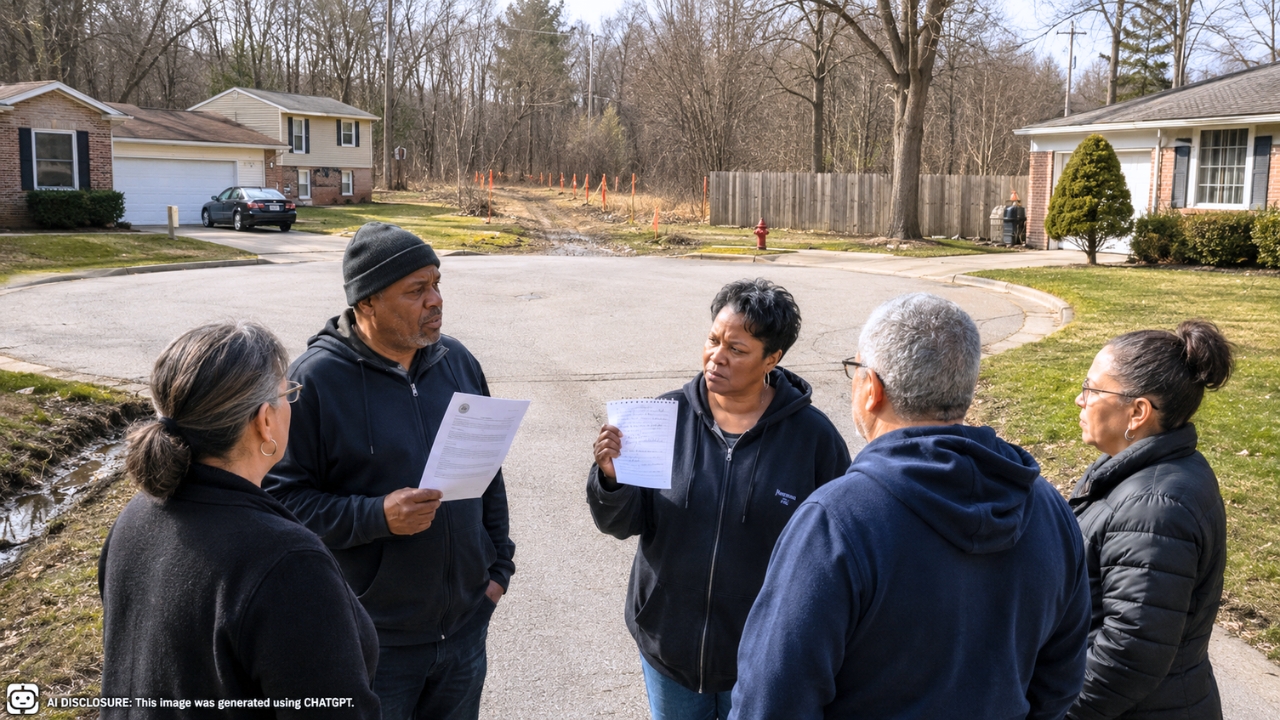
Cul-de-Sac Residents Watch the School District Take a 15-Foot Easement for a Bus Road — Then a Note Reading ‘Charles Hicks Coming at You’ Appears
Photo credit: AI-generated image created using ChatGPT. Illustrative only.
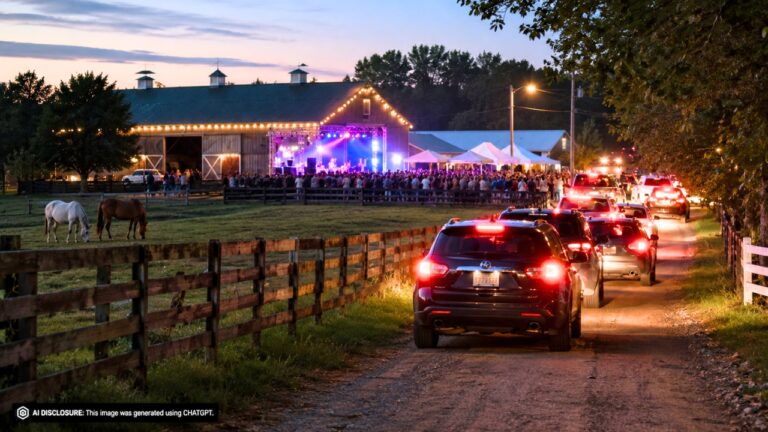
Green Valley Street is the kind of cul-de-sac people move to for a reason: quiet pavement, familiar dog-walk routines, and the sense that whatever drama exists is happening somewhere else. In Southfield, neighbors say that calm got replaced with mailboxes full of construction notices and the feeling that a road is about to be built right up against their backyards.
The details come from the source report, which lays out how a planned “emergency access road” has turned into a very personal property-line fight—complete with an anonymous note dropped into a resident’s mailbox with a handwritten message: “Charles Hicks coming at you.”
A cul-de-sac that stayed quiet for decades
Residents describe Green Valley Street as a long-running pocket of peace. Long-time resident Jane Miller called it “one of the greatest streets in Southfield,” the sort of place where people walk because they actually want to, not because they’re racing traffic.
That’s why the idea of any new roadway—especially one connected to a bus depot—lands like a threat, even when it’s described as “emergency only.” Pastor Daniel Moore put it bluntly: “You’re trying to make a freeway out of our neighborhood.”
The immediate fear isn’t abstract. Camille Johnson said there are no sidewalks, only ditches, and that the street isn’t built for large vehicles. In a neighborhood like that, “access road” doesn’t sound like a small tweak; it sounds like a change to daily safety.
The plan neighbors say they didn’t hear about until the notices arrived
Southfield High School and the district offices sit next to the subdivision. School leaders say they need an emergency route that would run from behind the district bus depot, through a wooded area, and connect to Green Valley Street.
That connection point matters because it takes the project from “something happening on school property” to “something touching the edge of homeowners’ lots.” The road would require removing several trees and taking down a fence in the wooded area, according to the report.
What really set people off was the timing. Even though the school board approved the plan in November 2019, neighbors said they didn’t know about it until August 2020, when construction notices showed up in mailboxes. Johnson described neighbors basically stopping each other on the street asking what the notice even meant.
District leaders later acknowledged communication went wrong, saying notice went to a now-defunct homeowners association. Residents said they weren’t aware of any HOA at all. That gap—whether it was a paperwork mistake or something else—left neighbors feeling steamrolled before they even had a chance to show up and argue.
The city said no… then the district used eminent domain anyway
Once neighbors started calling around, the request became clearer: the district wanted to purchase a small city easement to build the road. The Southfield City Council ultimately did not approve that purchase, and residents believed that was the end of it.
It wasn’t. Months later, Miller said she received a notice from a law firm placed in her mailbox anonymously. At the top, it had a handwritten line: “Charles Hicks coming at you.” Hicks is the president of the Southfield Board of Education.
Then came the move that changed the whole power dynamic. Using eminent domain, the district took over the city’s 15-foot easement next to residents’ property in order to build the emergency road “for the public good.”
Mayor Ken Siver said the city didn’t want to spend public money fighting in court, and that the council decided not to contest the eminent domain, recognizing they’d probably lose. For homeowners, that can feel like getting outvoted by a process that isn’t really built for a cul-de-sac.
“Emergency only” doesn’t stop homeowners from picturing buses
District leaders said this wasn’t a project they “initiated” so much as something they needed to do to comply with a new state law requiring emergency plans. Superintendent Dr. Jennifer Green said that, at least in that area, they are “out of compliance.”
Hicks framed it in terms of worst-case scenarios—fire or an active shooter—and said they want the ability to deploy buses to support an emergency response. It’s hard to argue with the desire for emergency readiness. It’s also easy to see why neighbors hear “bus depot” and picture the biggest vehicles on the street.
The district promised that once the access road is complete, it will be gated on both sides, and only emergency first responders will be able to open those gates. They said it won’t be used as a cut-through.
But homeowners aren’t wrong to focus on what they can actually verify. Gates can be left open. Policies can change. Personnel can change. A road, once built, is still a road.
That handwritten note turned a public works plan into something personal
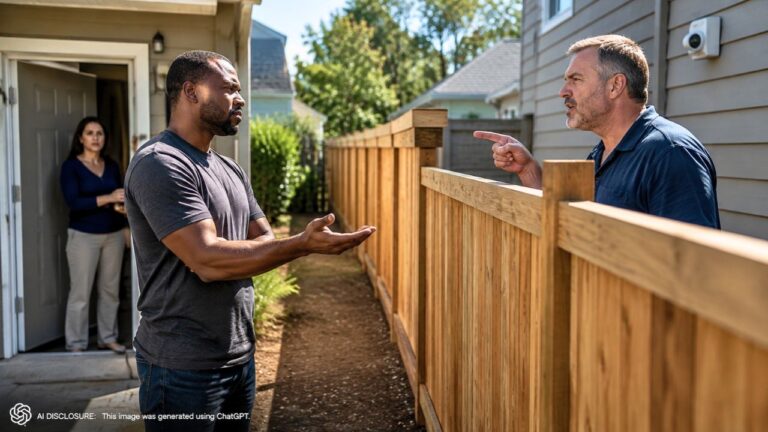
The note is the moment where this stops feeling like a routine government process and starts feeling like a neighborhood intimidation story. Miller said “all the neighbors were in shock” when she saw that line with Hicks’ name on it.
When asked about it, Hicks said he had “no idea” why someone would do that and said he was disappointed and upset it occurred. He denied coming after anyone, emphasizing the district’s aim to be proactive so administrators aren’t later left asking what they could have done differently.
Even if the note wasn’t connected to any official action, it did its damage. Homeowners don’t experience eminent domain through press releases; they experience it through mail that shows up uninvited, trees marked for removal, and a sense that someone else’s plan has become their backyard reality.
The practical homeowner playbook: document first, argue second
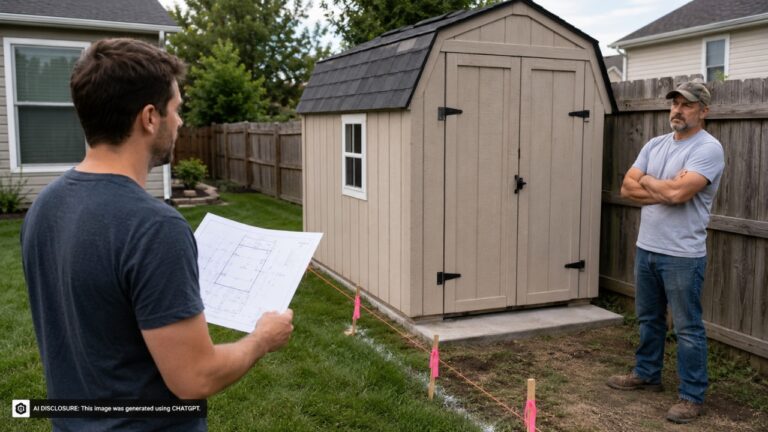
Stories like this tend to trigger the same practical instincts in homeowners: measure everything and put everything in writing. When a 15-foot easement is involved, people start thinking about where fences sit, where property pins are, and whether any grading changes could push water toward their yards.
The report doesn’t detail neighbors’ documentation efforts, but the concerns are familiar: traffic on a narrow street with ditches, liability if something goes wrong near a property edge, and the long-term effects of removing trees that act as a buffer. Once construction begins, the landscape can change quickly—and it’s harder to prove what was “before” if nobody recorded it.
On the district side, the promise of a gated road is meant to calm fears. On the homeowner side, “we were promised” is not the same as “we can enforce.” That’s where this kind of standoff tends to live: between the stated intention and the lived reality.
Construction was expected to begin soon, and Green Valley residents are left watching the edge of their cul-de-sac—where a strip of easement land is now the doorway for a project they didn’t ask for, and where one anonymous line in a mailbox made everything feel sharper than a normal public works plan ever should.
Like Fix It Homestead’s content? Be sure to follow us.