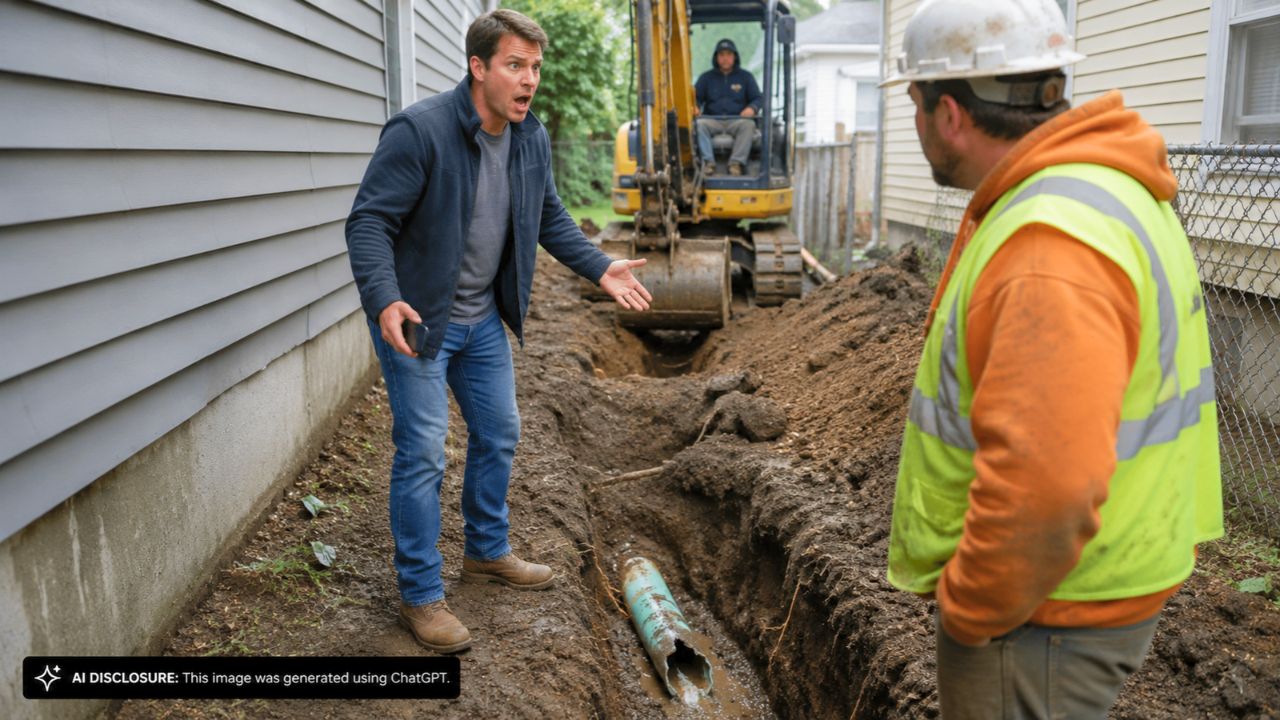
First-Time Homeowner Finds His Sewer Line Cut by the Crew Next Door — Then Learns There Was Never an Easement and the Fix Costs $35,000
Photo credit: AI-generated image created using ChatGPT. Illustrative only.
Tony Dalton thought he’d done everything right. He bought his first home in April, settled in, and assumed the unglamorous stuff—like where the wastewater goes—was simply handled the way it had been for years.
Then, a couple months later, the ground shifted next door. Construction crews working on a new parking lot for Hinsdale Elementary cut his sewer line, and Dalton’s house effectively stopped functioning like a normal house. The details come from the source post, and it reads like a nightmare scenario homeowners warn each other about but never expect to live through.
The day your house stops being usable
Dalton said his sewage line was accidentally cut in June by workers with Webbs Excavation. The company had been hired by the Kenton County School District as part of a project to build a new parking lot next door to his property.
At first, he figured it would be annoying but straightforward—dig, repair, reconnect, done. The home is about 25 years old, and Dalton said the line had “always been there,” which is the kind of detail that makes a new homeowner relax. If it’s been working for decades, surely it’s legitimate, right?
But Dalton’s immediate reality was blunt. “I no longer have any connection to sanitation,” he said. Not a little inconvenience. Not a partial backup. A complete loss of where everything goes after it leaves the house.
It got ugly when the word “easement” showed up
The surprise wasn’t just the cut line. It was what Dalton was told next: there was no formal easement for his sewer line to cross the neighboring property where the new parking lot would be.
That one detail flips the story from “contractor damaged my line” to “my line was never supposed to be there in the first place.” Without a recorded easement—an agreement allowing a private line to run through someone else’s land—Dalton lost the leverage most homeowners assume they’d have.
Dalton called it “unfair” and “unethical.” And you can hear why. He didn’t install the line 25 years ago. He didn’t approve its route. He just bought a house that, on paper, was a normal house. Then he found out the plumbing depended on a handshake from decades ago that apparently never got written down.
Temporary grace, then the cap went on
Dalton said the school district agreed to hold off on capping the sewer line for a few weeks. That window mattered, because once the line is capped, the home’s basics become a daily logistical problem.
Eventually, he said, the line was capped anyway. The practical consequence is the kind of thing people don’t think about until it happens: Dalton said he can’t use running water in his house because it has nowhere to go.
That means the “damage” isn’t just underground. It’s every routine you do without thinking—showers, toilets, laundry, dishes. When the drain system is compromised, the house stops being livable in a very immediate, very personal way.
Why the fix ballooned to $35,000
Kenton County’s sewer system is overseen by Sanitation District No. 1 (SD1). Dalton said SD1 gave him options for reconnecting to other sewage lines, but those alternatives are hundreds of feet away.
Distance is where the cost explodes. Long trenching runs, new pipe, restoration, potential permitting, and the unknowns you only discover after excavation starts—those are the ingredients that turn a “repair” into a major project. Dalton said he received an estimate that connecting to a new line could cost up to $35,000.
SD1’s spokesperson also drew a hard line about responsibility: SD1 is not responsible for private sewer laterals, and their responsibility “generally begins when sewer flow enters the public sewer system.” In other words, if the problem lives on private property before the connection point, it’s not their repair to own.
SD1 described a layered setup: one parcel had a private lateral connecting to an SD1 pipe across another parcel (the parking lot) without an express easement, and then Dalton’s parcel connected into that neighbor’s private lateral—also without an express easement. That’s the kind of daisy-chained arrangement that can function for years, until the day somebody digs.
Everyone sympathizes, but nobody wants the bill
Dalton said he doesn’t point the finger at one specific party. He just doesn’t think he should be left paying for a problem he didn’t create.
The school district’s attorney, Jeremy Deters, told WCPO they sympathize but aren’t responsible because there was no formal easement. Webbs Excavation’s owner told the outlet he had no comment.
That’s the part that makes this feel so familiar to homeowners: the moment when the people with equipment, contracts, and attorneys can all step back from the mess, and the person with the unlivable house is the one staring at estimates. Dalton described hoping “people would be responsible and work with me,” but said he felt “left in the dark.”
And because the line route wasn’t formally protected, sympathy doesn’t automatically translate into someone else paying. The missing paperwork becomes the deciding factor, not the fact that the house now can’t send wastewater anywhere.
The homeowner playbook people always recommend
When stories like this circulate, the homeowner reaction is usually less about outrage and more about triage: document everything, get the line located, pull property records, and find out exactly where the legal rights begin and end.
The key detail here—the lack of an easement—is also the thing many homeowners say they’d start hunting for immediately. Not because an easement magically repairs a pipe, but because it determines whether the route is protected and whether a neighbor (or a project on neighboring land) has to accommodate it.
People also tend to focus on estimates and second opinions, especially when the distance to an alternate connection is “hundreds of feet away.” A number like $35,000 makes anyone ask: is there a shorter route, a different tie-in point, a way to share part of the run, or a less invasive option? Even if the answer is no, having multiple bids and clear maps can be the only way to keep a terrible surprise from turning into an open-ended financial spiral.
Dalton’s own goal sounds simpler than anything legal: he wants “a civilized, mutual solution.” But until someone agrees they have a responsibility to restore what was cut—or to compensate for a line that functioned for decades without paperwork—he’s stuck between a capped pipe and a five-figure fix.
This is the part first-time homeowners don’t see in the listing photos: a house can look perfectly normal while relying on underground arrangements that only exist because nobody ever challenged them. The day a big project starts next door, “normal” can end in a single scoop of a backhoe.
Like Fix It Homestead’s content? Be sure to follow us.