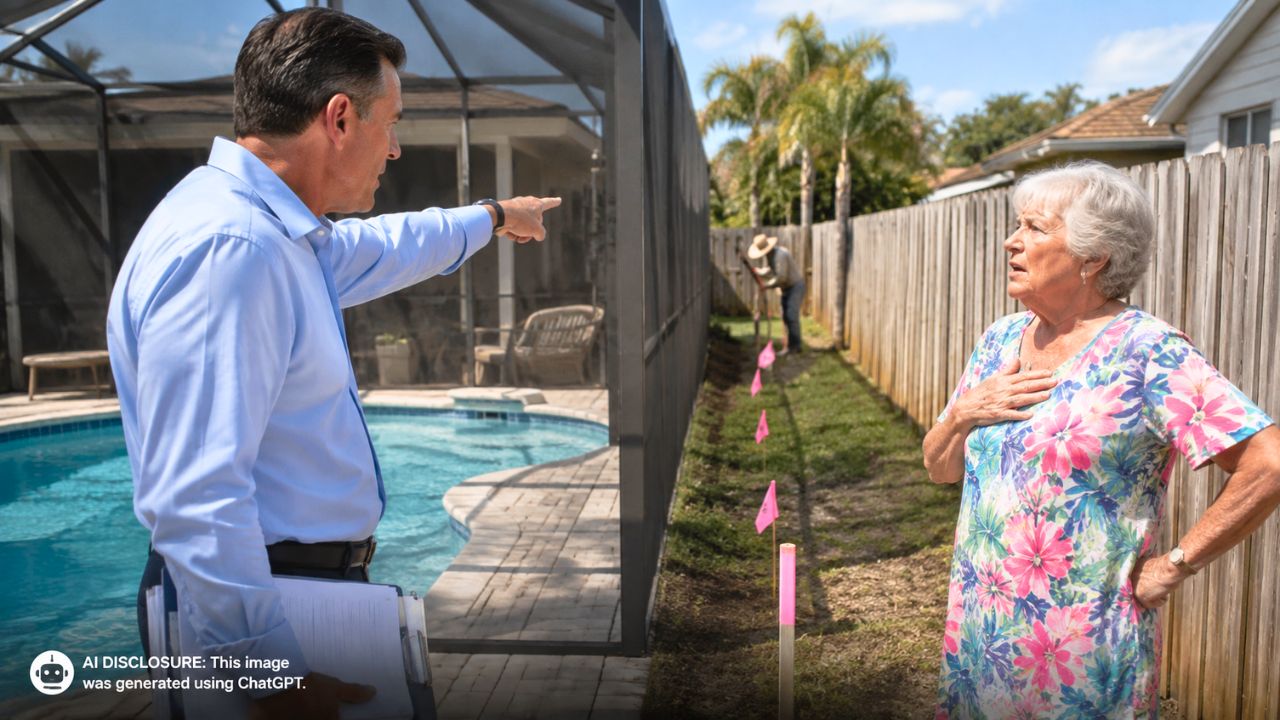
Florida Grandmother’s Fence, Lanai, and Pool Get Claimed by a New Survey From the Neighboring Lot’s Heir — Then His Title Rep Shows Up and Threatens to Bulldoze Part of Her Property
Photo credit: AI-generated image created using ChatGPT. Illustrative only.
For more than two decades, one Florida grandmother’s backyard felt like a settled fact. The fence was already there when she bought the house. The pool and screened lanai were part of the daily rhythm. Then a once-empty lot next door changed hands, a new survey showed up, and suddenly the boundary line was no longer “where it’s always been.”
In the original post, a family member described how a neighboring lot’s heir—trying to sell quickly while Florida prices were high—came in with paperwork and a plan. According to that survey, more than half of the grandmother’s backyard wasn’t hers anymore. The claim didn’t stop at grass. It reached the fence, the lanai, and even the pool.
A backyard that always had a “known” edge
The family said the grandmother has owned the house for over 23 years. When she purchased it, the fence was already installed, and she was told the yard ran from the end of the driveway to the fence line, plus about a foot beyond. It’s the kind of informal understanding many homeowners live with—especially when the neighboring parcel isn’t actively used.
Next door wasn’t a tidy, maintained property. The lot sat empty for years and, according to the post, was frequented by drug addicts and homeless people. The family dealt with ongoing issues tied to that, and the grandmother even mowed part of the land at times—more out of necessity and keeping things manageable than anything else.
That long stretch of “nothing happening” next door can make a boundary feel permanent. A fence becomes the landmark everyone points to. You stop imagining that a line on a plat map might cut right through the improvements you’ve lived with for decades.
The quick-sale scramble that changed everything
The original owner of the adjacent lot died, and a family member inherited it. Instead of sitting on the land, the heir reportedly wanted to move fast and sell while the market was hot. That meant getting a survey done and packaging the lot for a buyer who would likely build immediately.
But the survey result didn’t just nibble at an inch or two. The family said it was trying to claim more than half of the backyard. That’s the kind of boundary surprise that doesn’t feel like a paperwork correction—it feels like a takedown of your home’s livable space.
The stakes went up because the claimed strip wasn’t vacant. The fence, lanai, and pool were all implicated. Once a structure is “over the line,” the conversation stops being neighborly and starts sounding like demolition, rebuilds, and huge expenses.
When the title company representative showed up in person
The family described a confrontation that escalated quickly. The heir didn’t just send a letter. He arrived with a representative from his title company, came to the grandmother’s house, and the interaction turned “hugely unprofessional,” according to the post.
The threat that landed hardest wasn’t abstract legal talk—it was physical: they warned they would bulldoze part of the fence and the lanai so a new house could be built. For homeowners, that’s the nightmare scenario. You’re not arguing about where to plant shrubs. You’re picturing a machine ripping into improvements that make the property usable and safe.
And it wasn’t just one heated moment. The family said the heir and his side were getting aggressive, coming over, yelling, using abusive language, and making threats. For elderly homeowners in their 70s, that kind of doorstep pressure isn’t just stressful—it can feel like you’re being pushed out of your own home.
The fear wasn’t only losing land—it was waking up to damage
Once threats get specific—bulldozers, tearing down, building a house right up against you—the worry changes shape. The family wrote they were scared someone might do something to the house when no one was home. It’s the kind of fear that makes people start checking the windows twice, listening for trucks, and dreading every knock at the door.
Property line disputes can be slow when handled properly. But an aggressive neighbor can make it feel immediate. A fence can be cut in minutes. A contractor can be told, “That’s my land,” and suddenly you’re racing to stop work that never should have started.
Even the practical day-to-day becomes tense. If you’ve got a pool and lanai involved, you’re not talking about something that can be moved with a weekend project. Those are major installations tied into the home’s layout and value. The threat isn’t just the land itself—it’s the damage, the mess, and the possibility of losing what makes the property livable in Florida heat.
What people urged: slow it down, document it, and don’t meet anger with anger
The family said they were going to an attorney that day, which is the first move most experienced homeowners would make when a survey suddenly “re-draws” your yard through existing structures. When the dispute is about improvements like a pool and lanai, it’s not something to negotiate in the driveway.
In these kinds of boundary fights, the practical advice people tend to push is all about creating a paper trail and taking the temperature down, even if the other side refuses. Homeowners often start documenting every interaction, saving any paperwork tied to the property purchase, and gathering anything that shows how long the fence and structures have been in place.
And when there’s fear of someone showing up to tear something down, people commonly point toward visible deterrents: cameras, lights, and making it clear that any entry or demolition would be noticed immediately. Not as a provocation—more as a way to prevent a bad decision made in the heat of a land grab.
A quiet lot can turn into a loud, expensive border war overnight
This whole mess started with an empty lot that sat neglected for years. The grandmother lived next to it long enough that the fence line felt like a settled boundary, and the family’s attention was on the real-world problems the lot attracted. Then the lot got an heir, a survey, and a ticking clock to sell.
When the argument jumps from inches of grass to “your pool and lanai are on my land,” it stops being a neighbor spat and becomes a threat to the home itself. The family’s next steps were already moving toward legal help, but the pressure campaign—doorstep confrontations and bulldozing talk—made it feel urgent in the worst way.
For now, the grandmother’s backyard is still her backyard in the way that matters most: it’s where her fence stands and where she’s lived for 23 years. But with a new survey being waved around next door and a would-be seller trying to move fast, the family is bracing for a fight where the “line” isn’t just on a map—it’s right through the parts of the home that can’t be replaced easily.
Like Fix It Homestead’s content? Be sure to follow us.