Homeowner Agrees to Move a Fence, Shed, and Concrete Pad If a Survey Confirms the Neighbor’s Two-Foot Property Line Claim — Then the Neighbor Insists He Split the Cost of the Survey He Demanded
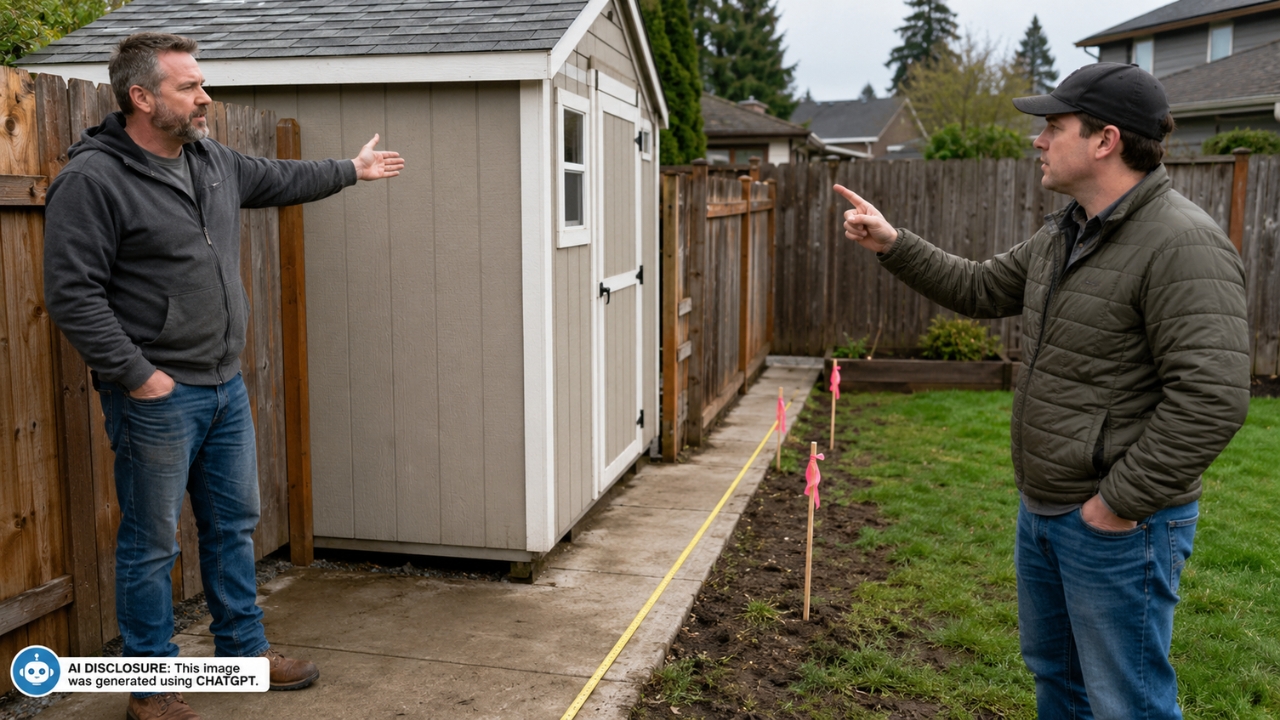
Photo credit: AI-generated image created using ChatGPT. Illustrative only.
It started with a neighbor looking at an existing fence and deciding it wasn’t where it belonged. Not by a little, either—by two feet. And in a backyard, two feet isn’t an abstract math problem. It’s the difference between “my shed fits” and “my shed suddenly lives in a legal gray zone.”
In the original post, an Oregon homeowner explains that the fence line has been in place, but the neighbor now claims it’s pushed over onto his property. The neighbor wants the fence moved, supposedly so it sits right on the property line. The homeowner’s response is surprisingly cooperative: get a real survey, and they’ll follow it—even if it means major work.
The fence wasn’t the real problem—the concrete and shed were
The homeowner isn’t just talking about pulling a few fence panels and resetting posts. Their yard has a concrete pad that runs right up to the current fence, plus a shed sitting inches from it. If the fence has to move two feet, that pad and shed become immediate headaches.
To comply, they’d have to relocate the shed, move “other things,” and likely cut back the concrete to create clearance. That’s labor, equipment, disposal, and the very real chance of damaging something that used to be perfectly fine. And all of it depends on one question: where is the property line, actually?
That’s the piece both neighbors can’t agree on—because there are no visible survey markers on the ground. No obvious pins. No clear “here it is.” Just a fence that someone now insists is wrong.
They tried measuring from a nearby survey, but it didn’t settle anything
Before hiring anyone, the homeowner and neighbor tried a common DIY workaround: measuring off known survey markers from another neighboring property. It’s the kind of thing people do when they’re trying to be reasonable and avoid turning a boundary disagreement into a full-blown project.
But the neighbor wasn’t satisfied with what that measuring exercise showed. He “was not happy with that result” and pushed for a formal survey to prove his point. That’s when the homeowner drew a line of their own: fine, get the survey, and they’ll comply with what a licensed surveyor says.
On its face, that should have been the de-escalation moment. A neutral professional settles it. The fence goes where it’s supposed to go. Everyone moves on.
Agreement on proof… until the bill came up
The neighbor wants the homeowner to pay half the cost of the survey. Not half the cost of moving the fence. Not half the cost of cutting concrete or shifting the shed. Half the survey—the very survey the neighbor is demanding because he doesn’t accept the informal measurements already attempted.
The homeowner’s frustration isn’t just about money. It’s about tone and leverage. They describe the neighbor as “a real jerk about the whole thing,” and the demand to split the cost feels less like cooperation and more like a tactic: make it expensive to dispute him, or make it expensive to delay.
Now the homeowner is stuck in that classic property-line bind. If they refuse to pay, will that make them look unreasonable? If they pay, are they funding the neighbor’s claim against them?
The homeowner’s question is straightforward: are they legally required to pay for half of the survey in Oregon?
Why this kind of dispute gets expensive fast
A two-foot boundary disagreement sounds small until you picture what two feet means in a tight side yard or a shed corner. If a survey confirms the neighbor’s claim, the homeowner isn’t just losing a strip of land. They’re looking at a domino effect: fence relocation, concrete modification, and moving a shed that was built assuming the fence was the boundary.
Even if the shed can be moved, it’s rarely as simple as “pick it up and slide it.” Sheds may be anchored, tied into electrical, sitting on skids that have settled, or placed so close to other features that moving them requires clearing access first. And concrete cutting isn’t a casual weekend chore—especially if the pad is thick or reinforced.
On the other hand, if a survey shows the fence is already on (or inside) the homeowner’s property, the entire push to move it loses momentum. But that still leaves the homeowner dealing with an angry neighbor who was convinced he was right.
That’s why people get so fixated on the survey. It’s not just a map. It determines who pays for what next—and who is the one “in the wrong” when the dust settles.
Commenters leaned hard on a basic principle: the person who wants proof usually pays
The post was framed as a practical question—who pays?—and it taps into a common rule of thumb homeowners hear over and over: if someone is making the claim and demanding a survey, they typically pay for the survey they ordered.
There’s also a second, quieter thread in reactions like these: don’t guess with property lines, and don’t rely on casual tape measurements when the outcome could require moving structures and cutting concrete. If the neighbor wants the fence moved and you’re willing to comply once it’s verified, the survey becomes the hinge point.
And once a survey exists, it becomes documentation you can keep. That matters, because boundary disputes have a way of resurfacing—especially when homes sell, new neighbors move in, or someone decides to “clean up” an old agreement.
The tension now is about more than a fence
At this stage, the homeowner has already offered what many people wouldn’t: they’re willing to do the hard part if it turns out they have to. That includes moving a shed and altering concrete—real, irreversible changes to their yard. The only thing they’re not willing to do is bankroll the neighbor’s push for proof, particularly after the relationship has already turned sour.
It’s the kind of standoff that makes small suburban spaces feel very small. Every backyard project becomes loaded. Every new post hole feels like a provocation. And once someone starts talking about moving established structures, it stops feeling like a minor disagreement and starts feeling like a threat to the way you use your property.
If a survey does happen, it will answer the boundary question. But it won’t automatically repair the neighbor relationship—or refund the time spent worrying about a shed that suddenly might not fit where it’s always been.
Like Fix It Homestead’s content? Be sure to follow us.