Homeowner Finds the Drainage Easement Behind Her Fence Clogged With Fallen Trees and Debris — Then Pulls a Baby Water Moccasin Out of Her Pool
Photo credit: AI-generated image created using ChatGPT. Illustrative only.
Behind Laura McBee’s backyard fence in Houston’s Spring Branch, the “drainage easement” isn’t acting like drainage at all. It looks more like a forgotten strip of land where stormwater goes to sit, trees go to fall, and broken fence panels end up piled like kindling.
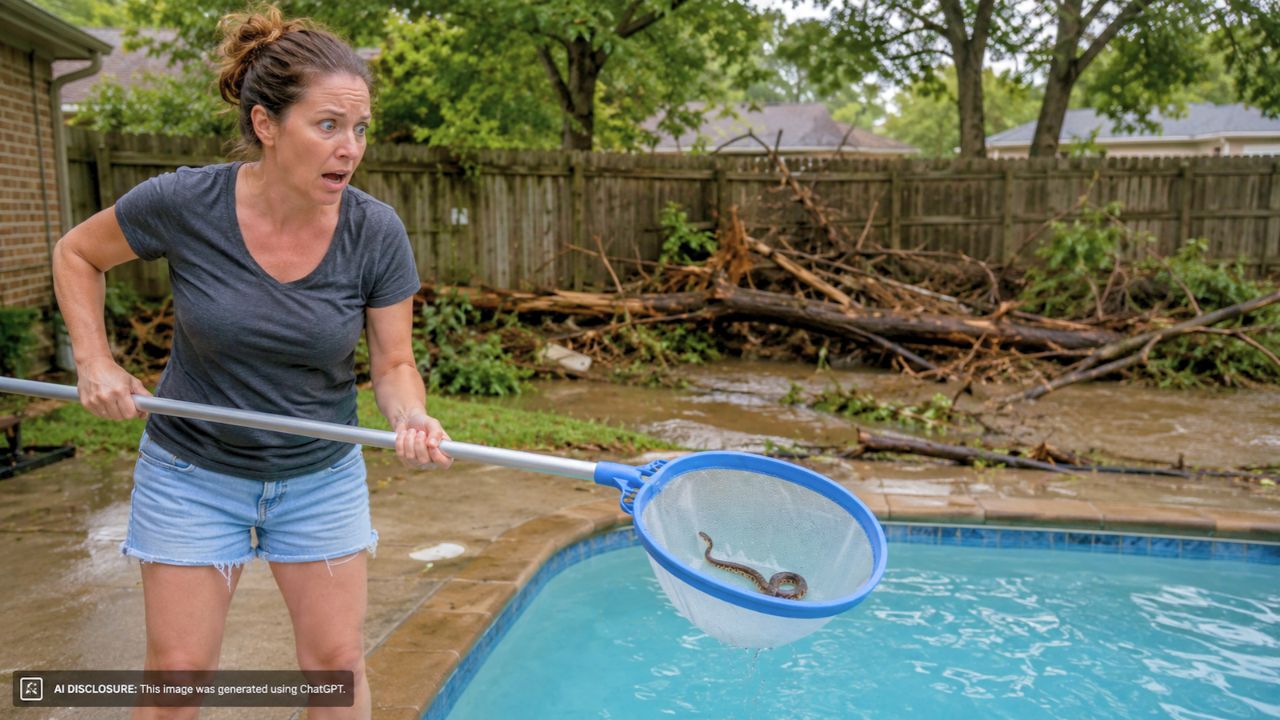
Then the backyard problems stopped being abstract. McBee told local reporters she reached into her pool skimmer and pulled out something she never expected to be dealing with at home: a baby water moccasin. The rest of the story—how the ditch got this bad, what the city says, and why neighbors are worried—was detailed in the source post.
The “invisible” strip behind the fence turned into a dumping ground
If you’ve lived anywhere with an easement behind the fence line, you know the deal: it’s not really your yard, but it absolutely affects your yard. McBee says the drainage path behind several homes along Rollingwood Drive is supposed to carry stormwater away and drain into a culvert near Long Point Road.
Instead, she says it’s filled with debris, fallen trees, damaged fencing, trash tossed over fences, and standing water. And when water can’t move, it starts stacking up like traffic on a closed lane.
That’s the part that makes homeowners’ shoulders tense up. Drainage isn’t one of those “we’ll get to it later” issues—because it doesn’t politely wait for your schedule. It waits for the next heavy rain.
Heavy rain turns the ditch into a rising bathtub
McBee says when storms come through, water levels rise fast. She pointed to a visible debris line—leaves and gunk left behind—showing how high the water has climbed before, up to street level.
That little line of stuck leaves is the kind of detail that spooks people who’ve been through a flood. It’s proof the water has already tested the system and nearly won.
And unlike a clogged kitchen sink, you can’t just grab a plunger. This is a shared drainage corridor, tied to multiple backyards and a culvert outlet. When it’s blocked in one stretch, it can back up like a bad pipe run through the whole row.
Standing water doesn’t stay “just water” for long
Once water sits, the problems multiply. McBee told reporters the standing water has brought “terrible mosquito problems,” plus snakes and other wildlife living in the overgrown, wet area.
That’s where this story takes the turn from annoying to unsettling. A mosquito issue is miserable but common after rain. Snakes are where people start changing how they use their yard—checking before they step, keeping pets close, scanning the pool edge before they reach in.
And in McBee’s case, the wildlife concern got personal fast. She said she pulled a baby water moccasin out of her pool less than a week before the report aired. Whether it came from the ditch corridor or simply found its way through the neighborhood, the timing makes her point for her: when the back-of-fence area becomes swampy and overgrown, it stops being background scenery and starts creeping into daily life.
“We’ve asked for years”—and the maintenance clock feels broken
McBee says she’s been emailing the city asking for help, and that the ditch has only been cleaned once in the past 12 years—three or four years ago. That’s the kind of timeline that makes homeowners feel like they’re paying taxes for services that never arrive at their street.
It’s also the worst kind of responsibility gray zone. Homeowners can’t safely clear a major drainage corridor full of downed trees and standing water on their own, and even if they could, they may not be authorized to. But when the official maintenance doesn’t happen, the neighborhood is still the one living with the consequences.
McBee’s message was blunt: “They need to come out and do this yesterday.” Because once the water gets high enough, the clean-up isn’t a clean-up anymore—it’s remediation.
The city says it’s a concern, but the weather doesn’t pause for paperwork
Houston City Councilwoman Amy Peck told reporters her office is aware and working to address the overgrown ditch, calling it “absolutely a concern” that “needs to be taken care of.” She said they’ve asked Public Works to expedite maintenance and that they’re willing to use council district service funds to get it handled quickly.
That’s the official response homeowners want to hear—acknowledgment and a path to action. But anyone who has watched rain in the forecast while waiting for a work order knows the feeling: a promise doesn’t move water.
McBee told reporters that standing water from recent rains was already approaching fence level, with more rain expected that week. When your fence becomes the measuring stick, you start mentally inventorying everything in your yard that can be ruined in a single night.
Homeowner reactions: document everything, because flood damage gets personal fast
One of the most practical parts of the report wasn’t the snake—it was the reminder about who gets stuck with the bill if water ends up in a home. The story notes that homeowners would likely be responsible for damage to their own property, and that many standard homeowners policies don’t cover flooding unless you have separate flood insurance.
It also described how insurers can sometimes try to recover costs from a government agency through subrogation, but that it’s hard. It can require documentation showing the city knew about the problem and failed to address it.
That’s the detail that tends to change how neighbors behave. Instead of only making phone calls, people start saving emails, taking date-stamped photos of water lines, filming clogged culvert outlets after storms, and keeping a clean record of who they contacted and when. Not because they want a fight—but because if the worst happens, “we’ve been reporting this for years” is stronger when you can prove it.
For residents along Rollingwood Drive, the push is still on to get the drainage easement cleared before the next downpour turns a clogged ditch into a neighborhood-wide mess. In the meantime, backyards are doing what they always do in these stories: becoming the front line, one fallen tree and one unwanted visitor at a time.
Like Fix It Homestead’s content? Be sure to follow us.