Homeowner Plants Arborvitaes and Builds a Privacy Fence to Block the Noise From Next Door — Then Testifies It Made No Difference at All
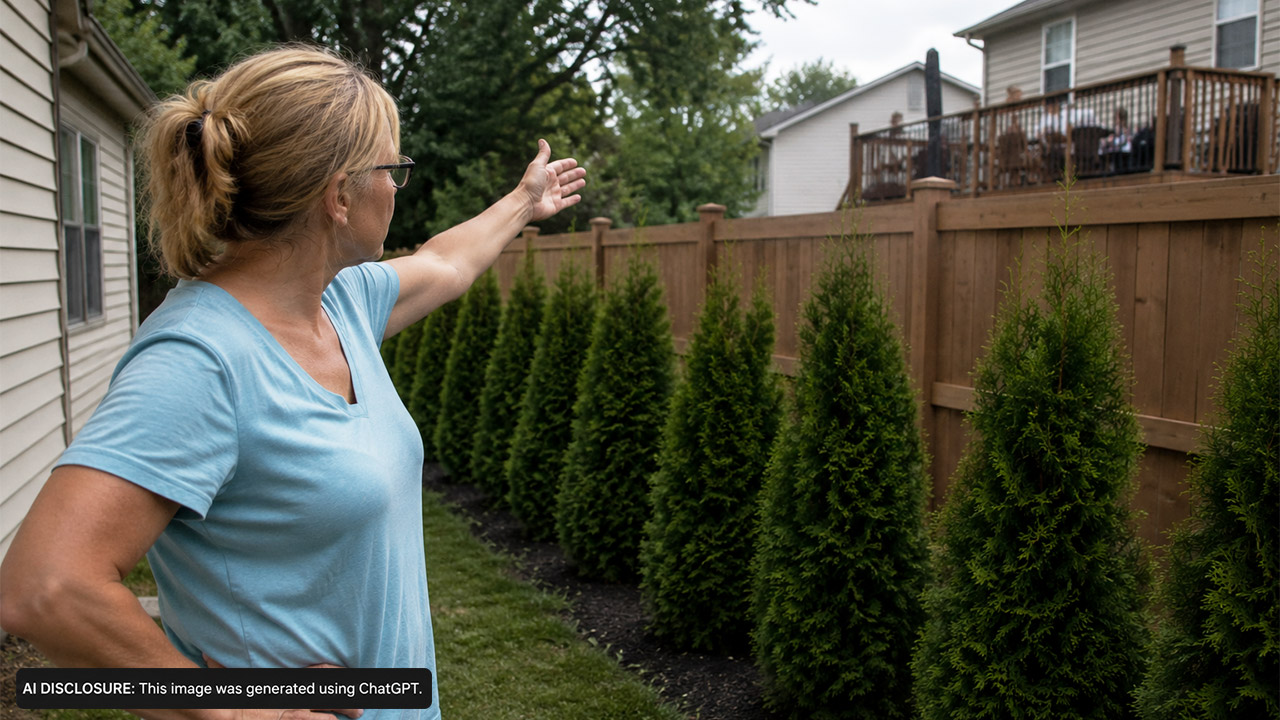
Photo credit: AI-generated image created using ChatGPT. Illustrative only
You can do all the “polite neighbor” things first—plant a living wall, put up a fence, try to tune it out—and still end up feeling like your own house has turned into a worksite. That’s what Vanessa Carlton and John McCauley told a Rhode Island judge after loud construction activity started next door and didn’t let up.
In their court filings and testimony summarized in the source post, the couple said they planted arborvitaes and built a privacy fence to get their home back. It didn’t work. The noise still came through, and they said it was affecting everything from basic comfort to their ability to make music inside their own place.
The quiet they bought into didn’t last
Carlton and McCauley bought and lived at 141 Post Road in Warwick, Rhode Island, in the Pawtuxet Village Historic District. Their property was zoned residential, and they described the early soundscape as what most people would expect: road traffic, plus occasional airplane noise.
Then, in July 2024, the baseline changed. Next door at 175 Post Road—zoned light industrial and owned by Artak Avagyan and Lee Beausoleil—activity ramped up with construction-related work. A crane company had moved onto the site earlier, and a company called JOGO Corporation began using the property for work tied to construction.
It wasn’t one loud afternoon. The homeowners described it as persistent, day-after-day noise: heavy machinery, backup beepers, hammering, generators, sawing, cranes. The kind of sound that doesn’t just annoy you—it controls your schedule.
They tried the homeowner fixes first: trees and a fence
A lot of people faced with a noisy neighbor do the same mental math: if we can block the view, maybe we can block the sound. Carlton testified that she tried exactly that—planting arborvitaes and installing a privacy fence.
But she told the court it made no meaningful difference. Even with windows closed, she said she couldn’t comfortably remain inside her own home. She described the noise as “absolutely maddening,” and said it made creating and arranging music extremely difficult.
McCauley testified along the same lines, explaining that he tours as a musician and time at home with family is especially important. He described eight or more hours per day of hammering, sawing, and beeping and called being at home “really unenjoyable and completely depressing.” He also said the noise aggravated tinnitus and hearing problems.
This is the part that makes homeowners grind their teeth: you can spend real money on landscaping and fencing, only to learn that some problems aren’t “property line” problems. They’re land-use and enforcement problems.
It wasn’t just noise—there were claims of watching and filming
The case didn’t stay in the lane of decibels and daytime working hours. Carlton also testified that Avagyan walked along the property line while appearing to film or photograph her home and backyard.
She described another moment that would make any parent’s stomach drop: she said a landscaper working next door appeared to point a phone toward her nine-year-old daughter while the child was playing in the backyard.
Carlton’s own landscaper separately testified that he had seen Avagyan along the boundary, apparently recording Carlton’s property. Taken together, the homeowners weren’t describing a simple “they’re loud” dispute. They were describing a home that no longer felt private.
Proof showed up with sound meters and police testimony
One of the hardest parts of noise fights is that they can sound subjective when you try to explain them later. This case had more than just personal accounts.
A nearby resident testified that the construction noise was a major intrusion. A Providence police sergeant brought a sound meter to the Carlton property and measured two events roughly 10 decibels above the neighborhood’s normal background level, including a backup alarm that read 68 decibels.
Warwick police also testified that they personally heard backup alarms, hammering, and construction noise coming from the neighboring property. JOGO ultimately received a noise violation.
That kind of outside documentation matters in the real world, because it turns “my neighbor is ruining my life” into something closer to “here’s what was measured, and here’s what officers heard.”
The judge didn’t just shrug and say, “You live near industrial”
Carlton and McCauley sued for private nuisance and asked for emergency injunctive relief—basically, a court order telling the neighboring owners and related businesses to stop certain behavior while the case continued.
After a three-day hearing, the Superior Court found they showed a reasonable likelihood of success on the nuisance claim. The judge pointed to frequent, prolonged, unreasonably loud noise—some of it exceeding the city ordinance limits—combined with intrusive conduct involving watching or filming.
The preliminary injunction that followed was specific. It prohibited the owners of 175 Post Road and the crane company from harassing, filming, photographing, or otherwise interfering with the family’s enjoyment of their property. It also barred operations that violated Warwick’s noise ordinance (the order treated that limit as 60 decibels), and it prohibited operations where noise unreasonably interfered with the family’s use and enjoyment of their home.
The neighboring owners appealed, raising arguments including that OSHA rules require backup alarms on construction vehicles, so local noise limits shouldn’t apply. The Rhode Island Supreme Court wasn’t persuaded. The justices noted the complaints were about much more than backup alarms, and even for backup alarms, OSHA allowed an alternative: backing up with a human observer signaling it was safe.
They also tried the familiar defense homeowners hear all the time: you moved next to industrial property. The Supreme Court acknowledged “coming to the nuisance” can be a factor in Rhode Island, but it’s not an automatic shield. The homeowners bought in 2021, and the specific noise they complained of didn’t begin until 2024.
The reactions were predictable: document, measure, don’t rely on a fence
If you’ve spent time around homeowner forums, the practical reactions write themselves. First, people tend to zero in on documentation—sound readings, dates, times, and witnesses—because noise disputes get brushed off fastest when they’re purely verbal.
Second, there’s usually a hard-earned warning about expecting landscaping to solve an industrial-noise problem. Arborvitaes and privacy fences can help with sightlines, and they can soften some sound, but they’re not a magic wall against machinery, backup beepers, and hammering that goes on for hours.
And third, when a dispute includes claims of filming or watching along the property line, people tend to get serious fast—because the issue stops being “annoying neighbor” and starts feeling like a safety and privacy problem.
In the end, Carlton and McCauley didn’t get their peace back from trees and boards. They got it—at least temporarily—through a court order. The Rhode Island Supreme Court affirmed that preliminary injunction, leaving the restrictions in place while the lawsuit continues. For homeowners stuck between “I tried everything I could afford” and “the noise still comes through the walls,” it’s a reminder that the next step isn’t always another DIY project. Sometimes it’s proving the problem exists at all.
Like Fix It Homestead’s content? Be sure to follow us.