California Homeowner Finds the Neighbor Ground Out the Builder’s Surveyor Mark in the Sidewalk and Cut a New Line Half a Foot Onto the Property — Then Widens the Driveway to the New Line He Made Up Himself
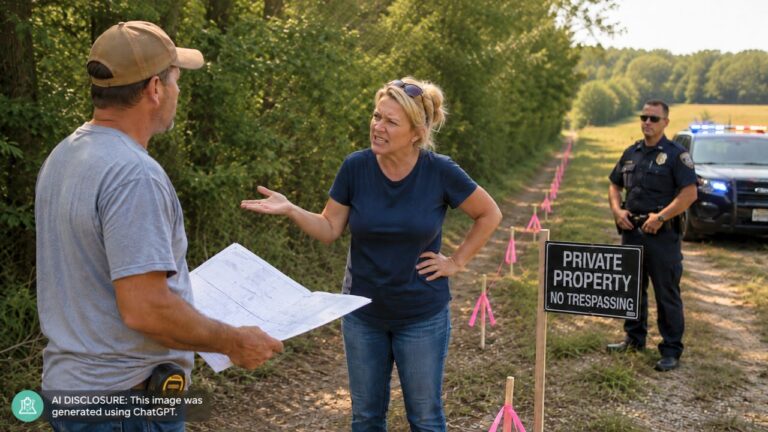
Photo credit: AI-generated image created using ChatGPT. Illustrative only.
A new-construction driveway is supposed to be one of those “finally, something easy” parts of moving into a fresh-built home. Instead, one California homeowner says they watched their neighbor turn the front edge of the property line into a DIY editing project—by physically erasing the builder’s surveyor mark in the sidewalk and cutting a new one farther over.
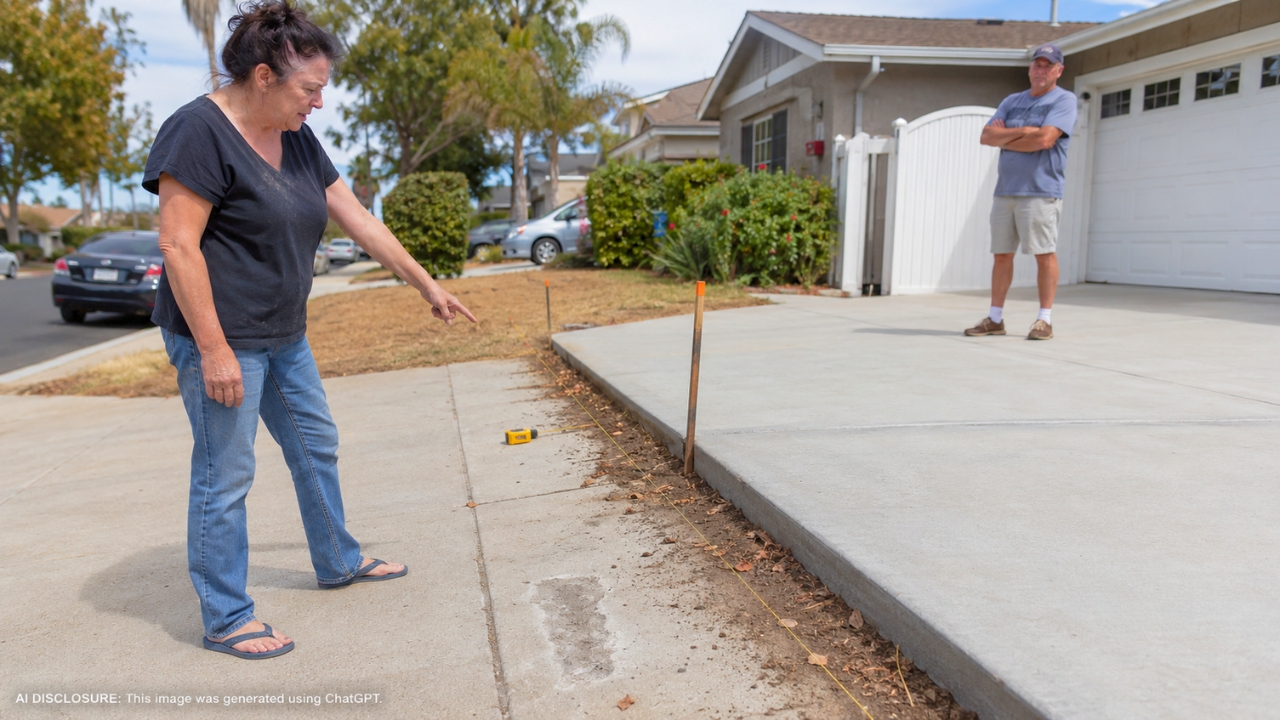
In the source post, the homeowner describes a driveway widening that didn’t just creep across the line—it allegedly came with a deliberate attempt to change the visible boundary. The original score mark in the sidewalk, cut to indicate the lot line, was “ground out / ruffed up,” then replaced with a new line about half a foot into the homeowner’s property, sloped downward to create a larger driveway apron.
The sidewalk line didn’t move by itself
What makes this kind of dispute so tense is how permanent it feels. A driveway apron isn’t a lawn edging mistake you can pull up and redo with hand tools. It’s concrete work, it affects drainage, and it signals intent: “This is mine now.”
The homeowner says the builder’s surveyor had already cut a score mark into the sidewalk to show the boundary. Then the neighbor allegedly altered that mark—first by grinding it down, then by cutting a new “property line” where it suited the driveway expansion.
Half a foot sounds small until you picture it the way a homeowner does: that’s the width of a fence post, the difference between a gate swinging cleanly or scraping, the space you rely on for setbacks, and—especially in California—paid-for land that isn’t getting any cheaper.
A bigger driveway apron, a smaller sense of safety
This wasn’t presented as a one-off disagreement over inches. The homeowner described the neighbors as “constant problems,” including vandalism, and said the behavior has been escalating. That context changes the whole feel of the driveway encroachment: it’s not just a boundary issue, it’s a daily stressor right outside the front door.
That’s why the homeowner’s immediate “fix it” instincts weren’t about arguing at the curb. They were about building a buffer—getting the line re-established, then putting up a fence and cameras so they can “relax at my own home.”
But even the obvious next step—hiring the original survey company—has been frustrating. The homeowner says the surveyor agreed to do the job but has been swamped, and after a month nothing has been scheduled. Meanwhile, the neighbor’s behavior has felt like it’s getting worse.
The hardest part: you can’t enforce a feeling, only a line
In property fights, the emotional part is often clear right away: someone feels encroached on, threatened, or disrespected. The practical part is slower. You usually need a survey you can point to, marks that can be photographed, and paperwork you can hand to whoever needs to get involved next.
The homeowner is already thinking ahead: security cameras, a professional survey, and a fence. They’re also anticipating that the driveway section may need to be removed—and that getting there could require court.
That’s where the stress spikes. Concrete doesn’t politely un-pour itself. If a neighbor has physically expanded onto someone else’s land, the path back to “normal” can involve formal demands, contractors, and possibly a judge telling someone to undo work they’ve already paid for (or decided to do themselves).
And before any of that, there’s the question the homeowner asked plainly: can a surveyor really determine that missing half foot accurately? When the visible “line” in the sidewalk has been tampered with, it’s natural to worry it’s now a he-said, he-said battle. The homeowner wants reassurance that a professional can re-establish the real boundary and not just shrug at the difference.
Why the wait for a survey feels like its own kind of damage
Waiting a month for a survey appointment doesn’t sound dramatic until you live through it. Every day you look at the widened apron, you’re watching a new reality harden—literally and socially. The neighbor gets used to driving over “their” new space. Guests see the bigger apron and assume it’s legitimate. The homeowner feels boxed in, like the clock is running.
Even if the encroachment is “only” inches, time can make disputes harder. A homeowner doesn’t want to accidentally signal consent just because they didn’t have the right professional lined up quickly enough. And in a neighborhood where tensions are already high, people often avoid direct confrontation until they have documentation, because one wrong conversation can turn into retaliation.
The homeowner’s fence plan also depends on knowing exactly where the boundary is. Put a fence in the wrong spot—even by a little—and the problem flips around. The homeowner becomes the one accused of encroaching, and now you’re paying twice to move things.
What people urged: document first, then make your next move count
The homeowner didn’t just want sympathy—they asked for steps. And in these kinds of disputes, the practical-minded advice tends to revolve around proof and pacing: lock down evidence, avoid escalating too early, and build a paper trail that doesn’t depend on anyone’s memory.
The homeowner already has the right instincts on the basics: cameras, a survey, and a fence. Cameras aren’t just about catching vandalism. They capture the everyday patterns—who’s using the space, whether anyone is altering the curb line further, and how the driveway apron is being treated.
A professional survey is the keystone because it turns a messy visual argument (“look where they cut the sidewalk!”) into something that can support whatever comes next. The homeowner is clearly hoping that once the line is re-marked, they can install a fence as a physical boundary and a mental reset: this is my space, that is yours, and we don’t touch.
And if removal of the encroaching concrete becomes necessary, the survey is what makes that request more than an accusation. Without it, any demand to tear out part of a driveway sounds like neighbor-on-neighbor noise. With it, the dispute becomes measurable.
A driveway isn’t just parking—it’s a claim
There’s a special kind of exhaustion that comes from front-yard conflicts, because you can’t avoid them. You drive past them. You mow near them. You see them every time you check the mail. And when the disputed area is a driveway apron—the most “used” part of a home’s edge—every car becomes part of the argument.
For this homeowner, the goal isn’t to win an abstract boundary debate. It’s to get their property back, build a fence buffer, and stop living on alert. But until the survey is scheduled and the line is officially re-established, they’re stuck staring at a tampered sidewalk mark and a widened apron that feels like a daily provocation.
In the meantime, their plan is simple and telling: record what’s happening, get the professionals out there, and create a hard boundary that doesn’t depend on anyone behaving well. That’s often what “fixing it” looks like when the repair isn’t in the walls—it’s next door.
Like Fix It Homestead’s content? Be sure to follow us.