Homeowners Argue Twenty-One Years of Implied Acceptance Fixed the Boundary — Then the Court Awards the Neighbors Just $550 for the Encroachment
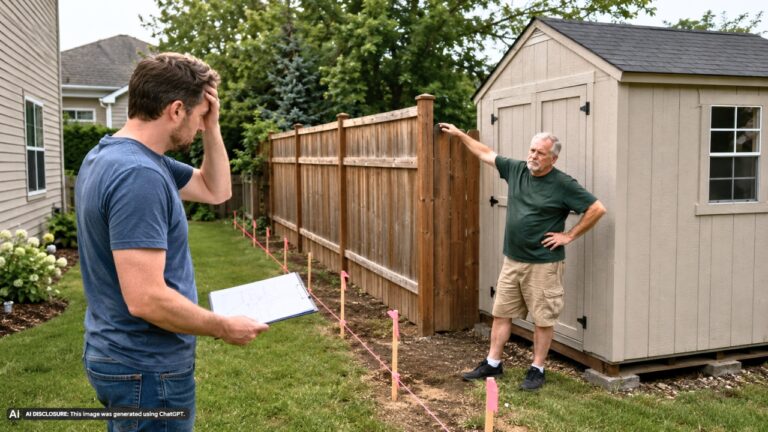
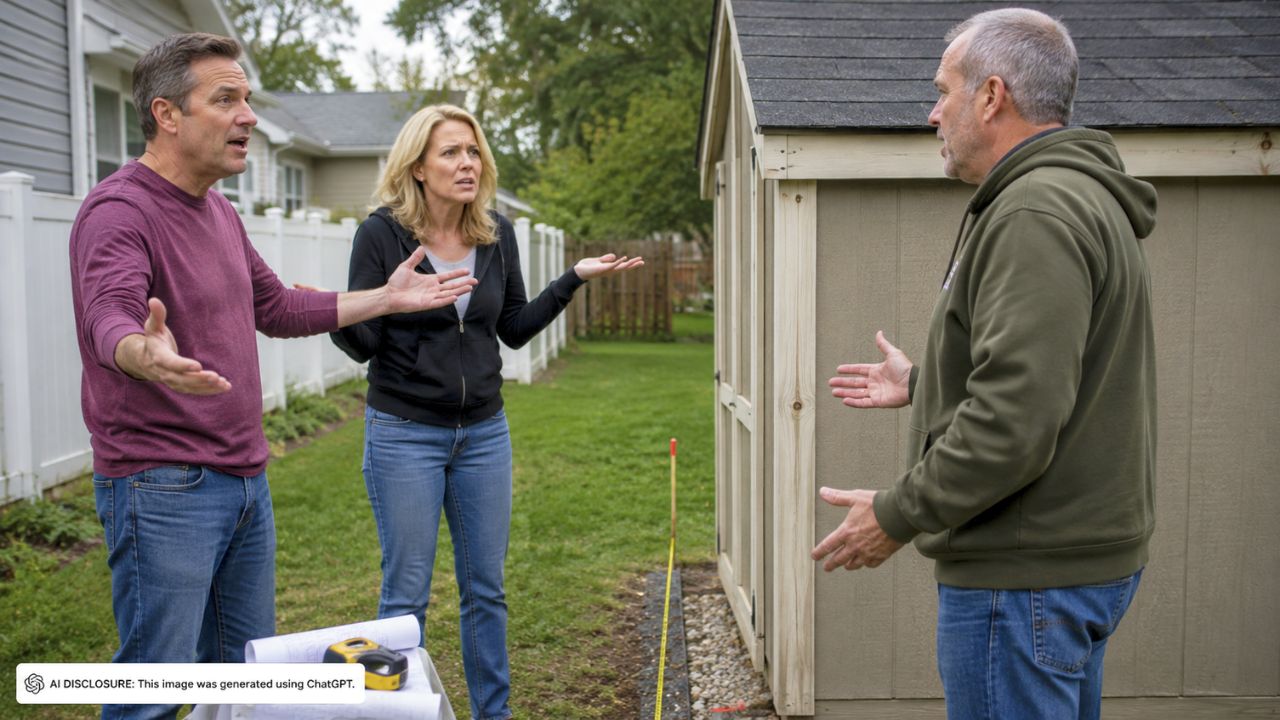
Photo credit: AI-generated image created using ChatGPT. Illustrative only
It started the way a lot of property-line fights start: a fence that “looks right,” a strip of grass that gets mowed a little too confidently, and a couple of backyard features nobody thinks twice about until the relationship goes sour.
But in a waterfront neighborhood in Sylvania, Ohio, that slow-burn tension turned into a full-scale legal war—over a sprinkler head, a fence post, and about eight inches of seawall. The court record in the discussion reads like the kind of neighbor dispute that keeps people up at night, not because the encroachment is big, but because the accusations and filings never stop.
The first mistake was a fence built a few inches off
Byrne Stapleton and the Byrne C. Stapleton Revocable Trust bought their place in 2003. Two years later, they hired a contractor to build a backyard fence. The contractor got the line wrong.
Most of that fence ended up slightly onto the next-door property—while one post actually sat a few inches back on Stapleton’s side. At the time, the adjoining owners asked if they could connect their fence to it and use Stapleton’s gate, and Stapleton agreed. That sounds neighborly, but it also created the kind of “everybody’s fine with it” arrangement that can turn into “wait, whose is this?” years later.
The Powers family bought the neighboring property in 2009. And by around 2011, Stapleton removed most of the physical fence and switched to an invisible dog fence. Jerry Powers asked them to keep the section attached to his property in place. Stapleton agreed—while also saying the remaining fence still belonged to him.
Powers didn’t see it that way. And that disagreement didn’t stay contained to one leftover panel of fencing.
When the physical fence came down, the boundary fight didn’t
Once the old fence was mostly gone, the “line” became more about habits: who mows where, who maintains what, and who feels entitled to treat a strip of yard like it’s theirs.
Jerry Powers began mowing a couple rows onto Stapleton’s side, according to the case summary. Stapleton told him to stop. Stapleton put flags down to mark where the underground invisible-fence line ran. Powers repeatedly removed the flags.
That’s the moment these disputes often cross over from annoying to personal. Because once you’re pulling up each other’s markers, you’re not just arguing about land—you’re arguing about control.
From there, each side accused the other of escalating behavior. Stapleton accused the Powers of cutting invisible-fence wires and pulling boundary markers. The Powers accused Stapleton of “booby-trapping” the boundary with stakes, nails, and strings, and also accused him of harassment, chemical spraying to kill landscaping, and even assault. Police got involved. A civil-protection-order petition was filed and later withdrawn.
At that point, it wasn’t really about a few inches of property anymore. It was about living next to someone you no longer trust.
Surveys finally showed what was actually over the line
Eventually both sides did what people always say they’ll do “if it comes to it”: they hired surveyors. And here’s the twist that should have calmed things down—both surveys agreed.
The surveys showed the disputed strip belonged to the Stapletons. They also identified just three encroachments coming from the Powers’ side: a sprinkler head about one foot over, a fence post roughly four inches over, and a timber seawall that extended about eight inches across the line.
Those are the kinds of encroachments that happen in older yards with shared systems—sprinklers laid out years ago, a seawall built to follow the shoreline instead of a plat map, a fence post set by a contractor eyeballing it. Small, but real.
So Stapleton sued in 2021 to quiet title and have the encroachments addressed. That’s where the Powers tried a big swing: adverse possession.
The “we’ve all treated it like ours” argument hit a hard time limit
The Powers argued they owned the strip by adverse possession—basically, that they (and prior owners) had treated it as theirs long enough that the law should recognize it.
Ohio’s rule is strict: they needed 21 years of open, notorious, exclusive, continuous, and adverse possession. The Powers themselves had owned the property for about 11 years, so they needed to “tack” on the prior owners’ conduct to reach the 21-year mark.
That’s where their proof fell apart. Jerry Powers submitted an affidavit claiming the earlier owners had possessed the disputed land, but the court noted much of it was based on “information and belief,” not personal knowledge. And their most concrete physical example was the sprinkler system—specifically, one sprinkler head that had been installed across the line years earlier.
The appeals court wasn’t impressed. It said adverse possession has to be obvious enough that the true owner is on notice that someone is claiming the property as their own. The court used a memorable phrase: an adverse possessor must essentially “unfurl his flag on the land.”
A sprinkler head that disappears into the grass doesn’t do that. Stapleton testified he didn’t even know it crossed the line until he struck it while digging to plant bushes.
So the Powers lost the ownership claim. The court found no genuine dispute: the disputed strip belonged to the Stapletons, and the Powers hadn’t shown 21 years of qualifying possession.
The court treated the encroachments as small—and priced one at $550
Once the title question was settled, the case returned to the practical question homeowners always care about: who has to move what, and who pays.
The Powers agreed to move the sprinkler head at their expense. The fence post was to be relocated, with the Powers reimbursing the Stapletons $550 because Stapleton had originally installed it. And rather than force an expensive rebuild over roughly eight inches of timber seawall, the judge allowed the existing wooden blocks to remain—but ordered the Powers to relinquish any control or ownership claim over them.
In other words, the court didn’t treat this like a bulldozer-and-start-over job. It treated it like what it was: minor physical encroachments that could be handled without tearing up a waterfront yard.
But the dollars that ended up mattering most weren’t tied to sprinklers, posts, or lumber.
The real financial damage came from the paperwork war
This is where the case stops looking like a standard boundary dispute and starts looking like a cautionary tale about how litigation itself becomes the weapon.
At various points, the Powers represented themselves and filed massive documents attacking Stapleton and his lawyers. One motion in July 2024 ran more than 700 pages, including 690 pages of exhibits, and accused Stapleton’s attorney of conspiring to submit false affidavits. Another filing exceeded 200 pages and claimed Stapleton and his lawyer paid someone to sign a false affidavit to extort money. Another ran 361 pages with 340 pages of exhibits.
The trial judge didn’t view this as messy but harmless pro se over-explaining. The court found the filings were designed to make Stapleton’s life miserable, embarrass him, damage his reputation, and prejudice readers. The accusations escalated into claims of hate crimes against the elderly, perjury and fraud, an illegal “cabal,” conspiracies with lawyers, and attempts to extort and financially ruin the Powers.
The judge also noted the Powers had been warned about a local 20-page filing limit, and they kept submitting hundreds of pages anyway.
The result: attorney fees. The trial court ordered the Powers to pay $12,128.24 for bad-faith and vexatious filings from 2022, plus $18,430 for a second wave in 2024. Total: $30,558.24.
The Powers appealed and lost again. Ohio generally makes each side pay its own legal fees, but bad faith is an exception—and the appellate court upheld the full award. It also pointed out something that jumped off the page: the Powers acknowledged part of their strategy was to overwhelm the case and force Stapleton to settle without trial.
In the end, the physical boundary issues were measured in inches. The financial punishment was measured in tens of thousands of dollars—and the neighbors still had to live next door when the dust settled.
Like Fix It Homestead’s content? Be sure to follow us.
- Man Says He Found Out the Fence He Paid For Wasn’t Actually on His Property
- Woman Says Her Neighbor Started Taking Mulch From Her Delivery Pile Before She Could Even Spread It
- I made Joanna Gaines’s Friendsgiving casserole and here is what I would keep
- What Caliber Works Best for Groundhogs, Armadillos, and Other Digging Pests?