Property Owner Finds the Shed Encroaching Past the Line and Onto the Alley — Then the Court Rules It Cannot Prove Twenty-One Years of Possession
Photo credit: AI-generated image created using ChatGPT. Illustrative only
It’s one thing to have a shed that’s a little crooked or a little too close to the back fence. It’s another to find out it’s sitting where nobody can agree it belongs — and then a paperwork change suddenly turns “that’s how it’s always been” into a full-blown removal order.
That’s what played out between neighboring properties at 101 and 103 W. Plain Street in Minerva, Ohio, in a case that ended with an appeals court telling one owner: you can’t keep what you can’t legally claim. The full decision is laid out in the source post, and it reads like the kind of property-line drama that starts with a shrug and ends with court dates.
A shed that “worked” for years—until the alley stopped being public
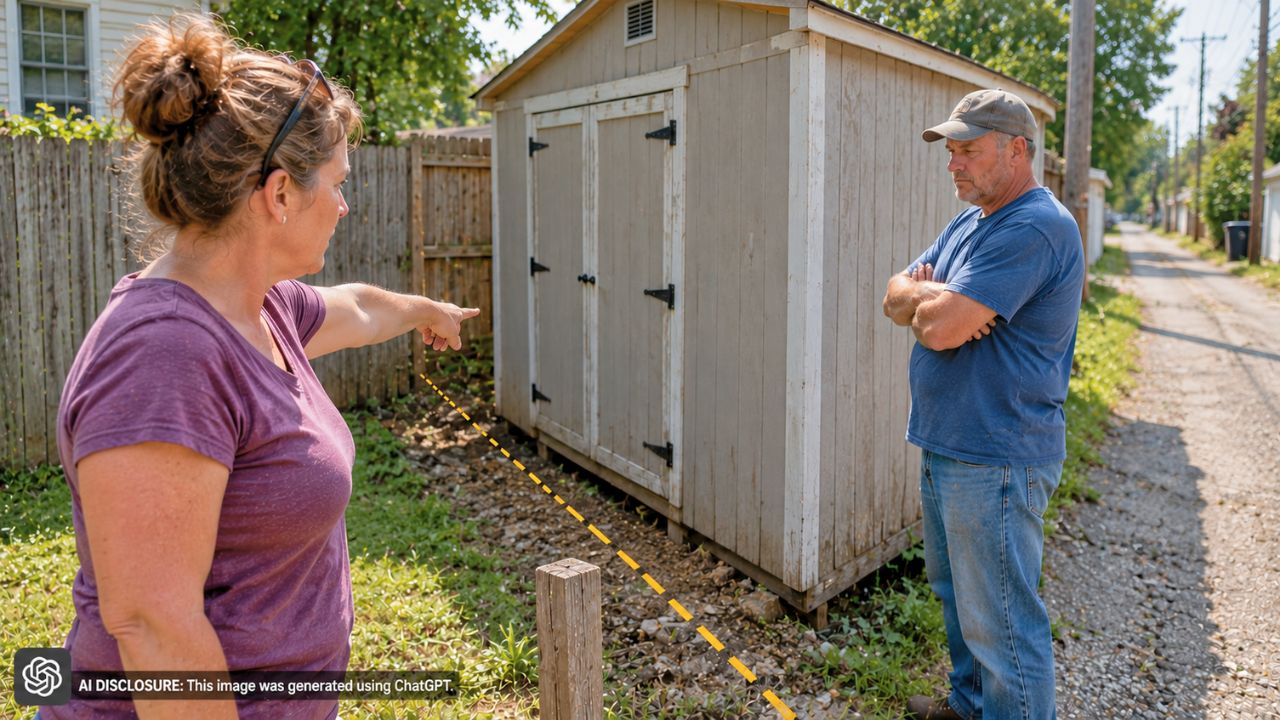
For years, a 12-foot-wide alley owned by the Village of Minerva ran between the two properties. At some point (the exact date wasn’t nailed down), Hasington, LLC or a predecessor built a shed toward the rear of that alley.
The structure didn’t just kiss the line. It sat essentially in the middle of the 12-foot alley, with part of the shed on one side and part on the other. Renters for Hasington also used the alley as a driveway, which likely made the layout feel normal day-to-day—one of those “everybody uses it” setups that can go decades without anyone pulling a tape measure.
Then came the change that turned an old placement into a new problem: on June 28, 2023, the Village formally vacated the alley. Instead of staying public, it was split down the middle—each adjoining owner received six feet.
The moment the lines moved, the shed became someone else’s problem
Once the alley was vacated, the Slentz side received the six-foot strip next to their property, and Hasington received the six feet next to its own. And just like that, land that used to be “the Village’s alley” became privately owned dirt with privately owned rights.
That shift mattered because part of the existing shed was now sitting on land that legally belonged to the Slentz side. What had been an awkward but tolerable “it’s in the alley” placement became a straight-up encroachment onto a neighbor’s property.
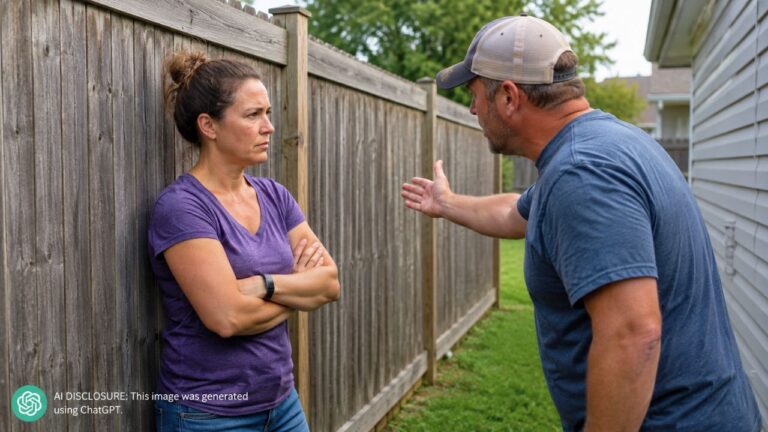
The neighbors demanded the shed be removed. The conflict didn’t stay polite. According to the case summary, the Slentz side allegedly threatened to cut the shed in half if it wasn’t moved—one of those statements that tends to happen when people feel trapped, angry, and convinced the other side is stalling.
By November 2024, the Slentz side sued for trespass and ejectment, asking for injunctions requiring the structure to be removed. This wasn’t just a disagreement over boundaries; it became a “move it or the court will make you” fight.
The defense hinged on “we’ve had it there forever”—but the clock didn’t count
Hasington’s response was to counterclaim and argue it had a prescriptive easement—basically, that it had used that spot in a way that should now be legally recognized because it had been open, notorious, adverse, and continuous long enough.
In Ohio, “long enough” is at least 21 years. That’s the key number property folks latch onto, because if you can prove the years and the kind of use, you can sometimes keep a driveway, a path, or a strip of use that technically sits on someone else’s parcel.
But the shed’s big problem wasn’t where it sat. It was whose land it sat on for most of its life. For nearly all the time anyone could point to, the ground under that shed wasn’t privately owned by either neighbor—it belonged to the Village of Minerva.
And Ohio law generally doesn’t let private parties acquire rights in government-owned land through adverse possession or prescription. So the shed could sit there for years, even decades, and it still wouldn’t build the kind of private prescriptive rights Hasington was trying to claim. The prescriptive “clock” couldn’t run while the Village owned it.
Once the alley was vacated in June 2023, that clock could finally start—because now it was private property. But the lawsuit came just over a year later. That’s nowhere close to 21 years, and the courts treated it that way.
Why the judge didn’t hit pause again, even with overseas travel and medical treatment
This case also had a procedural wrinkle that will sound familiar to anyone who’s ever tried to juggle real life with deadlines. Hasington, LLC was solely owned by attorney Hwa Lumley, who represented the company herself in the trial court.
In April 2025, she told the judge she planned to travel to Korea for IVF treatment and expected to be gone for two to three months. The court adjusted the schedule accordingly, setting a long runway: dispositive motions weren’t due until October 1, responses due October 29, and replies in November.
But Lumley’s time overseas lasted much longer than anticipated. She asked for either an indefinite stay or another 120-day continuance, saying treatment and recovery extended her absence. The trial court declined to keep extending the case.
On appeal, Hasington argued that this denied a meaningful opportunity to defend itself. The appeals court didn’t buy it. The panel emphasized the schedule had already been specifically designed to accommodate her planned treatment and had delayed the case for months. And it noted that Lumley knew the process could be extended or unpredictable but chose not to bring in outside counsel.
The record also undercut the idea that communication was impossible: despite saying she lacked internet access, she was able to email photographs of handwritten filings to someone in Ohio for submission. The appeals court concluded the judge acted within his discretion by refusing to freeze the case indefinitely.
The “unclean hands” argument didn’t save the shed either
Hasington also tried another angle: claiming the neighbors had “unclean hands” because of the alleged threat to cut the shed in half. In a real neighborhood, that kind of threat can feel like a turning point—people stop talking, start documenting, and start calling professionals.
The appeals court acknowledged that actually cutting a shed in half would have escalated things and been a bad idea. But the alleged threat alone wasn’t enough to block the neighbors from enforcing their property rights once the alley had been vacated and ownership was clear.
In the end, the Seventh District Court of Appeals affirmed the judgment in full. The shed had to go.
The reactions were predictable: “survey it, document it, move it”
Home-and-property readers tend to split into two camps when they hear a story like this. One side focuses on how common it is for old sheds, garages, and driveways to drift into “shared” areas when nobody’s watching the lines. The other side hears “vacated alley” and immediately thinks: new deed, new stakes, new reality.
The practical-minded takeaway people usually land on is boring but effective: get the boundaries in writing, assume public land can change status, and don’t gamble your outbuildings on “the alley’s always been there.” Once the ground becomes privately owned, what used to be tolerated can become trespass overnight—and courts are going to want proof, not neighborhood memory.
Here, the proof problem was fatal. Hasington couldn’t show 21 years of qualifying possession against a private owner because, for most of the shed’s life, there was no private owner to possess against. When the land finally became private in 2023, the timer basically reset to zero. A year later, the neighbors went to court, and the shed became a 30-day deadline.
In a small town, a shed sounds like a small thing. But when it’s sitting on land that suddenly belongs to somebody else, it turns into the kind of mess that costs time, attorneys, and eventually a moving crew—because “it’s been there forever” only matters if the law says those years count.
Like Fix It Homestead’s content? Be sure to follow us.