Land Survey Reveals the Neighbor’s Paved Driveway Sits Completely on the Homeowner’s Property — Then She Realizes She Needs That Same Driveway to Reach Her Own Land
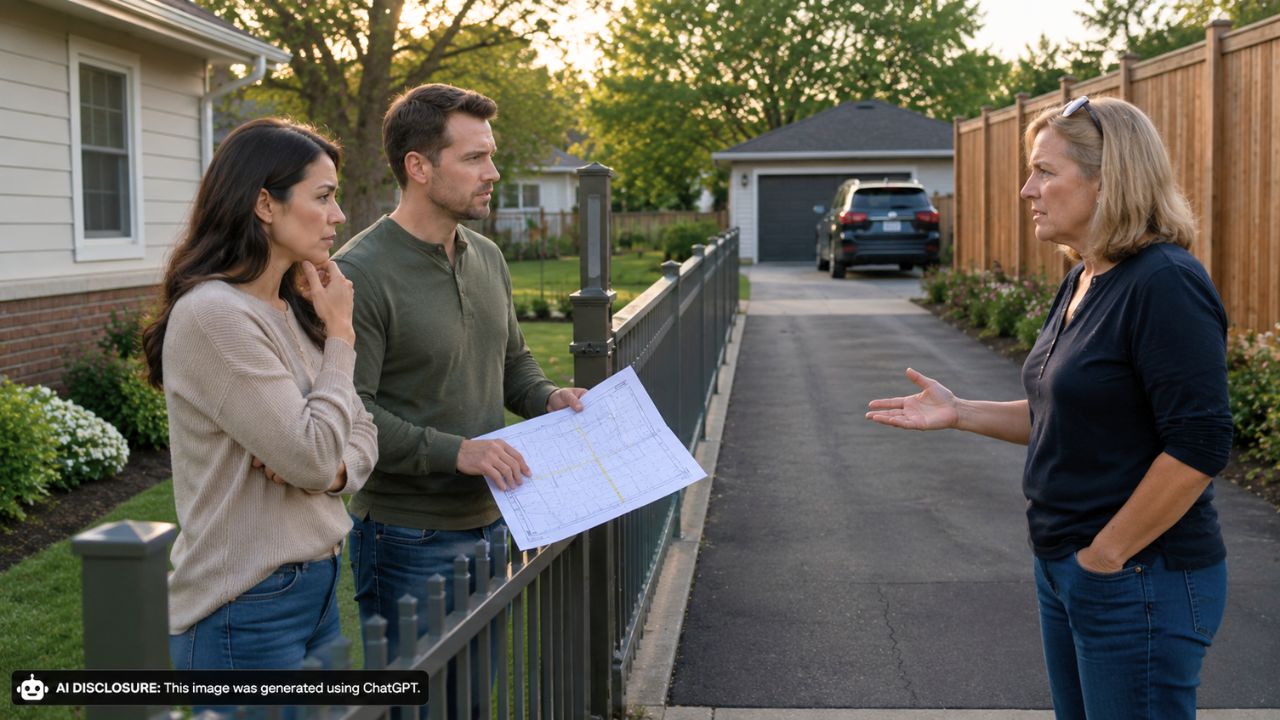
Photo credit: AI-generated image created using ChatGPT. Illustrative only.
It’s one thing to discover a fence is a few inches off. It’s another to learn an entire paved driveway—solid, obvious, and used every day—was poured on the wrong side of the property line.
That’s the bind one homeowner described in the original post: surveyors came out and disclosed that the neighbor’s paved driveway sits completely on the homeowner’s property. The twist is what makes it feel like a trap—this homeowner also needs that same driveway to reach their own land.
When the survey doesn’t match the “way it’s always been”
The homes involved go back decades, with the house built in the 1980s. That matters, because long-running property arrangements have a way of turning into “facts” in a neighborhood, even when they aren’t supported by a deed or a map.
A driveway is especially sticky. It’s not like a portable shed you can drag back over a line after a disagreement. Pavement signals permanence. It suggests someone paid money, ran equipment, and made a choice that was meant to last.
So when a survey says the whole thing is on the wrong parcel, it doesn’t just correct a drawing. It rearranges everyone’s sense of what belongs to whom.
The discovery that should feel like a win… until it isn’t
At first glance, a driveway on your land sounds like leverage. Many homeowners would read that as, “So I can make them move it,” or “So I can block it,” or “So I can charge for it.”
But the homeowner’s immediate question wasn’t about punishment. It was about access. They said they “actually do need access” to their property via that driveway.
That flips the whole emotional math. If you rely on the same strip of pavement that technically shouldn’t be there, you’re not just holding a card—you’re holding a card you might need to play against yourself.
“Can I claim equal usage rights?” sounds simple, but the ground is messy
The homeowner asked whether they can claim equal usage rights now that the driveway is confirmed to be on their side. It’s the kind of question that comes from trying to keep peace while still protecting yourself.
Because even if the pavement sits on your parcel, real life doesn’t reset overnight. The neighbor has likely been driving on it as if it’s theirs, possibly for years. The driveway likely connects to the neighbor’s garage or parking area. It may also be the most practical way—maybe the only way—for the homeowner to reach a portion of their own lot.
That’s where these property-line surprises get expensive, fast. The issue isn’t just “who’s right.” It’s what happens the first time someone gets mad and decides to change the daily routine: a parked car that blocks passage, a new gate, a row of boulders, or even just a quiet refusal to allow access.
And once a shared pathway becomes a point of conflict, every mundane thing attached to it becomes a question. Who maintains it? Who’s liable if someone slips? Who gets to repave, plow, patch holes, or decide where water drains?
The practical fear: access is priceless until it’s interrupted
The homeowner’s biggest pressure point is also the most relatable one: you can’t use land you can’t reach. A back section of a lot can be “yours” on paper and still feel unusable if the only workable route is tangled up in a neighbor dispute.
Driveways aren’t just convenience—they’re access for deliveries, emergency vehicles, contractors, and sometimes basic daily living. If the paved route is the path you need for your own property, then any change to its availability hits your schedule, your wallet, and your safety.
That’s why this kind of discovery can land like a quiet panic. You’re suddenly aware that a routine you rely on is built on an arrangement no one formally wrote down, and it only works as long as both households keep cooperating.
And cooperation is fragile when one party hears, “That driveway is not even on your land.” Even a good neighbor might feel embarrassed, defensive, or blindsided—especially if they paid to pave it or were told long ago it was fine.
What readers tend to focus on: paperwork, not driveway drama
Even with only a few lines shared, the question the homeowner asked points to the kind of responses these disputes usually draw: don’t treat it like a casual neighbor chat until you understand what you’re looking at.
When property lines and long-used paths collide, people tend to push for documentation: the survey itself, any plat maps, and anything from the closing paperwork that hints at an easement or shared access. The goal isn’t to “win” a driveway argument at the fence line. It’s to avoid making a move that accidentally creates a bigger problem later—like giving permission in a way that undermines your position, or escalating a dispute that cuts off your own access.
There’s also a practical reason commenters often lean hard on getting things in writing: driveways outlive friendly relationships. Neighbors move. Families inherit homes. A verbal “sure, you can use it” can evaporate the moment a new owner shows up with a different attitude.
So the instinct from experienced homeowners is typically to slow down and treat the driveway like what it is now: a piece of infrastructure serving two parties, sitting in the wrong place, with real consequences if either side gets impulsive.
A driveway can be a boundary marker—or a fuse
This homeowner is standing at an uncomfortable intersection of rights and reality. On one hand, the surveyors disclosed the neighbor’s paved driveway is fully on the homeowner’s property. On the other hand, the homeowner needs that same driveway to reach their own land, which makes any “take a hard line” approach risky.
It’s the kind of standoff that can stay quiet for years, until a trigger appears: a refinancing, a sale, a new fence project, a contractor needing access, or even just someone deciding to widen the drive or add landscaping along the edge. Suddenly the old assumptions don’t hold.
For now, the homeowner’s question—whether they can claim equal usage rights—captures the uneasy middle ground a lot of people end up in. They don’t necessarily want a war over pavement. They want guaranteed access, clear boundaries, and a way to live on their property without wondering if tomorrow’s commute down the driveway will turn into a confrontation.
And that’s what makes this kind of discovery so tense: the pavement isn’t moving today, but the meaning of it already has.
Like Fix It Homestead’s content? Be sure to follow us.