Three Months After Moving In, New Homeowner Watches the Neighbor Mow Three Feet Into the Yard — Then He Claims the Property Survey “Documents Are Wrong”
Photo credit: AI-generated image created using ChatGPT. Illustrative only.
Three months into owning a new place, the homeowner thought they were settling into the normal rhythm of yard work and getting to know the block. Then they pulled into the driveway and saw something that made their stomach drop: the next-door neighbor was mowing several feet past the fence line and into their grass.
In the original post, the homeowner describes how the neighbor didn’t treat it like an accident, either. When asked what he was doing, he claimed that strip of yard actually belonged to him—and that the fence had been “placed incorrectly years ago.”
The first sign was easy to brush off
The homeowner says it started small, the way these things often do. Soon after moving in, the neighbor began making comments about the fence between the two yards. Nothing explosive at first—just little remarks that suggested the fence wasn’t in the right place.
He also implied there was some sort of prior agreement, telling the new owner that the previous homeowner had supposedly agreed to move it. For someone still unpacking boxes and learning the quirks of a new house, it’s the kind of talk you might file away as neighborhood grumbling.
But those early comments had a direction. They weren’t about paint, upkeep, or replacing a panel. They were about where the property line “really” was.
Then came the moment the mower crossed the line
The day it turned from awkward to serious was simple and visual: the homeowner came home and saw the neighbor mowing about three feet into their yard. Not trimming along the fence. Not reaching over with a weed-whacker. Actually cutting a wide strip on the other side as if it was part of his regular route.
When confronted, the neighbor didn’t back down or act confused. He told them that section belonged to his property and repeated the claim that the fence had been wrong for years.
That’s the part that rattles people—because mowing isn’t just mowing in a dispute like this. It’s a message. It says, “I’m treating this like mine,” in a way that’s hard to ignore and even harder to undo without it turning into a face-to-face fight.
The paperwork said one thing, the neighbor said another
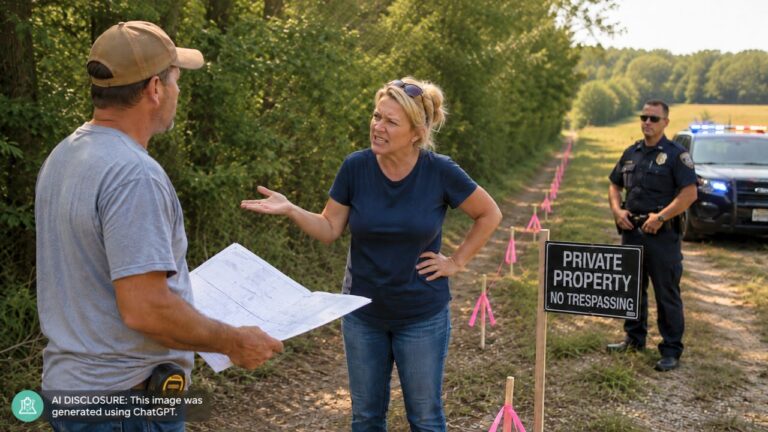
The homeowner did what most people would do after a shock like that: they pulled out the property survey from when they bought the house. In their telling, the survey clearly shows the fence line exactly where it currently sits.
So they showed him. End of story, right? Not in this yard.
The neighbor’s response was blunt: he claimed the documents were wrong. He also insisted “everyone on the street knows the boundary is different,” as if neighborhood lore overrides a survey tied to a home purchase.
After that, the comments kept coming. The neighbor reportedly kept saying the homeowners were using “his land,” and that the fence would have to be moved “eventually.” It wasn’t a one-time complaint anymore; it became a repeating drumbeat every time they were outside.
It stopped being about grass and started feeling personal
Property line disputes get under your skin because your yard is the part of home you share with the world. It’s where you walk the dog, grill, garden, let kids play, and wave to passing cars. Once the boundary itself becomes contested, even a normal afternoon outside can feel like you’re being watched.
The homeowner describes that exact shift. The neighbor began staring at the fence “like he’s measuring it.” That kind of behavior turns a simple fence into a daily stress trigger.
And it creates practical pressure. If you’re new to a home, you’re still building routines and budgeting for fixes you didn’t see coming. Suddenly you’re wondering if you need to pay for another survey, move landscaping, or prepare for a drawn-out argument every time a mower starts up next door.
Even if nothing else happens, the uncomfortable part is the uncertainty—whether the neighbor is just talking, or if he’s going to keep pushing the line with more mowing, edging, or attempts to “maintain” the strip as if possession is nine-tenths of the law.
When neighbors weigh in, they tend to focus on proof and patterns
In homeowner stories like this, the reactions from other homeowners tend to land in the same place: don’t rely on handshake history, and don’t let repeated behavior become the new normal. When someone insists the documents are wrong and “everybody knows” a different boundary, people often hear a warning siren—not because the claim is automatically false, but because it’s the kind of claim that can spiral if it’s never challenged.
A common theme in these disputes is documentation. When one person is mowing into the other’s yard and making repeated statements that the land is theirs, it stops being a misunderstanding and starts looking like a deliberate pattern.
That’s also why the homeowner’s detail about the survey matters. It’s not just a piece of paper tucked into a closing folder; it’s the thing that sets the baseline for what the buyer believed they were purchasing. When a neighbor tries to overwrite that with street consensus, it’s a recipe for a long standoff—especially if the neighbor is comfortable escalating in small, deniable steps.
Living next to a boundary dispute changes the whole feel of the house
The hardest part for this homeowner isn’t the three feet of grass. It’s the day-to-day tension. It’s stepping outside and feeling like the fence line is under surveillance, like every weekend chore could turn into another comment about “your” yard being “his” yard.
And it’s the mental math that starts creeping in: if the neighbor believes the fence is wrong, what’s next? Does he start pushing for the fence to be moved? Does he begin treating that strip like it’s his to landscape? Does he claim there was an old agreement the new owners must honor?
The homeowner’s survey shows the fence where it is now, but the neighbor is acting like that proof doesn’t count. That leaves the new owners in the exact spot nobody wants to be: forced to think about boundaries, paper trails, and escalation when they should be thinking about the fun parts of a new home.
For now, the fence hasn’t moved. But the neighbor’s mower already did—and that’s what makes this kind of dispute so hard to shake. Once someone starts acting out their version of the property line in plain sight, the tension doesn’t stay at the edge of the yard. It follows you back to the porch.
Like Fix It Homestead’s content? Be sure to follow us.