New Homeowner’s Surveyed Fence Draws a Threat From the Neighbor Over an Old Dock Stake — Then She Produces a Far Older Survey to Dispute the Line
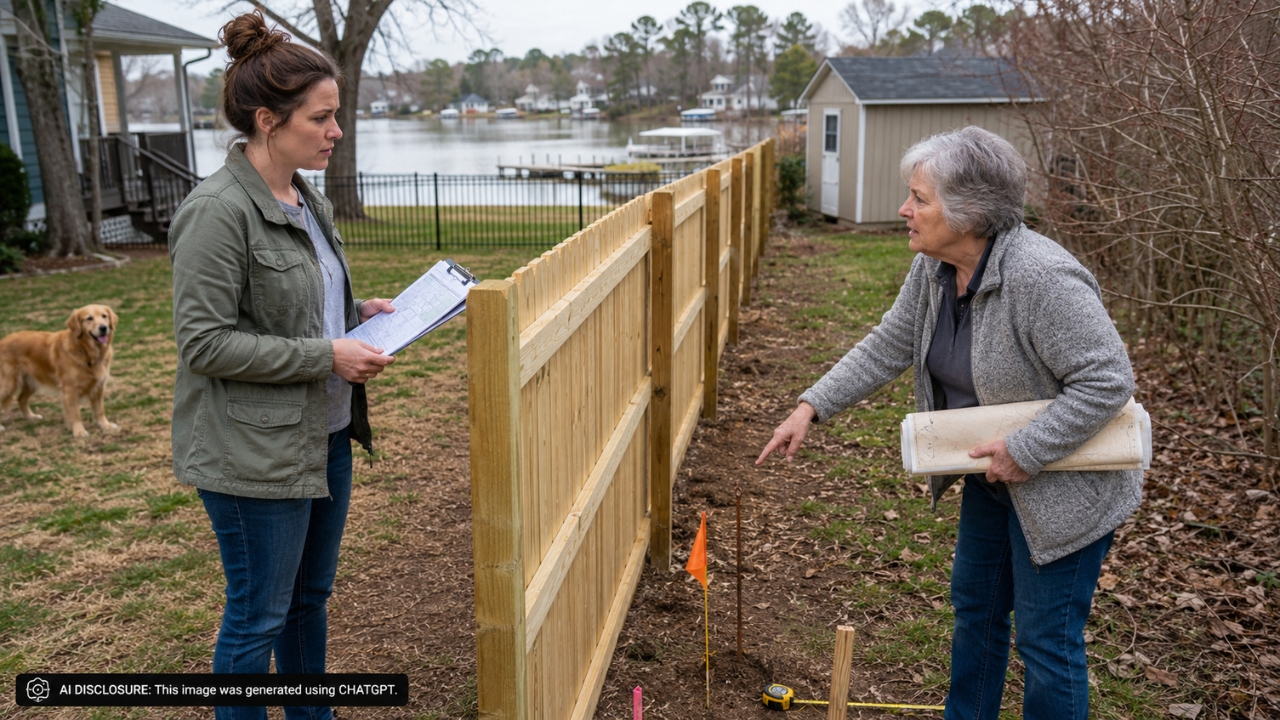
Photo credit: AI-generated image created using ChatGPT. Illustrative only.
You can do everything “right” as a new homeowner and still end up staring at a fence line like it’s a crime scene. That’s where one North Carolina buyer found herself after closing on a house in June 2023, paying for a survey, and putting up a fence so her dog could finally run free.
Five months later, a neighbor who’d been there for decades came over with a very different story: the fence was allegedly encroaching on her yard by as much as 1–5 feet, depending on which part of the line you believed. The details—and the stress—are laid out in the original post, where the homeowner asked what to do when someone insists your brand-new fence is suddenly on the wrong side of history.
A brand-new fence meets a decades-old memory
The homeowner’s confidence started with paperwork. She’d had a survey done before any posts went into the ground, the way you’re supposed to when you don’t want surprises later. The fence went up, life settled in, and then the knock came.
The neighbor wasn’t pointing to a fresh stake set by a surveyor last week. She was referencing an old dock and a metal stake left in the ground from some earlier owner’s fence—basically a relic that, in her mind, marked the “real” border. If that old stake was the true corner, the new fence would be 3–4 feet over.
And it didn’t stay polite. The neighbor reportedly threatened her over encroachment, and the neighbor’s granddaughter escalated it further by warning about “property damage” if the fence were moved—despite the homeowner saying she wanted to keep things friendly and was already trying to sort it out.
When the neighbor says, “My survey is older,” the clock starts ticking
The neighbor said she’d share her survey, and the homeowner expected it to be “much older” than hers. That’s the kind of detail that can rattle a new owner fast, because it carries an unspoken implication: “We’ve always known where the line is. You’re the new person.”
But older doesn’t automatically mean correct, and a metal stake in the dirt doesn’t automatically mean it’s a legally meaningful monument. In the meantime, the practical problem was immediate: there was now a fence, a dog using the yard, and a neighbor making threats.
The homeowner’s first instinct was the one most people wish everyone would choose: bring it back to documentation. She contacted her surveyor and asked him to come back out and re-walk the property line, with the neighbor present. It hadn’t been scheduled yet, but she was trying to get both sides looking at the same ground at the same time.
A “eureka” measurement mistake changes the mood
Then the homeowner did something that happens to a lot of us under stress: she went back to the measurements. She reviewed her survey and realized she’d made an error when checking distances herself—measuring 10.8 feet from the deck instead of from the foundation.
That sounds small until you’re arguing over feet. When she went back outside and measured again, she realized she had two more feet beyond her fence. In other words, the fence line that felt “too close” under pressure suddenly looked like it had breathing room after all.
And in the middle of that realization, another detail snapped into focus: the neighbors had recently built “a fancy new shed” right on the property line. When tempers run hot, it’s rarely only about a fence. It’s about who feels watched, who feels boxed in, and who thinks they can push first.
From property line argument to permit questions
Once the shed entered the picture, the homeowner took a step that can change neighbor dynamics overnight: she went to County Zoning and asked what was required for the structure. What she found wasn’t a simple “everything’s fine.”
According to her update, the neighbors didn’t have permits and may have built the shed in an area where they weren’t allowed to build. That kind of discovery turns a one-way accusation into a two-way problem. Suddenly, the person making demands might have their own exposure if code enforcement gets involved.
The homeowner also mentioned plans to install a new camera aimed toward the neighbors, framing it as a Thanksgiving “generous” mood. In real life, cameras aren’t about generosity; they’re about documentation. When someone is throwing around words like “property damage,” you start wanting timestamped proof of what happens near your fence line.
“Show me proof”—and the line in the sand she finally drew
After the initial panic and the measurement re-check, the homeowner’s position hardened. She decided to have her surveyor come back out, but she wasn’t going to treat the neighbor’s threats as a reason to immediately rip out and move the fence.
Her final stance was blunt: the neighbors can pay for their own survey, and if she’s wrong—then and only then—she’ll move the fence back. The point wasn’t stubbornness. It was refusing to reward intimidation.
That’s the emotional core of these disputes. A fence can be moved. A relationship can sometimes be repaired. But once one side learns that threats get results, the rest of the shared property line becomes a long-term pressure point.
The practical reactions focused on documentation and staying calm
The homeowner’s actions tracked with the most common real-world advice people give in boundary fights: stop arguing in the yard and start collecting facts. She reached out to the surveyor who already did the work, asked for a line walk with both parties present, and started checking her own measurements carefully so she wasn’t leaning on a misunderstanding.
On the escalation side, she also moved toward visible deterrence—cameras—and toward official channels by visiting zoning. That’s a fork in the road that many homeowners recognize: you can either keep it neighbor-to-neighbor and hope it cools down, or you can make it a record. Once it’s a record, people often behave better—or they get angrier because they can’t control the narrative anymore.
In this case, the tension wasn’t only about where the fence sat. It was about the implied threat that someone might damage the fence (or claim damage), and the uneasy discovery that the neighbor’s own recent construction may not have been as buttoned-up as they wanted to appear.
For now, the homeowner is still waiting for the cleanest reset button in these disputes: a surveyor on-site, walking the line, with both neighbors watching. Until then, she’s doing what many new homeowners learn faster than they expected—treating a simple fence as something you may one day have to defend with paperwork, photos, and a very steady voice.
Like Fix It Homestead’s content? Be sure to follow us.