Los Angeles Homeowner’s House Sits Two Feet From the Side Property Line — Then the Neighbor Widens His Driveway to the Line, Sending Tenants’ Cars Past the Windows Daily
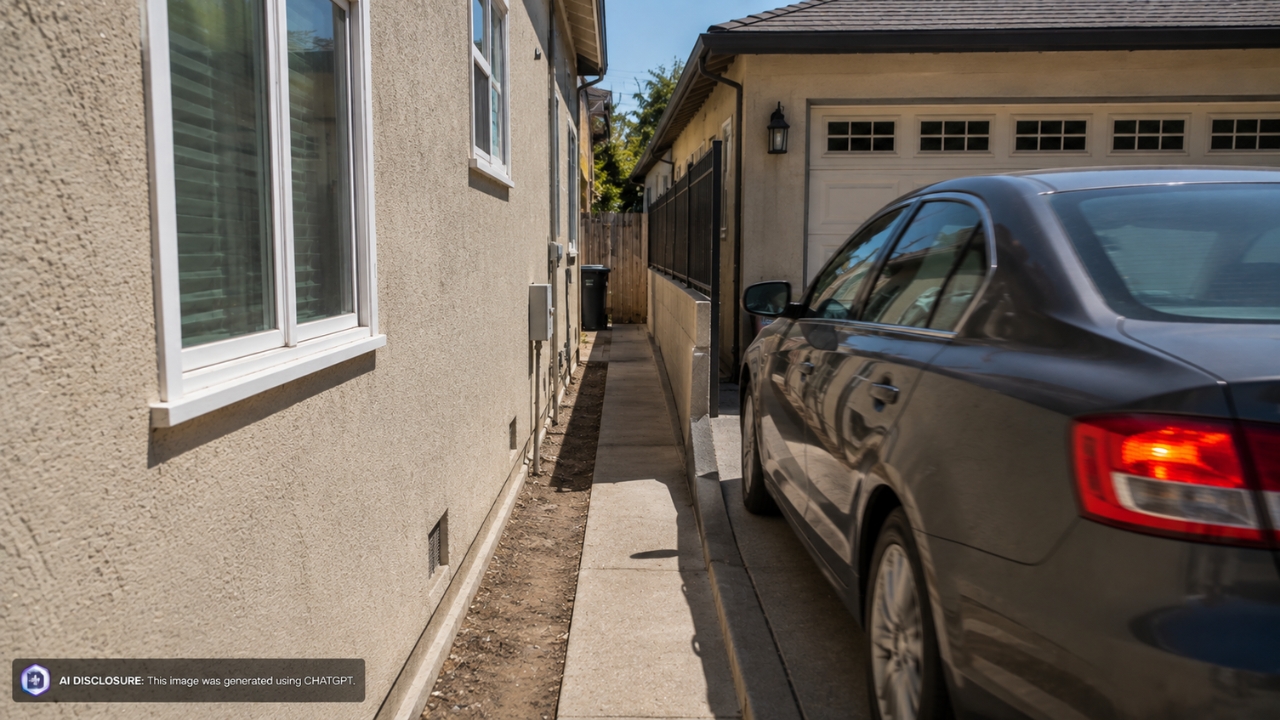
Photo credit: AI-generated image created using ChatGPT. Illustrative only.
In a lot of older Los Angeles neighborhoods, houses don’t sit politely centered on their lots. They sit where they sit—sometimes so close to a side boundary that you can practically touch the fence from your window. That’s the backdrop for a homeowner who realized their “normal” two-foot side gap had suddenly become a daily drive lane.
In the original post, the homeowner explained that their house was built “right on the side property line,” leaving about two feet between the home and the side boundary. Their neighbor recently widened an existing side driveway all the way to that line, and now the neighbor’s tenants drive directly alongside the homeowner’s windows every day. The homeowner’s question was simple and loaded: are there setback rules that prevent a driveway from being paved right up to the property line?
Two feet feels like nothing when cars start using it
That skinny strip along the side of an old house usually reads as dead space. Maybe it’s where you keep a hose, where leaves collect, where a side gate squeaks. It’s not “yard,” exactly, but it’s also not supposed to be traffic.
Once a driveway widens, that strip becomes something else: noise, headlights, exhaust, and the sense that strangers are suddenly moving through your personal space. When the cars are passing right beside bedroom or living room windows, it stops feeling like a property-line technicality and starts feeling like a daily intrusion.
The change wasn’t just paving—it was the way it shifted the whole property
The homeowner didn’t describe a brand-new driveway appearing out of nowhere. This was an existing side driveway that got widened. That detail matters because it suggests the neighbor already had a vehicle path—and then decided to push it right up to the edge.
In practical terms, widening a driveway can also change how people use it. Tenants might drive faster when the lane feels more forgiving. More vehicles may start using it because it’s easier to navigate. And if it now runs tight to the homeowner’s windows, the homeowner is left absorbing the consequences without having agreed to anything.
Even if the pavement itself never crosses the line, the lived experience can still feel like an encroachment: the “new normal” is cars inches from glass, every day.
When cars run next to windows, the worries multiply fast
This isn’t only about privacy. A driveway that hugs a house can bring a grab bag of headaches that don’t show up on a plat map.
Noise is the first one people notice—engines starting, doors slamming, music, conversations. Then come the visual hits: headlights sweeping across rooms at night, backup lights, people looking right into windows because they’re suddenly right there.
After that, homeowners tend to start thinking about the stuff that’s harder to measure. If a vehicle clips the edge of something—fence, gate, a window well—who pays? If a driver loses control, it’s not a hedge they hit. It’s your wall. And even without a dramatic crash, constant vehicle traffic can mean dust, grit, and exhaust collecting right where your windows and screens are trying to do their job.
There’s also drainage. Paving changes how water moves. If the neighbor’s widened driveway sheds water toward the homeowner’s side, that two-foot gap can turn into a channel, pushing runoff where it never used to go. On older houses, that’s how you end up with damp smells, peeling paint, or worse problems hidden behind stucco and trim.
The homeowner’s main question: are there driveway setbacks?
The post honed in on one key point: whether a driveway can be paved right up to a side property line in Los Angeles, especially when it results in vehicles traveling extremely close to an adjacent structure.
That’s the tightrope with old lots. The house placement may be nonconforming by today’s standards, but it’s still legal because it was built that way. Meanwhile, the neighbor’s improvements may be legal too—or they may require permits, drainage plans, or specific rules about where paving can go.
From a homeowner’s perspective, “Is it allowed?” is also shorthand for “Do I have any leverage?” If there’s a clear rule, the next steps are more straightforward. If it’s allowed, the choices get harder: live with it, negotiate, or invest in your own mitigation like window coverings, sound dampening, or barriers—none of which feels fair when you didn’t cause the change.
What people pushed: verify lines, verify permits, document everything
Posts like this tend to bring out a very specific kind of neighbor-war wisdom: don’t start with accusations, start with proof. The first thing many homeowners in similar disputes focus on is confirming exactly where the property line is, because fences, hedges, and “everyone’s always done it this way” don’t always match recorded reality.
The next instinct is usually permits. When a neighbor widens a driveway, that can be a simple improvement—or it can involve required approvals depending on grading, curb cuts, drainage, impermeable surface limits, or how close work gets to structures and boundaries. If the work was permitted, there may be a paper trail that answers the setback question quickly. If it wasn’t, that opens a different door.
And then there’s documentation. When cars are passing close to your windows daily, people tend to recommend cameras pointed at your side yard and the drive lane—not to escalate, but to create an objective record. If a mirror clips a window screen, if someone bumps a gate, if runoff starts pooling, it’s a lot easier to address with timestamps than with a vague “it’s been happening.”
Why this kind of property-line problem is so hard to “unsee”
The maddening part is that the homeowner’s house didn’t move. The neighbor’s driveway did. But the impact lands on the person whose home is already constrained by that old-school placement, with windows facing the narrow side gap.
Even if everyone stays polite, the day-to-day friction is baked in. Tenants come and go. Driving habits differ. The homeowner’s routine shifts because now they’re thinking about curtains in the afternoon, whether the window is open, whether the dog will bark, whether a visitor will park there and idle.
And it’s not just lifestyle. A narrow setback between structures and a traffic lane raises the stakes for maintenance. Washing windows, painting trim, cleaning gutters, checking for termites along the edge—those were already awkward in a two-foot strip. Add regular vehicle movement and it becomes a space you may avoid, which is exactly where small home problems like moisture damage and pest activity can quietly grow.
For this homeowner, the question wasn’t asked out of curiosity. It was asked because the widened driveway turned a sliver of side space into a daily reminder that on tight LA lots, one neighbor’s “upgrade” can feel like another neighbor’s loss of peace.
Like Fix It Homestead’s content? Be sure to follow us.