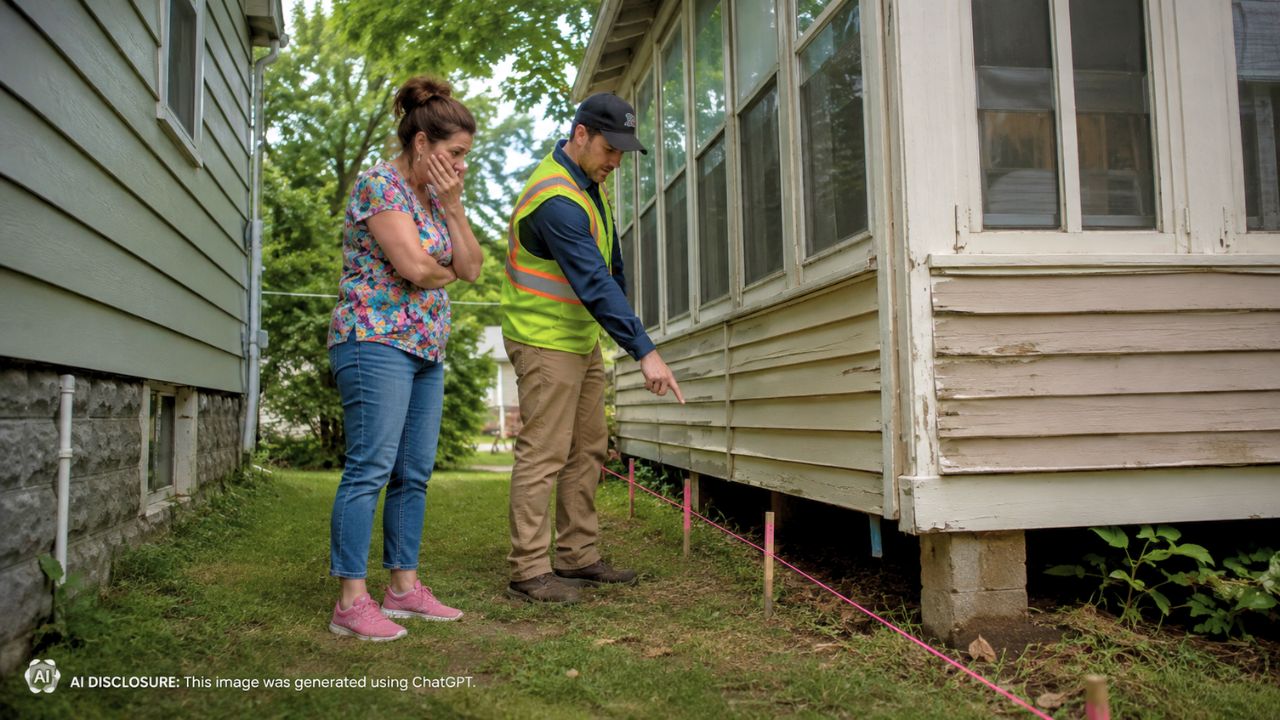
Pittsburgh Homeowner’s New Survey Reveals a Neighbor’s Home Addition Sits on Her Property — Then Learns the Encroachment Is Likely Forty to Fifty Years Old, Predating Both Families’ Ownership
Photo credit: AI-generated image created using ChatGPT. Illustrative only.
A homeowner in Pittsburgh thought they were doing the responsible thing: get a fresh property boundary survey, know exactly what you own, and move forward with peace of mind. Instead, the paperwork delivered the kind of surprise that can make your stomach drop—part of the neighbor’s house addition appears to sit on her land.
In the original post, she explained that this wasn’t some noisy new build that popped up overnight. The structure is an “existing home addition,” and her best guess is that it’s been there 40 to 50 years. It likely predates her ownership, and may even predate the neighbor’s current ownership, though the neighbor’s house has been in the same family for generations.
The survey didn’t just find a line—it found a building
Most people order a boundary survey expecting small discoveries: a fence that’s a little off, a shed that’s too close to the line, maybe a neighbor’s landscaping that drifted over time. This was different. A survey showing an actual portion of a home addition on your parcel isn’t a “move the fence six inches” kind of problem.
And because it’s a permanent structure, it can quietly affect everything tied to a property—future selling, refinancing, home equity loans, and even the basic question of where one homeowner’s maintenance responsibility ends and the other’s begins.
The homeowner’s question was simple and very practical: what can be done to remedy it? But anyone who’s owned a house long enough knows “remedy” can mean a lot of things, and not all of them are realistic once decades have passed.
When it’s 40–50 years old, the past starts owning you
The detail that changes the whole tone is the age. If the addition really has been there for four or five decades, the problem isn’t just physical—it’s historical. Over that kind of time, paperwork gets lost, verbal agreements turn into “that’s how it’s always been,” and people stop seeing the boundary at all.
That age also hints at why it might have happened. Older additions weren’t always built with the same level of permitting, surveying, and oversight homeowners expect today. A family building onto a house decades ago might have relied on a handshake understanding of where the line was, or an assumption based on a fence, a tree row, or the way the yard was mowed.
Now the current homeowner has a modern survey saying one thing, and a very old building saying another. And unlike a stray fence, you can’t just “fix it this weekend.”
This isn’t only about land—it’s about leverage and liability
Encroachments get tense because they turn neighborly life into a question of rights. If part of the neighbor’s addition is on her property, the homeowner has to think about what happens if she does nothing. Does ignoring it weaken her position later? Does it complicate her title? Does it become her issue to disclose when she sells?
There’s also the everyday, unglamorous side: maintenance and access. If the addition is over the line, who maintains siding, gutters, or a foundation edge that technically sits on someone else’s land? If repair work is needed, do contractors step onto the homeowner’s parcel to do it? What if there’s water runoff, grading issues, or a future basement problem tied to that addition?
Then there’s the emotional pressure. It’s one thing to dispute a hedge. It’s another to look at a neighbor’s home—something deeply personal and expensive—and realize part of it is in your yard on paper, even if the yard doesn’t feel like “yours” in that spot anymore.
The “remedy” could be paperwork, money, or a fight nobody wants
The homeowner didn’t describe any direct confrontation yet—just the discovery and the worry. That’s often the stage where people freeze, because every path forward feels like it could explode the relationship next door.
One outcome people immediately think of is removal. But if the addition is truly decades old, tearing it out is rarely the first option anyone reaches for, even when the survey is clear. The cost, disruption, and hostility can be enormous, and it’s hard to imagine a neighbor reacting calmly to being told part of their home has to go.
More commonly, long-standing encroachments get resolved with paperwork that matches reality: adjusting boundaries, granting an easement, or reaching an agreement that clarifies rights and access. But those options can involve legal fees and—importantly—require cooperation. If the neighbor’s home has been in the family for generations, they may feel blindsided, defensive, or convinced the survey must be wrong.
And even if both sides want to keep things civil, the age of the structure raises another complicated question: whether time itself has changed what each party can reasonably demand. A 40–50-year-old addition can come with a very different set of legal and practical expectations than something built last summer.
Reactions leaned toward documenting first and moving carefully
When homeowners share stories like this, the most common reaction isn’t “storm next door and demand answers.” It’s a quieter, more careful instinct: protect yourself with documentation before you say anything that can’t be unsaid.
In cases like this, people tend to focus on the basics that keep a bad surprise from turning into a permanent problem: keeping copies of the survey, understanding exactly what the survey shows (and whether it’s a boundary survey versus a different type), and being deliberate about any communication. A casual conversation can be fine, but once words like “my land” and “your addition” hit the air, the tone can change fast.
There’s also a practical reason people hesitate to go in hot. If the neighbor’s family has been there for generations, emotions can run deep—and so can assumptions. What feels like a clean, factual discovery to one homeowner can feel like an accusation to another.
The hardest part is living next to the problem while deciding what to do
This homeowner is stuck in an uncomfortable in-between: the survey says the boundary is one place, but the neighborhood has been living with a different reality for decades. That gap creates pressure, because doing nothing feels risky, but doing something feels like it could light a fuse.
In Pittsburgh—where lots can be tight, homes are old, and additions were sometimes built in another era—this kind of surprise isn’t impossible. What makes it so unsettling is that it lands on the current owner’s lap, even though she didn’t cause it and may not have had any way to see it coming before a survey.
For now, all she knows is what the survey revealed: part of the neighbor’s addition appears to be on her property, and the structure likely predates both families’ current ownership timelines. That’s the kind of discovery that turns a simple homeownership “to-do” into a long-term decision—one that has to balance paperwork, money, and the reality that you still have to live next door when the conversation is over.
Like Fix It Homestead’s content? Be sure to follow us.