Rural Landowner Finds Trouble on a Shared Driveway Easement Crossing Train Tracks — Then a New Neighbor Starts Making Demands About the Cows
Photo credit: AI-generated image created using ChatGPT. Illustrative only.
Living down a dirt road in rural Texas usually means you get used to mud, animals, and the occasional mess that comes with being far from town. What this landowner didn’t expect was that the real headache would start on the shared driveway—right where it crosses the train tracks and splits three ways.
In the original post, the homeowner describes a setup that worked fine for years: multiple properties tied together by a shared driveway easement, with everyone understanding that cattle and country living come as a package deal. Then the neighbor next door sold and a new owner moved in. That’s when the “normal enough” introduction turned into a string of demands, threats, and texts about everything from trash to cattle guards to cow manure.
A driveway easement that runs through somebody’s yard
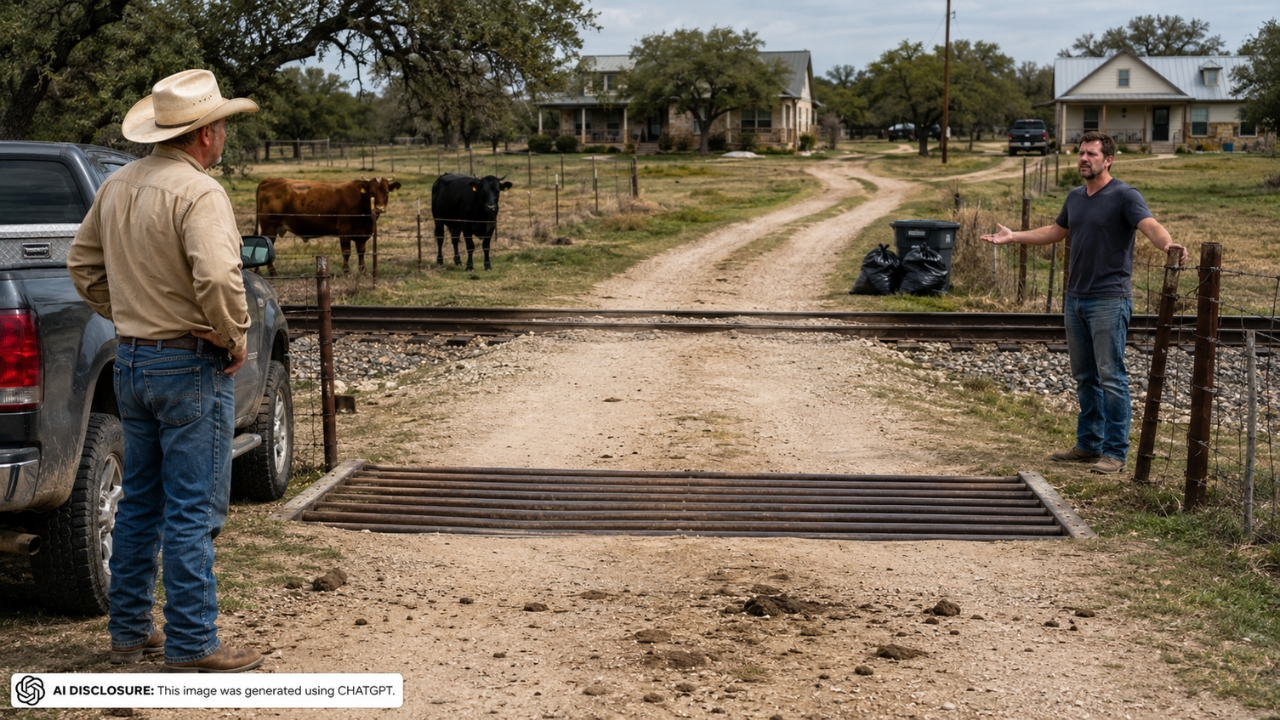
The layout matters here, because the access is the leverage. The homeowner’s place sits down a dirt road, then down a shared driveway that crosses train tracks, then splits toward three homes. To reach their house, they have to drive past a neighbor’s home “through their yard” on the easement.
When they moved in, everyone on the driveway had cows, and cattle were allowed to roam between the properties. That kind of informal agreement is common in rural areas—until it isn’t, and then every gate, fence, and strip of gravel starts to feel like a legal document.
A few years earlier, the previous owners next door decided they were done dealing with cattle. In response, a cattle guard was installed on the fence right at the property line, half on each side. It didn’t cause problems, and it fit the new reality: the poster still had cows, the neighbor didn’t, and the guard helped keep everyone from constantly chasing animals around.
The first blow-up wasn’t about cows at all
The new neighbor’s first big issue wasn’t livestock—it was trash. She put multiple trash bags at the end of her driveway, and a dog belonging to an older neighbor down the road got into them overnight, leaving garbage scattered across the shared driveway.
The landowner says this wasn’t some shocking surprise out there. They’d already tied their own trash can to a fence for a reason, and they explained that even if dogs were contained, animals in the country will find a way into loose bags. They even offered to help clean up and offered practical options, like switching to a trash company that provides a large can or setting posts so her trash could be tied off.
But the new neighbor didn’t treat it like a “country problem.” She treated it like a person problem—and decided it was the dog owner’s fault.
Trash on the driveway turned into a standoff
According to the post, the neighbor looked the dog owner up online, found his phone number, and called him about the mess. The older man came over, cleaned up, and even gave her a metal cage to secure the trash.
It still didn’t solve the underlying issue: animals got into the trash again. More garbage ended up along the shared driveway—except this time the new neighbor refused to pick it up. The homeowner says it sat for nearly two weeks before they finally said something.
Instead of taking ownership of the mess in front of her house, the neighbor questioned them about what kinds of animals were even out there, “as if she didn’t believe” them. Then she shifted into what the poster describes as a legalistic mode—talking about getting other neighbors involved and drafting a new agreement for the easement.
That’s the moment a lot of rural homeowners recognize: the problem is no longer the trash. It’s the person who wants to rewrite the rules of the road.
Then came the texts about manure and “cow country”
The tension escalated after a rough moment with a calf. The homeowner explains they were tagging the ear of a new baby cow when the tool got stuck. The calf struggled, the ear tore, and the animal panicked and ran off. They couldn’t catch it and decided to give it overnight to calm down.
Somewhere in that scramble, the calf apparently left manure in the neighbor’s yard. The new neighbor texted asking “how can we prevent this in the future,” adding that she “doesn’t want everyone’s cows pooping on her property just cuz this is cow country.”
By then, the homeowner had started ignoring the messages, worried that every reply was going to be used as ammunition. In rural neighbor disputes, casual texts can turn into screenshots and “agreements” real fast, especially when one party is already talking about lawyers and new rules.
The cattle guard became the next target
After the manure complaint, the neighbor moved on to the cattle guards. She claimed the guards on the shared driveway were illegal and said she would have the one at the beginning of the driveway removed—even though, as the homeowner notes, it isn’t near her property.
Then came the bigger threat: a text declaring the homeowner had 15 days to remove “our” cattle guard from “her” property—referring to the guard installed along the fence line that sits half on each property.
To the landowner, that demand felt detached from the reality on the ground. The guard wasn’t new, it wasn’t hidden, and it was put in when the previous neighbors were still living there, back when there was no hostility about it. In other words: it wasn’t a surprise feature that showed up after she bought the place.
But now it was being framed as a trespass and a deadline. And when a neighbor starts issuing deadlines about shared infrastructure, the fear isn’t just “Will she complain?” It’s “Will she try to remove something that controls animals and protects the property line?”
How commenters steered the conversation: proof, paperwork, and staying boring
Even without diving into courtroom hypotheticals, the practical theme that tends to dominate these disputes is documentation. When a shared driveway easement crosses multiple properties, the paper trail matters more than anybody’s memory of “how it’s always been.”
Many readers pushed the same basic idea: pull the deed records and easement language, confirm exactly what’s allowed, and treat the cattle guard like a property improvement that needs clear boundaries. People also tend to recommend keeping communication in writing, staying calm, and not getting pulled into arguments over text.
On the homestead side, the unspoken advice is also about prevention. If someone is threatening to remove a cattle guard, homeowners often start thinking about cameras, dated photos, and keeping installation details—anything that helps establish when it was put in and where it sits relative to the line.
The landowner’s approach so far has been to cut off contact and stop feeding the back-and-forth. That’s a survival instinct in a neighbor dispute, especially when access to your home depends on the same strip of driveway the neighbor wants to “renegotiate.”
For now, nothing is resolved. The cows are still there, the driveway is still shared, and the new neighbor’s demands are getting more specific and more time-sensitive. Out in the country, you can fix a torn fence post in an afternoon. Fixing a neighbor who wants to rewrite the unwritten rules is the kind of project that drags on for months.
Like Fix It Homestead’s content? Be sure to follow us.