Texas Landowner Watches a Creek Behind His Home Fill With Dumped Concrete From the Neighbor’s Truck Business — Then Fifty Yards of Blocked Drainage Floods an Acre of His Land Three to Four Feet Deep
Photo credit: AI-generated image created using ChatGPT. Illustrative only.
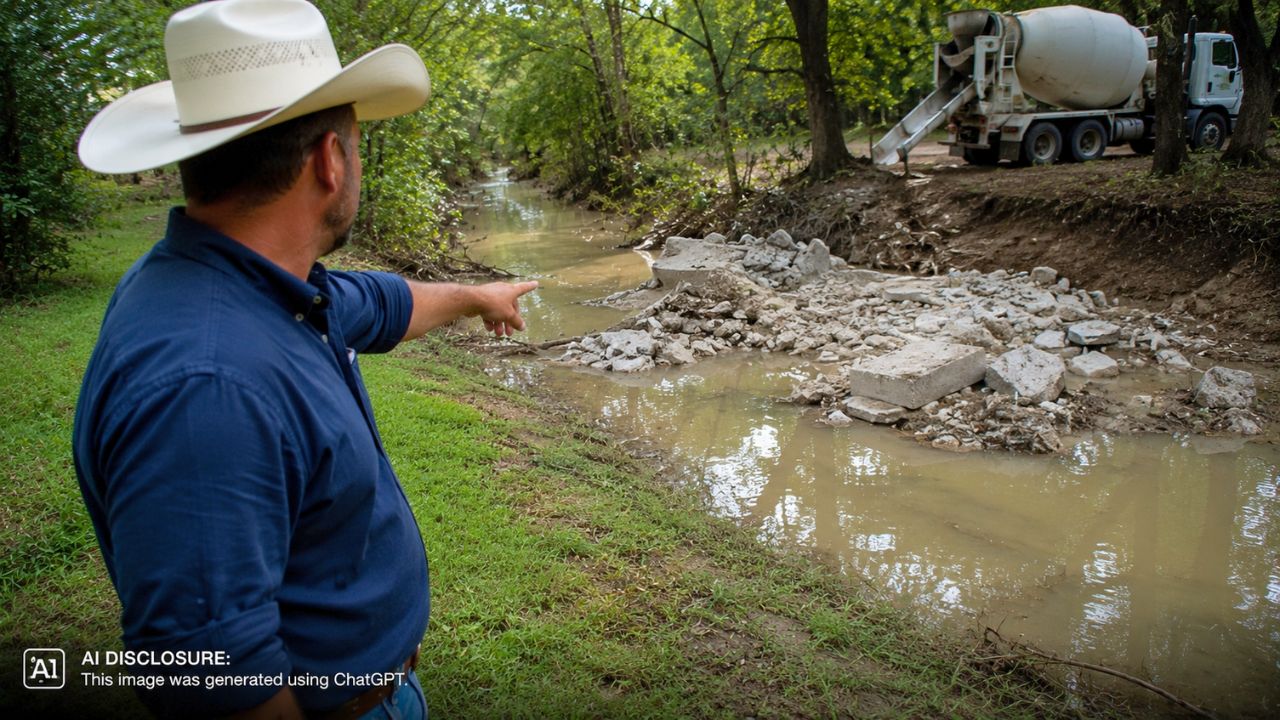
It started behind the house, where most people barely look until something feels off. A creek and drainage ditch that used to carry rainwater away was quietly being packed with chunks of dried concrete, dumped a load at a time until the channel nearly disappeared.
In a post asking for help, a friend of the landowner described how the neighbor—who works on concrete mixing trucks from home—had been breaking out hardened concrete from the trucks and disposing of it directly into the creek bed. The details and photos were shared in the original post, along with a blunt question: if the county won’t help, who will?
The creek didn’t “erode”—it got filled in
This wasn’t a natural clog from storm debris or a beaver dam that can be cleared in an afternoon. The material described is heavy and unnatural for a drainage channel: chunks of broken concrete, added repeatedly until the ditch was “almost all the way” filled.
The fill wasn’t limited to a single spot, either. The blocked section was described as running close to 50 yards, long enough to turn a moving drainage path into a backed-up basin whenever it rains. And once a creek is treated like a dump site, it doesn’t take many storms for everything upstream to start paying the price.
When the rain came, the water had nowhere to go
The result, according to the post, is the kind of flooding rural landowners dread because it doesn’t just show up—it stays. Rainwater now piles up behind the blockage and spills out, covering more than an acre of the homeowner’s land.
The reported depth isn’t minor nuisance flooding, either: three to four feet of standing water. That’s deep enough to swallow low fencing, wash out soft ground, and make parts of a property unusable for long stretches. The water reportedly stops only about 25 yards short of the home, close enough that every storm becomes a watch-and-wait problem.
Worse, the water isn’t draining away after the storm. The friend says it can sit for months at a time, turning a patch of land into a stagnant pond and changing everything from soil stability to pest pressure.
The damage isn’t just muddy grass—it’s dead trees and long-term loss
Standing water is brutal on mature trees that weren’t meant to live with drowned roots. The post claims the flooding has already killed 30 to 40 large trees on the property, and those dead trees don’t stay harmless for long.
They become expensive to deal with and risky to leave in place. Cutting down large dead trees isn’t like trimming branches; it’s time, equipment, and often professional help if they’re near structures or power lines. Even if the homeowner does the work himself, it’s still a dangerous, exhausting job created by someone else’s dumping.
And the loss goes beyond cleanup. Trees that took decades to grow are part of what makes acreage livable—shade, privacy, wind protection, and just plain value. Once they’re gone, they don’t come back quickly.
The hardest part: the homeowner can’t get the right door to open
The person asking for help said the landowner is an immigrant with very basic English and computer skills, which makes the paperwork side of a drainage fight feel like a second full-time job. He contacted Collin County, but after almost a year, there hadn’t been follow-up or meaningful help.
That’s the part that makes these property problems spiral: even when the physical cause looks obvious, getting an agency to act can be slow. Meanwhile the land keeps flooding, more trees die, and the homeowner is left watching damage accumulate while he waits for someone with authority to show up.
The friend writing the post made a point to describe him as someone who built his home with his own hands on five acres—someone not looking for drama, just trying to protect what he worked for. With the creek blocked, though, the land is taking the hit every time it rains.
People zeroed in on documentation and enforcement, not small talk with the neighbor
The responses to the post leaned practical: focus on proof, keep records, and look for the right enforcement route rather than trying to argue it out in the yard. When a drainage channel is altered and dumping is involved, casual conversations can turn into denial fast—especially if the neighbor’s business operations depend on continuing as-is.
Commenters also pointed the poster toward reading material and websites—tools the friend could use to help the landowner navigate the process when language and tech skills make it hard. The tone wasn’t “deal with it”; it was more like, “there are ways to push this forward, but you need a paper trail and the right agency.”
That instinct makes sense because the physical evidence is time-sensitive. Concrete fill doesn’t look like much until the creek is nearly gone, and then it becomes a permanent reshaping of the land. Photos, dates, rainfall timing, and repeated documentation can be the difference between “it’s just flooding” and “here is the obstruction causing it.”
A creek behind your home is easy to ignore—until it becomes a wall of water
This is one of those homeowner problems that doesn’t feel real until the water line is visible and the ground stays wet long after the storm passes. The landowner isn’t describing a minor drainage swale; he’s describing a creek and ditch system that used to work, then was filled with broken concrete until it effectively stopped functioning.
And once water starts pooling for months, it changes the property’s day-to-day life. It can block access, soften soil around trees, and turn routine mowing and maintenance into a stuck-tractor headache. It can also invite mosquitos and other pests that thrive in standing water, adding another layer of misery on top of the damage.
The friend who posted wasn’t asking for a fight—he was asking for a path forward that doesn’t require the landowner to navigate civil court alone. In the meantime, the flooding keeps coming, the trees keep dying, and that blocked creek sits behind the home like a problem nobody wants to claim.
Like Fix It Homestead’s content? Be sure to follow us.