New Landowner Finds a Deck the Neighbor Built Fifteen Years Ago Extending Onto the Property — Then the Neighbor Says Tearing It Down Now Would Be “Excessive”
Photo credit: AI-generated image created using ChatGPT. Illustrative only.
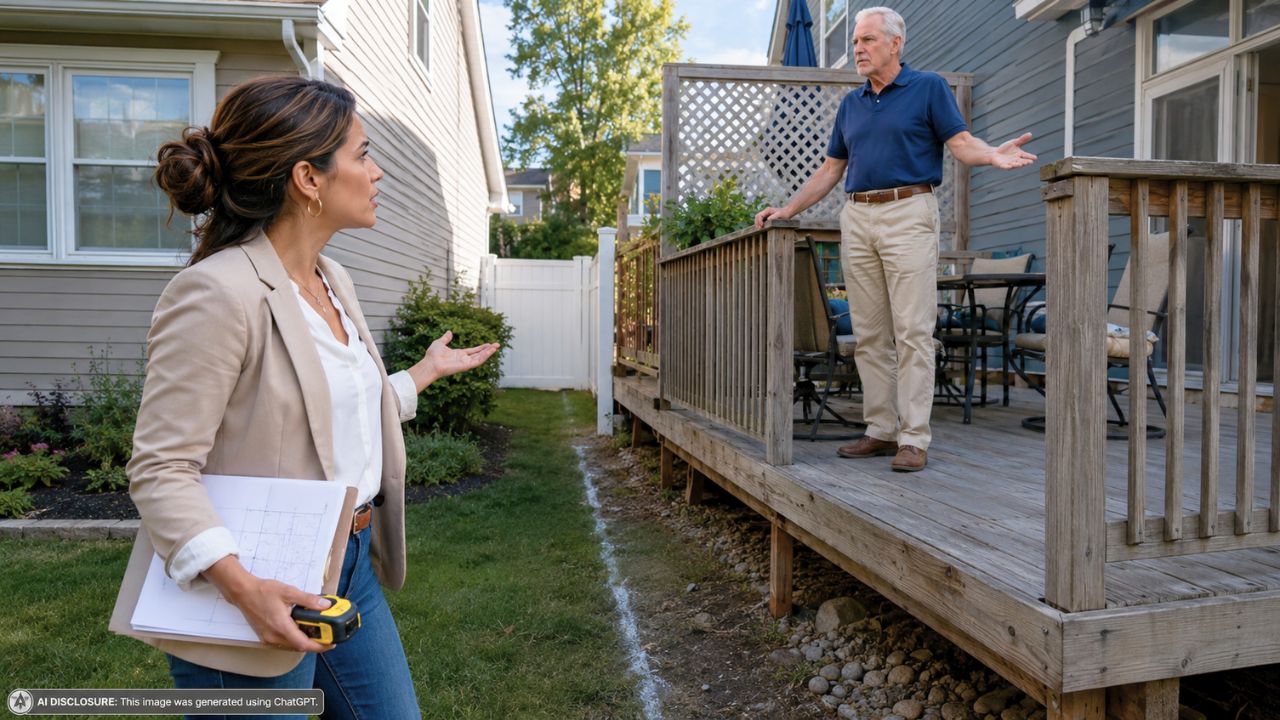
It started as one of those “we’ll deal with it later” homeowner discoveries: a back-deck corner that wasn’t actually sitting where everyone assumed it was. A Georgia homeowner in an HOA learned that the neighbor behind them had built a deck that extended a few feet into their backyard—something the homeowner didn’t even know until the neighbor brought it up after getting a survey for an appraisal.
The details came from the original post, where the homeowner laid out how a decade-old build turned into a present-day standoff the minute repairs and rebuilding entered the picture. The neighbor had been friendly at first. But once that deck started rotting and a rebuild was planned, “friendly” became “let’s just keep it the same size.”
The first sign was easy to brush off
The neighbor didn’t hide the issue. During an appraisal about a year earlier, he had a surveyor map the original property lines and then told the homeowner the deck was partially on the homeowner’s land. At the time, it landed during the pandemic, and the homeowner was already juggling trees and landscaping problems.
So the response was basically: we’ll circle back later. It’s a normal move. Nobody wants to pick a fight when life is already messy, and the deck wasn’t changing day-to-day.
But property line problems don’t stay frozen in time. They just wait for the next trigger—like construction.
A rotting deck turned a boundary question into a deadline
A year later, the homeowner needed improvements near that shared edge of the yard. At the same time, the neighbor’s deck was “unsafe and falling apart,” and he was planning to rebuild it. That’s when the homeowner tried to reset the boundary the cleanest way possible: rebuild it, but pull it back to the real line.
The neighbor’s response was basically that the deck had been that size for years and he wanted it to stay that way. The homeowner didn’t want confrontation, but the timing mattered: a rebuild isn’t maintenance. It’s the moment when “we’ll deal with it later” turns into “we’re locking this in for another decade.”
And once a new structure goes up, it’s not just awkward. It can become expensive to undo.
It wasn’t just about a few feet of wood
Even in a friendly HOA, the homeowner could see the snowball forming. If part of the deck was on their land, what happens when someone gets hurt? Who’s responsible if the structure fails? How does that look to insurance, a mortgage company, or the HOA if there’s ever a dispute?
The homeowner also worried about something many people don’t think about until they’re staring at it: whether a long-standing encroachment creates rights for the neighbor over time. They asked if the neighbor had “already acquired some right to a piece of my backyard” because the deck had been there for so long.
In other words, this stopped being about being nice. It became about making sure the homeowner didn’t accidentally sign up for permanent problems by doing nothing.
Neighbors pushed proof, paperwork, and a calm spine
In the discussion around the post, the through-line wasn’t “go start a war.” It was more practical: know exactly where the line is, document what you know, and don’t let a rebuild happen in the wrong place just because it’s easier in the moment.
That mindset—proof before confrontation—matched the homeowner’s goal. They weren’t looking to punish anyone. They wanted the neighbor to rebuild safely, but on his own property, and to leave behind something clear so this wouldn’t keep resurfacing.
The homeowner’s own thinking also shifted toward clarity. They started talking about a physical demarcation—“a fence or some barrier of trees”—so the property line wasn’t just something on a survey page. It would be visible, obvious, and harder to ignore.
The conversation changed when “liability” entered the room
After getting “this huge wealth of information,” the homeowner went back to the neighbor for a direct talk. The neighbor said he would rebuild because the old deck was unsafe and falling apart. But he still didn’t like the idea of losing any deck size.
This is where the homeowner picked a strategy that kept the temperature lower: they used “liability” as the reason. Not anger. Not control. Just the simple fact that if someone gets hurt, the person whose land it’s on could get dragged into it.
The neighbor pushed back hard. He insisted that his family “isn’t like that,” and argued that even if he trespassed and broke his leg on the homeowner’s property, the homeowner would still be liable, so “it doesn’t matter where his deck is from a liability perspective.” The homeowner described it as “blah blah,” but the key part was what came next: they didn’t budge.
Standing firm didn’t require shouting. It just required not getting talked out of the boundary.
Drainage claims, a moving threat, and the worry he’ll try something sneaky
Once it was clear the homeowner wasn’t folding, the neighbor pivoted. He said he “may just sell the house and move” because he didn’t want a tiny deck. It’s the kind of line that lands like a guilt trip: look what you’re making me do.
Then came a bigger accusation: a grading issue, with water from the homeowner’s yard flooding into the neighbor’s basement and causing damage. That can be a serious claim in any neighborhood, especially where lots were engineered to shed water in specific ways.
The homeowner’s response was steady: bring in a landscaper and a lawyer to look at it. The neighbor backed down. To the homeowner, that read like someone testing for leverage—and dropping it when they realized it wouldn’t work.
By the end, the homeowner felt the neighbor “didn’t have a leg to stand on,” but also admitted a realistic fear: he might still “try something sneaky.” That’s what makes these property line disputes so exhausting. Even when the facts are clear, the stress isn’t over until the build is done, the boundary is respected, and there’s something physical on the ground—fence, trees, or another clear marker—so the same problem can’t quietly creep back.
The homeowner left it on a note that will sound familiar to anyone who’s ever had to defend their space without turning it into a feud: it’s amazing how different a conversation goes when you’ve done your homework and you know the facts are on your side.
Like Fix It Homestead’s content? Be sure to follow us.