Homeowner Sets Up a New Backyard Shed — Then the Neighbor Storms Over Screaming and Hands Over a List of Demands, Including Moving It Twenty Feet to Restore Her View
Photo credit: AI-generated image created using ChatGPT. Illustrative only.
It started as one of those backyard upgrades that feels almost too perfect: a free shed, a little elbow grease, and a plan to finally keep a few chickens without blowing the budget. The homeowners in Georgetown’s extra-territorial jurisdiction in Texas hauled home a disassembled 7x7x8 shed—“if you can move it you can have it”—stacked the pieces in their garage, and spent a few days putting it together.
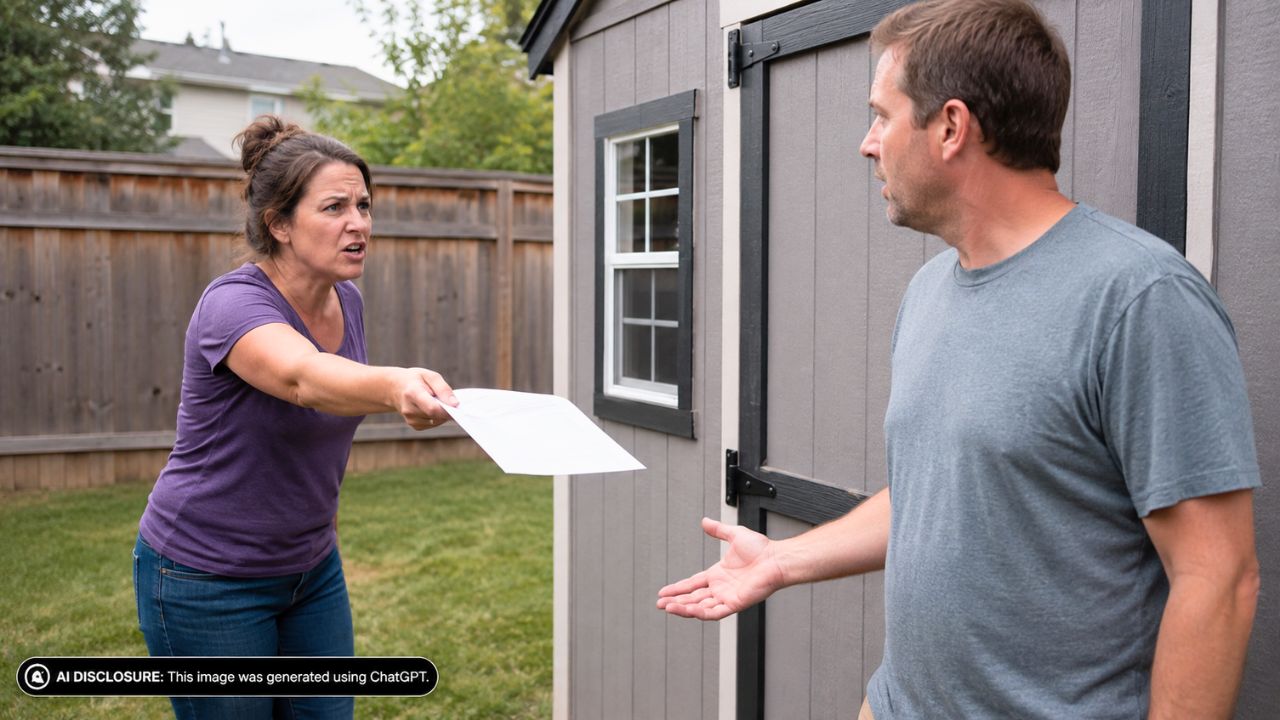
Then, just days after it went up, the neighbor marched over—screaming—handing the wife a list of demands with a countdown clock attached. In the original post, the homeowner describes being given 36 hours to comply or the neighbor would contact local government to have the shed removed.
A free shed turns into a 36-hour ultimatum
The shed wasn’t a fancy prefab kit or a poured-slab project. It was basic plywood and 2x4s, assembled in the yard and intended to help them start a small chicken setup. But to the neighbor, it was suddenly an emergency requiring a rapid response.
Her requirements were specific and immediate: move the shed at least five feet away from her fence, shift it at least twenty feet down the fence line so she could “regain the view she had before,” and even angle the structure so the sloped roof wouldn’t send rainwater toward her fence or yard.
The timeline is what made it feel less like a normal neighbor gripe and more like a threat. The homeowner notes the shed is at least 1,200 pounds—something that would take several people and the right tools to relocate even a few feet—let alone reposition and re-angle within a day and a half.
It wasn’t just about the shed—it was about chickens
The neighbor didn’t stop at placement and drainage. She also told them local laws require any structure to be at least five feet from the property line and claimed it was illegal for them to raise chickens on their property.
After the confrontation, the homeowner dug into the paperwork and found deed restrictions dating back to 1997. One line jumped out: “No animals or fowl shall be raised, bred or kept on any Lot other than common household pets, which may be kept on a strictly non-commercial basis.”
What made that feel surreal is the homeowners’ description of the neighborhood reality: half-acre lots, no HOA, and “at least a dozen houses” nearby with chickens anyway—along with other apparent violations. The poster even says they can see multiple deed violations on the complaining neighbor’s property, including a chain-link fence, a broken car parked for over a year, and what they describe as another shed sitting within five feet of their own property line.
Drainage and “my view” arguments can get expensive fast
If you’ve lived next to someone long enough, you know how quickly the argument can shift from “please” to “prove it.” The neighbor’s list mixed practical concerns (water runoff) with subjective ones (“restore my view”), and those aren’t equal in how they’re treated in the real world.
Runoff is the kind of detail that can snowball if it’s real. Water hitting a fence line can rot wood, erode soil, and create muddy spots that start as an annoyance and turn into a recurring complaint. But in this case, the neighbor tied it to her dogs getting messy, which the homeowner seemed baffled by.
The “move it twenty feet so I can see what I used to see” part is what many homeowners recognize instantly: some neighbors treat the space around them like it’s theirs, even when it’s not. Views are emotional currency in suburbia, and once that door opens, every new structure becomes a referendum on who gets to decide what the backyard looks like.
Deed restrictions, enforcement, and the messy reality of “rules nobody follows”
The homeowners admitted they didn’t do everything “by the book,” including not pulling a building permit for the shed—something they’d never heard of needing for a chicken coop. But they also pointed out the uneasy truth that a lot of neighborhoods run on: rules exist on paper, while daily life runs on what people tolerate.
That’s why their questions focused on enforceability. If a restriction hasn’t been enforced in almost 20 years, can someone suddenly decide it matters now? Does it matter that other neighbors have chickens and other violations? Could a selective complaint trigger action even if the neighborhood has been treating the restriction like a dead letter?
They also worried about what happens if local authorities do get involved. Even if the shed placement is wrong, would they be given time—something like 30 days—to correct it, rather than being forced into an impossible 36-hour scramble?
And there was a wild card: another neighbor mentioned getting a “variance” for chickens, which the homeowner couldn’t find online. That detail hints at a confusing overlap many homeowners trip over—deed restrictions versus county/city ordinances versus ETJ rules. One can be private, one can be public, and they don’t always line up.
Commenters pushed proof, paperwork, and not getting cornered
When homeowners share stories like this, the practical voices tend to show up fast. The consistent theme is usually: stop arguing in the yard and start building your folder. When a neighbor is already using deadlines and threats, a friendly chat can turn into “he said, she said” with zero paper trail.
People in these discussions often urge homeowners to verify the property line and setbacks instead of trusting what an angry neighbor announces at the fence. If the “five feet from the property line” rule is real in that jurisdiction, knowing it early changes everything—especially before you invest more time and money into a coop, run electrical, or add a foundation.
Another common push is to separate the issues: a shed placement question is one thing; the chicken question is another. And deed restrictions aren’t automatically enforced by local government the way building codes are. That distinction matters when someone threatens to “contact local government entities” as if every private restriction is a code violation with an inspector ready to act.
Now the shed is up—and every next step feels like a trap
The homeowners were left in the worst part of a neighbor dispute: the moment when the project is finished enough to be visible, but not settled enough to feel safe. Moving a 1,200-pound shed isn’t a quick favor—it’s labor, logistics, and risk of damage. Doing it under pressure makes it more likely something breaks, someone gets hurt, or the structure twists and never sits right again.
At the same time, ignoring the neighbor entirely risks escalation. A call to code enforcement or a complaint about setback violations can trigger inspections, letters, and deadlines that cost more than just shifting a shed a few feet. And once chickens enter the picture, every sound and smell becomes another opening for conflict.
What they wanted was simple: a modest backyard setup and a little self-sufficiency. What they got was a reminder that in tight neighborhoods—even on half-acre lots—one structure in the wrong spot can turn into a power struggle overnight, with “my fence,” “your roof,” and “my view” becoming the new daily vocabulary.
Like Fix It Homestead’s content? Be sure to follow us.