New Neighbor With a Deeded Easement Locks the Gate to Block Access Entirely — Then Trespasses to Pull the SD Card From a Trail Camera and Imposes His Own Speed Limit on the Road
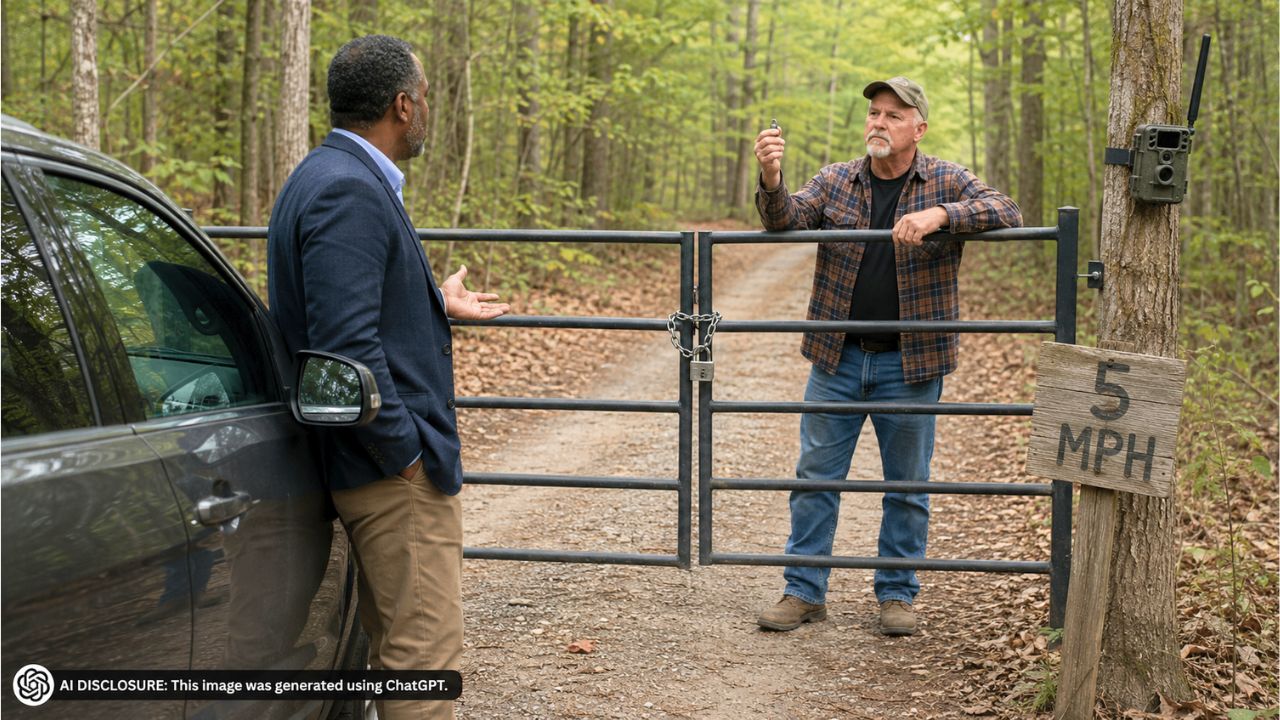
Photo credit: AI-generated image created using ChatGPT. Illustrative only.
You don’t expect the first big surprise on your own land to be a padlock you didn’t put there. But that’s what greeted one landowner when they arrived at property they’re planning to build on—only to find the access gate locked by a brand-new neighbor whose land the driveway crosses.
In the original post, the landowner explains they have a deeded ingress/egress and utility easement through the neighbor’s property. They’re not living on the land yet, but they’ll need consistent access soon for contractors, deliveries, and all the everyday traffic that comes with building. Instead, they’re getting threats, a key handed over after a phone call, and a neighbor who appears to be treating the easement like his personal driveway.
Showing up to a locked gate is a different kind of wake-up call
The poster describes “several contentious run ins” with the new neighbor, but the gate was the moment things turned from awkward to unworkable. They arrived and found the gate locked “to keep me out,” even though their right to use the road is written into the property arrangement.
After calling, the neighbor did provide a key. That solved the immediate problem of getting in that night, but it didn’t solve the bigger one: the neighbor had already demonstrated he was willing to physically block access whenever he felt like it.
For someone who isn’t living on-site yet, that’s a terrifying preview. Construction schedules don’t care about interpersonal drama. If a concrete truck can’t get through, or a contractor shows up and can’t enter, the landowner is the one burning money and goodwill.
The easement wasn’t the only boundary that got crossed
The same neighbor problem spilled over into another area of rural life: trail cameras. The poster says the neighbor went onto their land and pulled the SD card from one of their cameras because it was aimed toward a creek the two properties share “1/2 ownership of.”
The neighbor’s reasoning, as relayed by the poster, was that he worried the camera “may have caught him and his wife swimming in the buff.” Instead of knocking on the door, asking about the camera’s angle, or requesting it be moved, the neighbor allegedly took the direct route—crossing onto someone else’s property and removing the card.
What makes that detail stick is the casualness of it. The poster notes the neighbor “did not offer to replace the chip or anything of the sort.” It’s not just a privacy concern at that point. It’s a pattern: taking matters into his own hands, literally, and leaving the landowner to absorb the cost and the uncertainty of what else he’ll do.
Then came the threat: follow my rules or I’ll lock you out
The poster says that the night of the gate incident, the neighbor added a new condition: he was “imposing a speed limit on the easement road.” The message wasn’t framed as a request or a safety conversation. It came with teeth.
If the landowner didn’t follow that limit, the neighbor said he would lock them out.
That kind of threat hits differently when the road isn’t a friendly shared driveway, but the only practical access route to a build site. It’s also the sort of thing that escalates fast, because it mixes two volatile categories: property rights and day-to-day control. Even if the landowner drives carefully, the neighbor has already shown he’s willing to create a new “rule” and enforce it with a padlock.
And once contractors are involved, it’s not just one driver. It’s subs, deliveries, utility work, inspectors, and anyone else who needs to get in and out without calling a neighbor for permission.
The practical fear isn’t the gate—it’s the domino effect during a build
The landowner says they already made an appointment with a lawyer “to fix this,” which tells you how seriously they’re taking it. They also make their own position crystal clear: “I do not want a gate, a lock or anything that will stop people I need to do work from being able to do that work.”
That’s not stubbornness. It’s logistics. A gate with one key can turn into a constant point of failure—someone forgets it, someone loses it, a worker arrives early, a delivery shows up late. The landowner becomes the middleman for access to land they own and have legal rights to reach.
Even worse is the uncertainty. A neighbor who has already locked it once can lock it again, change the lock, or decide the key is “lost” whenever there’s a disagreement. And a neighbor who was comfortable taking a trail camera SD card is signaling that boundaries are optional when he feels justified.
All of it creates a kind of background pressure that’s hard to describe unless you’ve lived rural: the feeling that you can’t just quietly work your own land without someone else inserting themselves into the routine.
How readers reacted: document everything, stop negotiating at the gate
The poster ends with a blunt question—“Am I the asshole here?”—but the tone of the write-up isn’t someone looking to win an argument. It reads like someone trying to prevent a full-scale access war before construction begins.
In these kinds of property disputes, the most practical public advice tends to be less about revenge and more about leverage: keep records, keep communications clear, and don’t let “informal rules” replace written rights. A neighbor who escalates to locks and threats is unlikely to de-escalate because of a calmer conversation in the driveway.
And the SD card detail adds another common theme people latch onto: proof. Cameras, photos, timestamps, and a paper trail aren’t about being petty; they’re about protecting yourself when someone is willing to cross onto your land and take things because they think their feelings override your boundaries.
The landowner already seems to be thinking that way, even if they didn’t phrase it as “documentation.” They noticed the access interference, noticed the card was taken, and recognized early that their future build depends on stable entry.
This isn’t just neighbor drama—it’s access, security, and control
What makes this story feel so tense is that it’s not one disagreement. It’s multiple pressure points stacked together: a locked gate, a forced key handoff, a trespass onto the poster’s land, a removed SD card, and a threat to use the gate as punishment for not obeying a speed limit the neighbor decided on.
The landowner can probably tolerate an annoying neighbor. What they can’t tolerate is a chokepoint—one person holding the only practical access route hostage right as a building project is about to start.
For now, they’ve got a key and a lawyer appointment, which is at least a move toward something more solid than driveway negotiations. But the tone of the post makes one thing clear: they don’t want to spend the next year building a home while also managing a gatekeeper next door.
Like Fix It Homestead’s content? Be sure to follow us.
- Man Says He Found Out the Fence He Paid For Wasn’t Actually on His Property
- Woman Says Her Neighbor Started Taking Mulch From Her Delivery Pile Before She Could Even Spread It
- I made Joanna Gaines’s Friendsgiving casserole and here is what I would keep
- What Caliber Works Best for Groundhogs, Armadillos, and Other Digging Pests?