Tennessee Landowner Finds a 70-Year-Old Walnut Tree Stump Twenty Feet Inside Her Property Line After the Neighbor’s Clear-Cut — Then He Threatens to Shoot Trespassers Even Off His Own Land
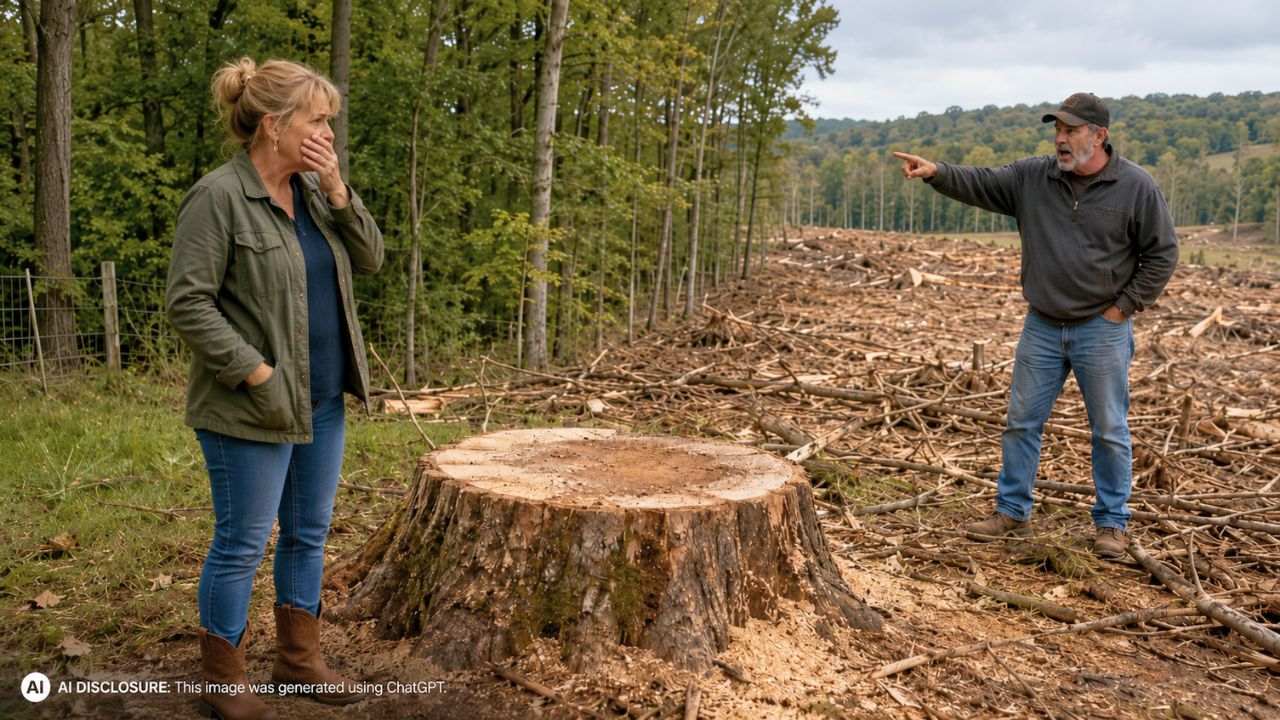
Photo credit: AI-generated image created using ChatGPT. Illustrative only.
In rural Tennessee, a property line isn’t just a line on paper—it’s where your peace and quiet either holds or falls apart. One landowner says that after a neighbor bought more than 200 acres and rushed into a clear-cut, she discovered the kind of damage you don’t unsee: a massive black walnut stump sitting well inside her side of the boundary.
Worse, she says the neighbor didn’t just brush it off. After she and her husband walked just inside their own line to check things out, the neighbor allegedly warned he’d shoot trespassers and texted her husband to stay off his property anyway. The details were shared in the original post, along with a photo showing the stump, scattered limbs, and the rough edge where the logging stopped.
A clear-cut first, a survey later
According to the homeowner, the neighbor bought the adjacent acreage and hired a logging company without getting a survey first. The logging happened a couple years ago, and only about eight months ago did a surveyor come out—after the trees were already down.
That timeline matters because property disputes are often fueled by “I thought it was mine” logic. Out in the country, where fence lines wander and old markers disappear, people make assumptions. But assumptions don’t put a 70-year-old tree back in the ground.
The homeowner says multiple trees were cut from her property, but the black walnut is the one that stings. Walnut isn’t just shade or scenery; it’s often treated like an asset, something people plan around and sometimes even pass down with the land.
The moment the damage became real: a stump 15–20 feet over
The homeowner describes finding a large stump and big limbs left behind, with the stump sitting roughly 15 to 20 feet over her property line. It’s the kind of physical proof that makes the whole thing feel less like a misunderstanding and more like a taking.
And it wasn’t near the edge by inches. Twenty feet is a full room’s length. It’s far enough that you stop wondering if someone “nicked” the line and start wondering how much else was treated as expendable during the cut.
She also notes the tree was about 300 yards from their house. That detail matters in a rural way: it wasn’t a front-yard showpiece, but it was still on their land, still part of their woods, still something they lived with and expected to keep.
Living next door to a threat changes everything
What makes this more than a tree-loss story is the fear layered over it. The homeowner says they avoided going near the boundary because the neighbor has said he will shoot trespassers. She describes it as terrifying dealing with “a person that doesn’t understand laws with a .308 rifle.”
Even after they walked just inside their own line, she says the neighbor texted her husband to stay off his property. That’s the kind of escalation that turns a normal “let’s talk it out” neighbor moment into something that feels risky and unpredictable.
On a homestead or rural parcel, you can’t always simply avoid the edge of your land. You’ve got downed trees, fence checks, erosion, invasive plants, boundary maintenance. When someone makes the border feel off-limits through intimidation, it effectively shrinks your usable property.
The walnut question: not just sentimental, potentially expensive
The homeowner isn’t presenting herself as lawsuit-hungry. She says they’re not the type to sue or make enemies with neighbors. But she also wants to know what happens next, and that’s where walnut becomes more than a memory.
She reached out to a local arborist company, hoping they can help with documentation and value. She’s waiting to hear back and asking what information an arborist typically provides once they come out.
In these disputes, that usually means turning a “big tree” argument into something measurable: species confirmation, estimated age, trunk diameter, condition before removal (as best as can be inferred), and a valuation method. With walnut, people also talk about timber value versus landscape value—because a mature walnut can be prized for lumber, but a long-standing tree can also carry value as part of the property itself.
She also asks a key practical question: is the neighbor liable for the logging company he hired? In plain everyday terms, homeowners often assume they can blame the contractor and wash their hands of it. But from the perspective of the person who lost the tree, the contractor didn’t decide where the line was—the landowner who ordered the work did, or at least had the responsibility to confirm it.
Reactions centered on proof, safety, and paper trails
The post reads like someone trying to do the “right” thing while also not putting themselves in danger. That tension tends to pull practical advice from onlookers: document everything, avoid direct confrontation, and treat the boundary like a place where you need receipts, not emotions.
When a stump sits 15–20 feet over the line, the first order of business is usually proving exactly where that line is on the ground. The homeowner already has a survey done on the neighbor’s side, but what matters is what she can obtain and use—maps, markers, flagged points, and any written survey details that establish the encroachment clearly.
Then there’s the logging debris itself. Big limbs left behind aren’t just unsightly; they can create access problems and change how the land drains and regrows. If you’re hoping to sell timber later, or even just keep the woods healthy, a messy cut line can become a long-term maintenance headache.
And hovering over all of it is the safety issue. When someone has made shooting threats part of the conversation, “just go take more photos” stops being casual advice. It becomes a question of how to gather proof without stepping into an encounter you can’t control.
A stump doesn’t rot away fast enough to fix the relationship
The homeowner’s photo description is telling: she’s standing on the property line facing their side, showing stumps and large limbs left. That’s not a person chasing drama. That’s someone trying to figure out what was taken and what’s now permanently changed.
The neighbor’s clear-cut may have happened a couple years back, but the consequences didn’t end when the logging trucks left. A mature walnut doesn’t “grow back” in any reasonable timeline. The boundary now has a scar, and the neighbor relationship has a hard edge to it.
For now, the homeowner is waiting on an arborist and trying to understand the next step—value, responsibility, and how to address a wrong without provoking someone who’s already talking like a vigilante. Out in the country, people love to say, “Good fences make good neighbors.” But sometimes, it’s the paper line—and the willingness to respect it—that decides whether anyone feels safe using their own land.
Like Fix It Homestead’s content? Be sure to follow us.