Homeowner Asks the Neighbor to Wait for a Survey Before Installing an Underground Dog Fence Along Their Shared Line — Then He Has It Installed Anyway While Avoiding Her
Photo credit: AI-generated image created using ChatGPT. Illustrative only.
It started the way a lot of neighbor problems start: a quick shout across the yard while someone is heading to work, a casual ask that doesn’t feel like it needs a meeting. A 35-year-old homeowner said her older neighbor called out to ask if he could install an underground dog fence along the long side their properties share, with the installer scheduled to come just two days later. She hesitated for one reason that tends to haunt homeowners for years—she wasn’t sure where the property line actually was.
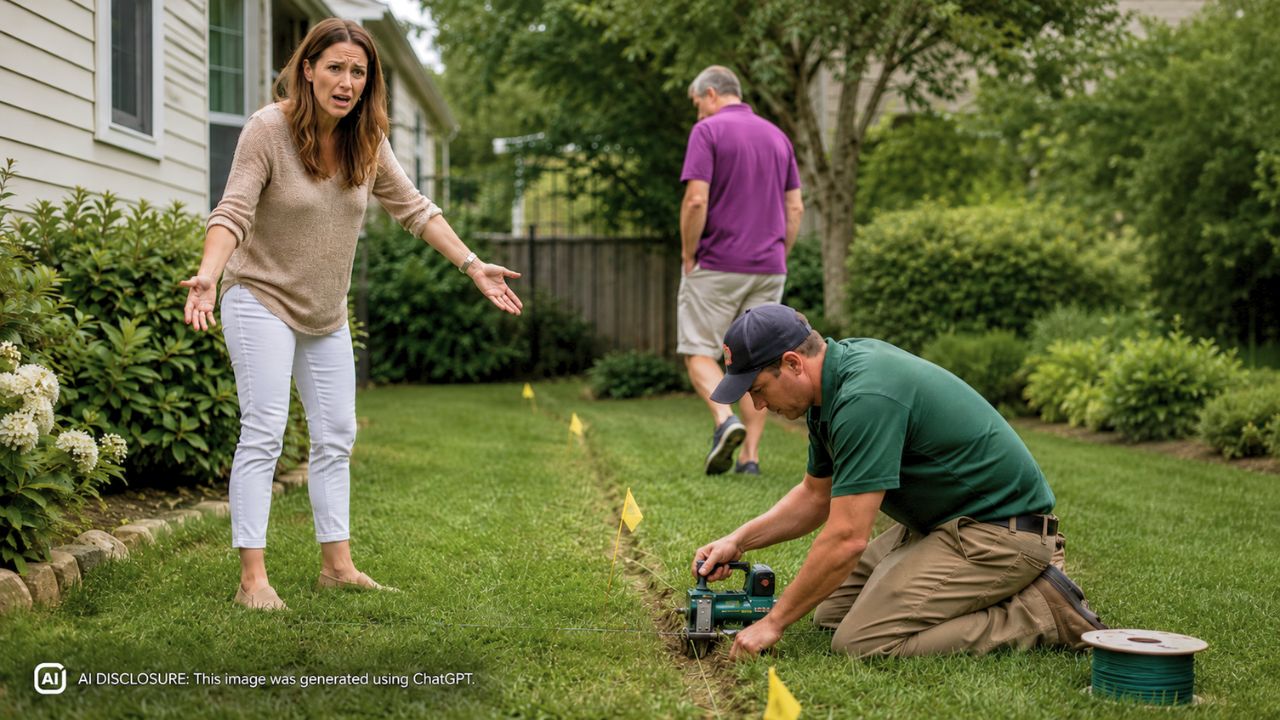
In the original post, she explained that she told him she wasn’t comfortable with either of them digging along the border until there was a survey. She even offered to start the process herself since it was something she’d wanted done anyway. He didn’t argue much in the moment, but he also didn’t reschedule. On Saturday, she heard the machine start up and realized the fence was being installed anyway—while her neighbor suddenly became hard to find.
A quick driveway conversation turned into a line-in-the-ground problem
The homeowner’s boundary concerns weren’t theoretical. She said her deed describes her yard as 50 feet by 160 feet, “essentially a perfect rectangle,” but her neighbor’s use of his yard doesn’t match that clean geometry. She described his gardens, sidewalk, chairs, and décor sitting at an angle that gradually creeps closer to her side as you walk south.
That kind of slow drift is exactly how property disputes happen without anyone meaning to start one. One season’s garden edge becomes the assumed boundary. Then a path. Then furniture. Then, in this case, a buried wire that’s supposed to mark where a dog can roam—and where it can’t.
Underground fences feel “lighter” than a physical fence because you can’t see them. But for property lines, invisible doesn’t mean harmless. Once something is installed, it becomes a fait accompli: move it and you’re the one “messing with” someone else’s property, even if it was placed wrong to begin with.
She said no—then listened to the installer show up anyway
What pushed this from mildly annoying to infuriating was the sequence. The neighbor asked if it was okay. She said she wasn’t comfortable moving forward until a survey confirmed the boundary. He acknowledged he didn’t know where the line was either, but said he’d already scheduled the installer.
When the work started, she went outside during the install—specifically when the crew reached the portion of yard that runs alongside hers. She asked where her neighbor was, but said she couldn’t get a straight answer. That’s the part that reads like a homeowner’s stomach dropping: the person who requested permission is suddenly unavailable, and the homeowner is left negotiating with a contractor who’s just trying to complete a job.
The installer told her, “well he likely owns at least a few inches off this sidewalk,” something she said she didn’t know was true. And that’s another common pressure point—someone on-site offering an offhand guess about legal boundaries, as if that makes digging okay.
The real issue wasn’t the wire—it was the pattern
By itself, an underground dog fence might seem like something you shrug off. But the homeowner said this isn’t the first time she’s felt her neighbor treated her yard like shared space. She wrote that he “consistently walks across my yard without asking,” and that he has even set up party guests on her yard before, again without asking.
That history matters because it changes what “just a few inches” means. If someone already behaves like the space is communal, a buried fence along a fuzzy border can look less like convenience and more like staking a claim. Especially when the border is the long side of both lots—lots of linear footage where “close enough” can turn into “mine” over time in everyday practice.
She also described an age gap—he’s in his 60s, she’s in her 30s—and felt that the generational divide adds friction in how they view boundaries and permission. Whether it’s generational or just personal habits, the day-to-day result is the same: one neighbor feels disrespected, and now there’s a physical installation that’s hard to ignore.
Once it’s installed, the stakes get practical fast
Property-line uncertainty isn’t just a neighborly etiquette issue. It can turn into money, labor, and long-term headaches. If that wire ends up on her property and she later wants to landscape, install her own fence, put in a shed, or do drainage work, she’s the one who has to worry about damaging someone else’s system.
Even worse, underground fences can involve more than a single line. Depending on the setup, there can be loops, splices, and sections that run wider than expected to keep the signal consistent. If any part crosses the line, fixing it later can mean paying for troubleshooting, re-trenching, and reinstalling—plus the awkward question of who pays.
And then there’s the dog. If the fence is positioned wrong and the dog thinks it can roam into her yard, she’s potentially dealing with an animal boundary problem on top of the property boundary problem. Invisible fences aren’t walls; they rely on training and equipment working correctly.
People focused on proof, not yard yelling
While the post itself centered on whether she was overreacting, the underlying theme is what homeowners always circle back to in boundary disputes: get the line confirmed and document what’s happening. When someone installs something after being asked to wait, it’s a signal that friendly verbal agreements may not be enough.
In these moments, homeowners tend to shift from “please don’t” to “I need records.” A survey becomes more than a nice-to-have—it’s the only neutral referee that can settle whether the install was reasonable or an encroachment. And if the neighbor avoids direct conversation while the work is being done, it increases the pressure to keep future communication in a form that can’t be shrugged off later.
The homeowner’s frustration wasn’t just about the digging. It was about being put in a position where she either has to confront a neighbor mid-project or swallow it and hope it doesn’t become permanent.
The awkward part now is living next to it
Nothing about this kind of dispute ends cleanly. If the line is later surveyed and the fence is on the wrong side, she may have to ask for it to be moved—an expensive, touchy request after the neighbor already paid to install it. If the fence is actually on his side, she’s still left with the bigger question: what happens the next time he wants to do something “along the border” and treats her answer as optional?
For now, she’s left with a machine-dug reminder running the length of the side yard, plus the feeling that her “no” didn’t count. When property lines are fuzzy, small choices can harden into permanent features. And once a neighbor starts acting like the boundary is negotiable, the only thing that really resets the conversation is a survey stake in the ground—literal, clear, and hard to argue with.
Like Fix It Homestead’s content? Be sure to follow us.