Homeowner Returns From Military Leave to Find the Neighbor Tore Down Their Shared Fence — Then Learns the Neighbor’s New Garage Is Meant to “Be the New Fence”
Photo credit: AI-generated image created using ChatGPT. Illustrative only.
After two weeks away on military leave, one homeowner stepped back into normal life expecting the usual chores—mail, yard check, maybe a little catch-up sleep. Instead, they walked outside and found something missing: the fence line that had separated their property from the neighbor’s was gone.
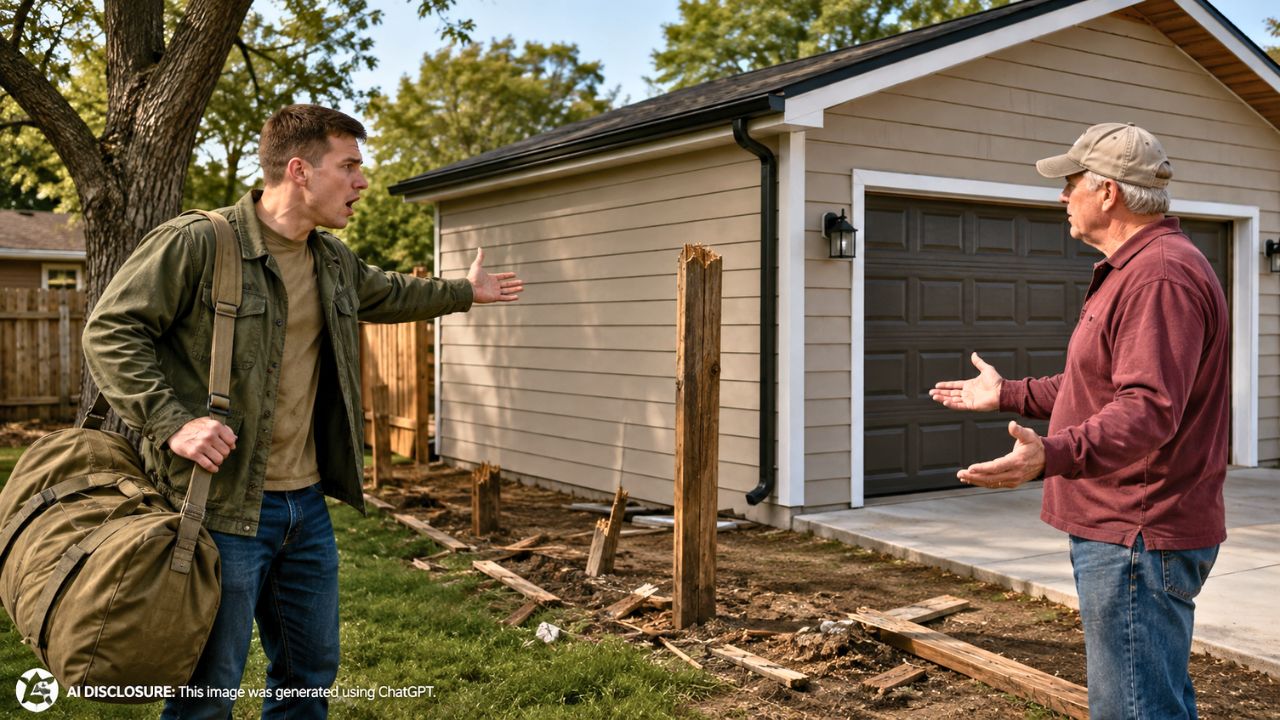
In the original post, the homeowner describes seeing family members on the neighbor’s side finishing the job, pulling the last couple of poles. When asked what was happening, the answer was blunt and oddly confident: the neighbor’s new garage was going to be “the new fence.”
Coming home to a missing boundary
Fences are one of those things you stop noticing until they’re not there. The homeowner says the removal happened while they were gone, with no heads-up, no conversation, no note on the door.
That’s what made it land so hard. This wasn’t a storm that knocked panels down or a repair that got out of hand. It was a deliberate tear-down of a boundary line—something most people would assume requires agreement, or at least a quick, respectful heads-up.
Instead, the homeowner returned to the sight of an active work scene: relatives removing the last posts like it was routine maintenance. Only it wasn’t their fence to casually change—at least not from the homeowner’s perspective.
“The garage will be the new fence”
The phrase that stuck was the explanation: the garage would replace the fence. That kind of logic might make sense in the mind of someone who’s focused on their own build and wants a clean perimeter. But it’s a jarring thing to hear when you’re the person on the other side of the property line.
A fence isn’t just a visual divider. It’s privacy. It’s dog control. It’s keeping kids from wandering. It’s a clear signal about where one yard ends and another begins. A garage, even a very large one, doesn’t automatically do all that—especially if it doesn’t fully span the boundary or if it shifts the line by even a foot.
And then there’s the bigger issue: a structure is not a “swap” for a fence if you didn’t agree to the swap in the first place.
The parcel viewer made it feel worse, not better
After the shock, the homeowner did what a lot of people do now: they pulled up the parcel viewer. What they saw escalated the worry fast. According to that map, the homeowner believed the fence line—and now the posts—were on their land.
They also mentioned that posts were on their side too, which added to the impression that this wasn’t a shared improvement or a simple replacement. It sounded like the neighbor’s plan required reaching onto the homeowner’s side of the line, removing physical markers, and then proceeding with a build as if that space was fair game.
That’s the kind of detail that keeps people up at night, because once a big project like a garage gets framed and enclosed, it’s not a weekend fix. A fence can be put back up. A garage footprint is a different level of commitment—and a different level of argument.
The real damage is how fast it can get out of hand
Even without anyone yelling, a fence dispute can snowball in days. The homeowner’s first question was the one most people would ask in their shoes: do I just let him do it or what?
If the neighbor’s garage truly ends up over the line—or even close enough to create access problems—there are practical consequences that show up immediately. Suddenly there’s a question of who can enter which side for maintenance. There’s runoff from a new roofline. There’s the awkward reality of a solid wall facing your yard where a fence used to be, changing sightlines and privacy in a way you didn’t choose.
Then there’s timing. A fence coming down is a visible moment. A foundation pour or framing work is another point of no return. The longer it goes unanswered, the harder it is to reset expectations without a fight.
How homeowners reacted: document first, then pick the hill to die on
The homeowner’s frustration wasn’t just about land. It was about being cut out of the decision entirely. That’s the kind of thing that makes neighbors start thinking in terms of proof and paper trails, not friendly chats over the hedge.
In conflicts like this, people tend to urge the same basic approach: take photos immediately, capture where the fence used to sit, note what’s being removed, and save any screenshots or records that show the property line as understood. Even the homeowner’s mention of the parcel viewer hints at that instinct—get something concrete before the site changes again.
And because a garage isn’t a small change, reactions tend to focus on stopping the momentum. The longer construction continues, the more a neighbor can act like it was always the plan, always the boundary, always “fine.” Homeowners who’ve been through it know that silence can be interpreted as acceptance, even when it’s really just shock or absence.
The other common reaction is to avoid turning it into a shouting match in the yard with family members who are “just helping.” The people pulling posts may not be the decision-makers, but their work is what makes the decision permanent.
The awkward part: you still have to live next door
This is where these stories get sticky. The homeowner didn’t describe wanting revenge. They described being annoyed, blindsided, and unsure what to do next.
That emotional mix matters because it affects choices. If you come in hot, you risk turning a bad neighbor move into a full-time feud. If you do nothing, you may end up staring at a garage wall that sits where your fence used to be, with no easy path back.
And it’s not just about property lines. It’s about the feeling of control over your home. A fence being removed while you’re away—especially during military leave—hits a nerve for a lot of people because it reads as opportunistic. Whether the neighbor meant it that way or not, the result is the same: the homeowner returned to a changed property boundary without consent.
The tension now sits in that unanswered space between “shared fence” and “my land,” between a quick tear-down and a permanent structure. And once a garage becomes someone’s “new fence,” it’s not just a building project anymore—it’s a boundary decision made unilaterally, with the homeowner left scrambling to catch up.
Like Fix It Homestead’s content? Be sure to follow us.