Rural Oregon Property Owner Watches a Neighbor’s Cattle and Goats Roam Onto Her Fourteen-Acre Horse Pasture for Over Two Years — Then Learns One of the Goats Died of Apparent Neglect While Left Unconfined
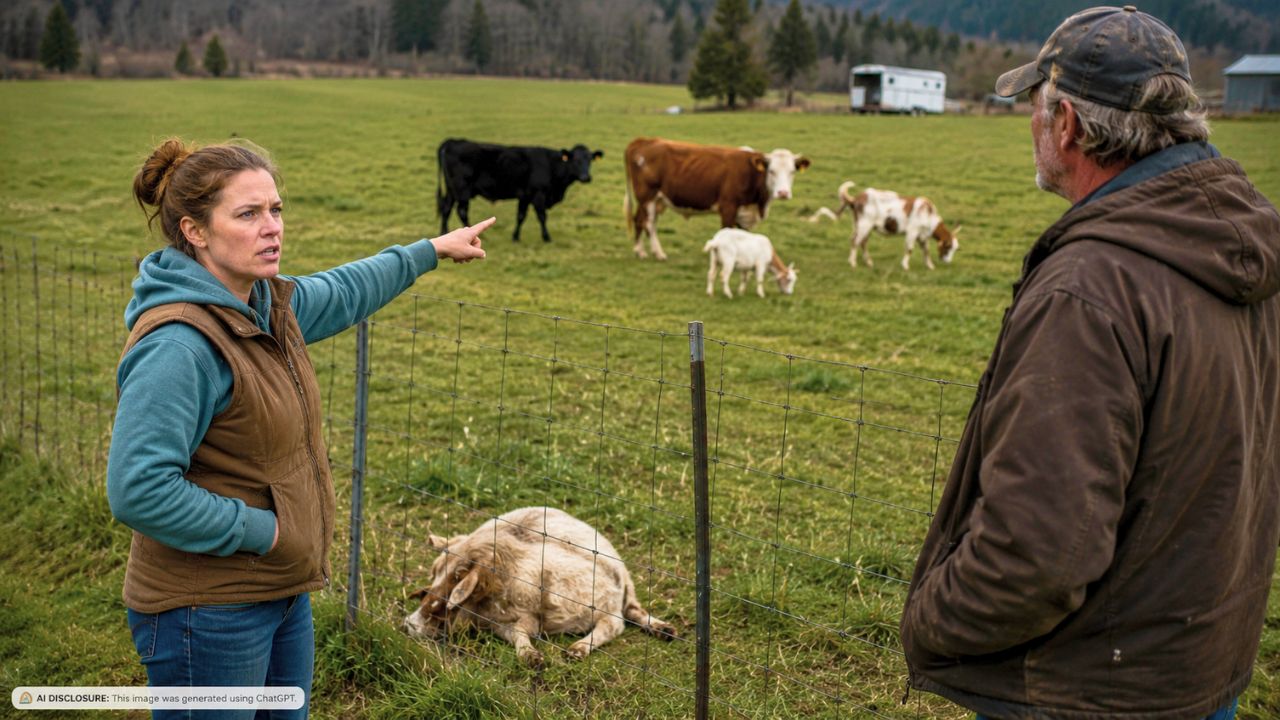
Photo credit: AI-generated image created using ChatGPT. Illustrative only.
On a rural stretch near Portland, Oregon, one property owner says she’s spent more than two years doing the kind of unpaid work nobody budgets for: tracking down a neighbor’s loose livestock, documenting damage, and trying to keep her own animals safe behind fences that actually hold.
Her account, shared in the original post, reads like a slow-motion escalation—starting with the occasional goat wandering over, then turning into cattle trampling, pigs rooting up ground, and finally a dead goat that, in her view, showed clear signs of being left without basic care while unconfined.
A working horse pasture kept getting treated like open range
The property owner describes living on 14+ acres used largely as horse pasture for three horses, plus hobby farming: a small orchard, berries, and hens. Her animals are “always enclosed,” and she mentions a well-trained shepherd dog and two indoor cats—basically, a household that’s doing its part to keep animals where they belong.
Next door is a smaller 3+ acre parcel where a man is living on property tied to his grandparents. Over time, the neighbor’s animal count and variety grew: small cattle intended for meat, several goats, later “up to 40 pigs” including breeders and piglets, plus guinea fowl, a new dog that “barks endlessly outside,” and a semi-feral cat.
The core problem wasn’t that the neighbor kept livestock. It was that the livestock regularly ended up on someone else’s land.
The fence failures weren’t rare—they were routine
She says the neighbor’s land is “painfully overgrazed,” and because he’s “rarely home” and even more rarely tending to the animals, they roam whenever his hotwire goes down. And in her telling, that hotwire goes down a lot.
When it happened, she’d contact him. She says he would respond with explanations for why he couldn’t fix it for days at a time—delays that meant more time with cattle, goats, or pigs wandering onto her pasture and hobby farm areas.
The pattern matters, because it turns “oops, the fence broke” into something closer to predictable access. Animals learn where the good grazing is. Horses get stressed. Pastures get torn up. Trees get damaged. And the person who didn’t buy the animals ends up spending time and energy managing them anyway.
It stopped being annoying once the property damage stacked up
The first big red flag was tree damage. She says goats were stripping bark off fruit trees—girdling that can kill young trees and permanently set back an orchard. That’s not cosmetic. That’s years of growth gone.
Then came the heavier damage. She says the neighbor’s cattle got loose and trampled her things. Later, pigs dug under the hotwire and started rooting up her property, in the same place multiple times. Anyone who’s dealt with pigs knows what that looks like: torn sod, churned soil, holes that can twist an ankle, and a muddy mess that doesn’t just “go back” without work.
She also raises a health and husbandry concern: she believes none of the animals were getting proper deworming or vaccinations. Even if you set aside the animal welfare angle, unmanaged livestock coming and going raises practical worries—parasites, manure loading, and biosecurity for her own animals.
The goat death changed the tone from “trespass” to “neglect”
What pushed this beyond everyday rural frustration was what she describes happening with the goats. She says the original goats “have all died, likely of neglect,” and she believes she has evidence for at least one case.
After she complained about the goats damaging trees, she says the neighbor staked them to T-posts on a slope (she wasn’t sure if that slope was fully his property or partially hers). According to her account, the goats had neither shelter nor water.
One goat, she says, “strangled itself and/or died from thirst.” She adds that the carcass was left out for days and then buried where it died, “mere yards from a creek and pond between our properties.” For a rural neighbor dispute, that detail lands hard—because now it’s not just fences and turf. It’s a dead animal near water, and the kind of burial choice that makes people think about runoff and contamination.
She says she contacted animal control and got nowhere, noting that she is a veterinarian and a mandated reporter. Her frustration isn’t subtle: she describes animal control as “totally MIA.”
When she pressed the issue, the neighbor started denying obvious damage
For a long time, she says, the neighbor wasn’t exactly apologetic but also didn’t deny his animals were loose. That changed after she texted him about the pigs’ latest visit.
On the phone, she says, he acted like it was “impossible” the damage she found was from his pigs—even though she believed it was clearly pig rooting and in the same spot that had been torn up before. Then he asked to take down a strip of shared fence to replace it with hotwire.
She refused, telling him he could build hotwire inside his own property. She says he responded that he wasn’t losing “his property line” and hung up.
That’s the moment a lot of rural property owners recognize: once the conversation shifts from “I’ll fix it” to boundary games and denial, you’re no longer negotiating with someone who shares your goal of keeping animals contained.
People focused on documentation, boundaries, and going around the unreliable gatekeeper
The property owner says law enforcement told her they couldn’t do anything about loose animals unless they were on public property, and suggested she send the neighbor a bill and sue if he didn’t pay. Her response was the one many readers would have: the neighbor has no money, so what does suing really accomplish?
So she started building a different kind of leverage—paperwork, property lines, and enforcement channels that don’t rely on the neighbor’s cooperation.
In an update after a day of research and phone calls, she says she identified at least two code issues: the neighbor’s pastures allegedly running to the property line instead of being set back 30 feet, and the livestock carcass burial allegedly being too close to running water. She also flagged an Oregon statute she believed might apply to pigs roaming.
She also dug into ownership and found the house is owned by a trust named after the grandparents. With the grandfather deceased and the grandmother in a retirement facility, she prioritized figuring out who the trustee or “landlord” decision-maker was, aiming to involve whoever actually has authority over the property.
At the same time, she lined up a surveyor to mark the property line and planned to fence off an open area to cut off access to a shared pond. And she began compiling a detailed log of trespass events with photos and videos—“sooooo many” loose animal clips—because in rural disputes, the person with clean documentation usually lasts longer than the person with the loudest story.
She also found a free mediation service in her area and said she’d rather resolve it in a way that preserves a workable neighbor relationship, if possible. But she wasn’t pretending the damage didn’t matter: she mentioned billing for girdled stone fruit trees and “lawn grazing rights” if it came to that.
For now, the tension sits where so many homestead problems end up: one landowner tightening up fences and records, the other pushing boundaries—literally—while animals keep testing the gaps. In rural living, “good fences make good neighbors” isn’t just a saying. It’s a survival plan.
Like Fix It Homestead’s content? Be sure to follow us.