Rec-Room Addition Survey Shows a Homeowner’s Own Standalone Structure Encroaching Five to Six Feet Onto the Neighbor’s Land — Then a Bathroom and Closet Turn Out to Sit on the Wrong Side of the Line
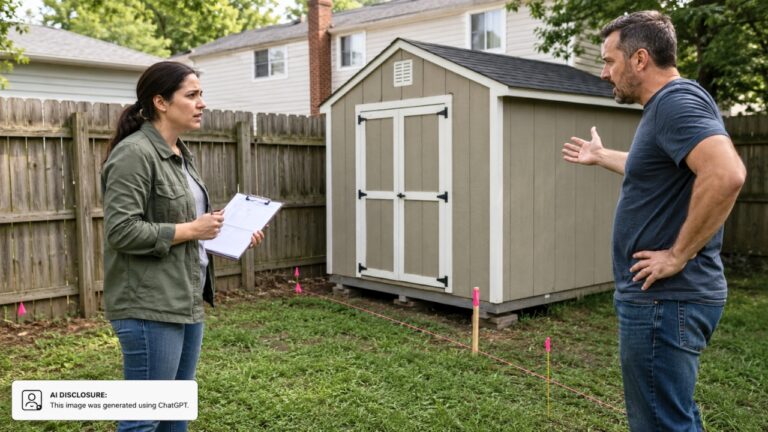
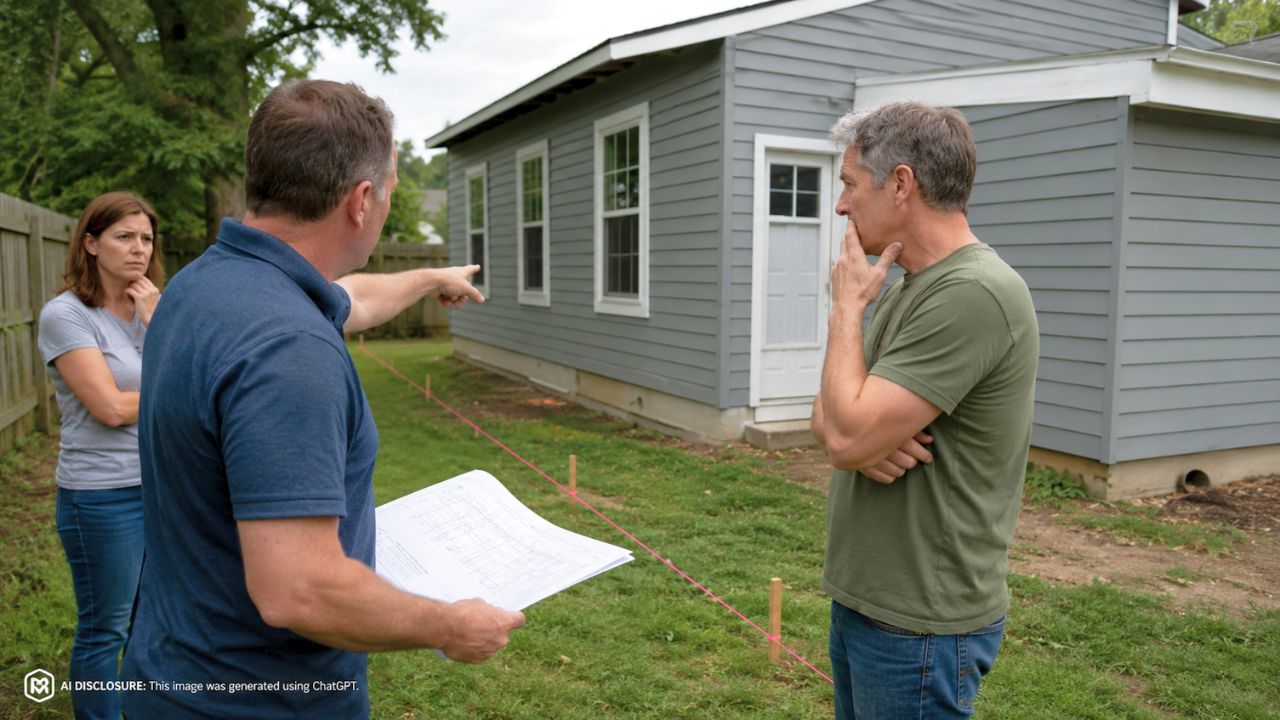
Photo credit: AI-generated image created using ChatGPT. Illustrative only.
It started like a normal, responsible new-homeowner move: get a survey, find the exact boundaries, then plan a fence that protects the trees and follows the slopes. Instead, the survey came back with a gut-punch—what the owner thought was a simple rear “rec room” building wasn’t just close to the line. Part of it was over the line.
In the original post, the homeowner says the standalone structure at the back of the property appears to sit about five to six feet onto the neighbor’s land. And it’s not just a corner eave or a strip of deck. The survey result puts a bathroom and a closet on the wrong side of the boundary.
The survey wasn’t about the rec room—until it was
The owner bought the property in October and didn’t order the survey because of a dispute. It was about fencing logistics—where to wrap around trees, how to deal with the slope, and how to keep the fence placed correctly.
Like a lot of people, they’d done the casual homework already. Online maps and searches suggested the line was close to the structure, but nothing prepared them for the idea that the boundary could run through the building itself.
That’s the part that turns this from a “huh, that’s annoying” into something that can’t be ignored. A building that crosses a property line isn’t just a neighborly question. It can become a title, permitting, and resale problem all at once.
Then the neighbor turned “fine” into unpredictable
If the neighbor had been consistently cooperative, the discovery might still be stressful, but at least it would be clear what comes next. Instead, the homeowner describes a neighbor who swings hot and cold.
On one hand, the neighbor has said he doesn’t care about the space because it’s at the bottom of a slope and “completely unusable” to him. That would sound like an opening for a simple written agreement—something that makes everyone whole and keeps the peace.
On the other hand, the neighbor called police on the survey crew. That one detail changes the temperature fast. It signals this could turn into an emotional boundary fight, not just a paperwork fix.
Five to six feet doesn’t sound like much—until it’s a bathroom
Encroachments can be tiny: a fence that drifted, a shed built too close, a driveway that got widened over time. But five to six feet is enough to swallow a real chunk of a room, and here it’s not dead space. It’s a bathroom and closet.
Bathrooms aren’t just walls and flooring. There’s plumbing. There’s a question of what was permitted and where utilities run. Even if nobody touches the structure for years, the moment the owner tries to refinance, remodel, or sell, the survey becomes the piece of paper that refuses to go away.
And from a practical, homestead-style standpoint, it’s hard to “just ignore it” when the neighbor might decide later that they do care—especially if relations sour or the property changes hands. The owner is stuck thinking not only about today’s peace but tomorrow’s leverage.
The first calls aren’t to contractors—they’re to paperwork
The homeowner’s mind immediately went where it usually has to go in these moments: what are the legal options, and what will insurance do? They mention reading about encroachment law, lot line adjustments, adverse possession, and reviewing the title insurance purchased during escrow.
The big question they’re wrestling with is whether title insurance might cover legal costs tied to a solution like a lot line adjustment. The second question is more tactical: is it smarter to pursue a lot line adjustment, or to draft an easement that allows the structure to remain where it is?
That’s the fork in the road. A lot line adjustment can be clean and permanent if the neighbor is willing and local rules allow it—but it can also trigger surveys, recordings, lender questions, and fees. An easement may be more achievable when a neighbor doesn’t want to “give up” land but might agree to allow continued use. Either route typically requires the neighbor to sign, which is where the police-call detail starts looming large.
What other homeowners pushed: document first, talk second
Even without a pile of comments pasted in, the direction homeowners usually go in these threads is predictable—and it’s not because people love conflict. It’s because a boundary problem becomes a memory contest if it isn’t documented.
When someone says a neighbor is friendly one day and confrontational the next, the common advice is to stop relying on casual chats as if they’re agreements. The survey is step one, not the final word. People tend to recommend keeping every version of paperwork, saving communications, and making sure the survey stakes and maps are preserved in case they “disappear” later.
And when a neighbor escalates to calling police on survey work, experienced homeowners often suggest avoiding improvisational conversations at the fence line. Get calm, get clear, and keep it in writing. That doesn’t mean going in aggressive. It means protecting yourself from the whiplash of “I don’t care” turning into “move it immediately” after a bad week.
The real fear is getting trapped between “move it” and “can’t move it”
The nightmare scenario isn’t just paying an attorney. It’s ending up with a structure you can’t legally keep as-is and can’t cheaply fix. Moving or cutting back a standalone building sounds straightforward until you remember it contains a bathroom. That’s walls, pipes, fixtures, and the risk of uncovering more surprises once demolition starts.
At the same time, doing nothing carries its own risk. If the neighbor decides to press the issue, the homeowner could face demands that arrive on a deadline. The owner can already see how quickly the mood can change. That uncertainty is what makes people start reading about adverse possession and encroachment rules late at night.
For now, the homeowner is left where a lot of property-line disputes begin: a fresh survey in hand, a neighbor who is not reliably on the same page, and a building that suddenly feels less like a bonus rec room and more like a long-term liability. The next move likely won’t be swinging a hammer—it’ll be figuring out what can be put in writing before the line in the dirt becomes a line everyone is willing to fight over.
Like Fix It Homestead’s content? Be sure to follow us.