74-Year-Old Homeowner Lets a Neighbor Expand His Driveway Into Her Front Yard on the Condition He Pays for It — Then He Offers Her $1 to Buy the Strip Back and Shows Up With a Video Camera Screaming She’s “Cruel”
Photo credit: AI-generated image created using ChatGPT. Illustrative only.
It started the way a lot of property-line headaches start: one neighbor wanted “just a little more room,” and the person next door tried to be accommodating. In this case, a 74-year-old homeowner agreed to let the man next door expand his driveway into a strip of her front yard, with clear conditions attached. Years later, when he decided to sell, he came back with a stunning offer to “fix” the problem he created.
The details come from the original post, where the homeowner’s family describes how a driveway expansion turned into cameras, screaming at the front door, and a fence going up just to restore peace.
It was supposed to be a simple, controlled favor
The neighbor—described as a man in his mid-sixties—decided he needed a bigger driveway so it could hold four cars, including vehicles belonging to his two adult children who didn’t even live there anymore. The homeowner, already in her seventies, reluctantly agreed to let him build over the property line.
But she didn’t agree to give it away. Her condition was straightforward: he would pay for everything built over the line, and she would maintain the right to remove it later or even build on top of it if she wanted. In other words, she was allowing use, not transferring ownership.
Anyone who has owned a home for long knows why that distinction matters. A driveway isn’t a potted plant you can scoot back later. It’s concrete or asphalt, excavation, base material, grading—something that changes how water moves and how people move. Once it’s in, it becomes “normal,” and that’s when “normal” starts to harden into entitlement.
Then the neighbor tried to turn “use” into “ownership” for a dollar
A few years passed, and the neighbor decided he wanted to sell his house. That’s when he approached the homeowner with what can only be described as a pressure-play: he asked her to sell him the portion of her property he’d built onto for $1.
That alone would be insulting enough, but the post adds another detail that makes it worse—part of that driveway work had been paid for by the homeowner herself. So the request wasn’t just “give me your land.” It was “hand over the land and validate the driveway footprint permanently,” for essentially nothing.
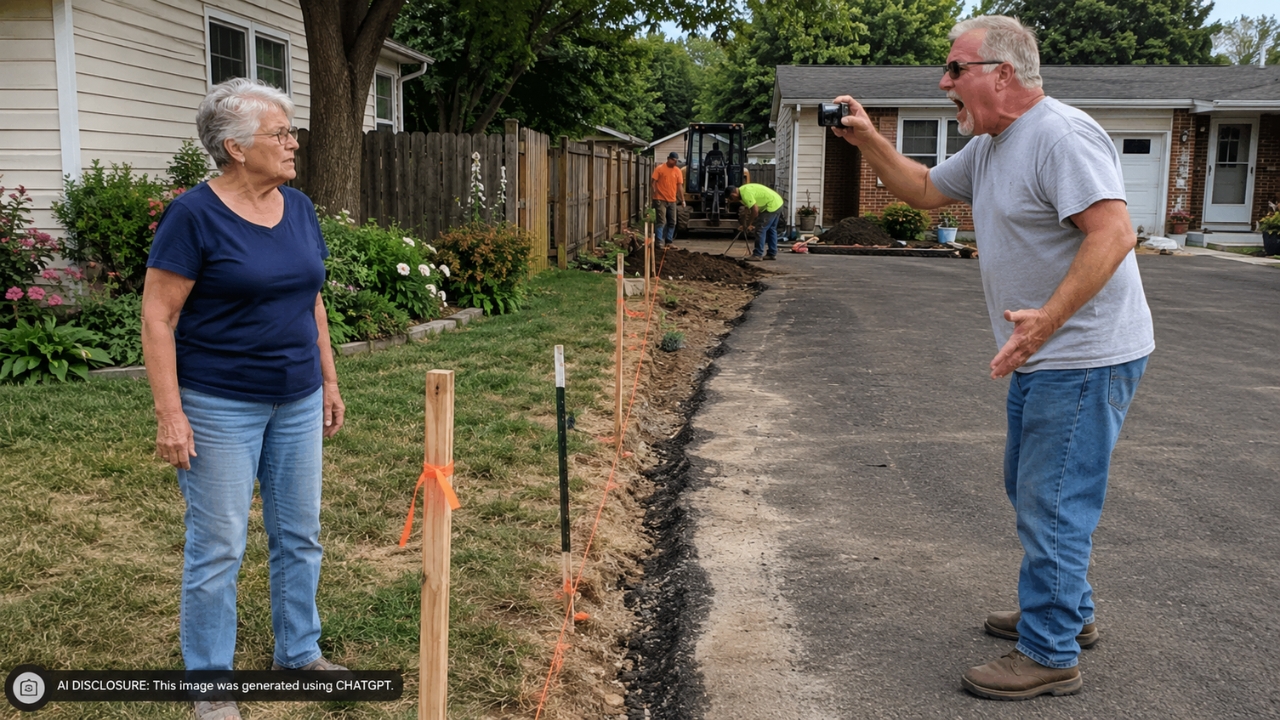
She said no, and the tone shifted instantly. Instead of accepting the answer and figuring out how to market a home with legal boundaries, the neighbor reportedly turned the refusal into a moral accusation. He began showing up at her house with a video camera, screaming at her and calling her “cruel,” claiming she didn’t want him to see his kids.
Meanwhile, the practical reality on the street didn’t match his story. The post states there was permitted street parking, each residence had two parking passes, and residents could request up to six temporary guest passes. This wasn’t a neighborhood where one driveway slot was the difference between family relationships and loneliness. It was about convenience—and about winning.
The camera at the door made it feel less like a driveway and more like intimidation
There’s a particular kind of escalation that happens when someone brings a camera into a private dispute. Suddenly it’s not just neighbors arguing; it’s someone building a narrative, trying to create a “gotcha” moment, or hoping you’ll snap so they can frame you as the aggressor.
According to the post, that’s exactly how it felt: the neighbor repeatedly came to the homeowner’s house filming and yelling. He wasn’t negotiating. He was performing.
And as often happens, the person who wanted a favor turned into the person demanding a concession. The homeowner was no longer being treated like the owner of her own front yard. She was being treated like an obstacle to be shamed into compliance.
A survey and a fence turned the argument into action
Eventually, the homeowner moved from trying to endure the behavior to formally re-establishing the boundary. She hired a surveyor to determine the property line and built a fence to keep the neighbor and his family off her land.
That’s the moment these stories tend to pivot. Because once the property line is staked and marked, there’s nowhere left to hide behind “I thought it was mine” or “it’s been that way for years.” A survey doesn’t care who’s louder.
When workers began pulling up the portion of the driveway that was on her side, the aggression reportedly intensified. The neighbor’s wife showed up crying, saying they couldn’t live without the extra driveway space. At the same time, the family allegedly tried to make the work harder by strategically parking cars to block access.
Then it got uglier. The post says they threatened to report the workers to ICE, despite having no knowledge of anyone’s immigration status. That’s not a driveway dispute anymore. That’s a willingness to use any lever—real or imagined—to punish people for doing a job on the rightful owner’s property.
The workers’ response, described in the post, was blunt and a little darkly funny: they removed everything around and under the son’s car so the vehicle was left with only its tires still on the remaining driveway area.
“I’m going to buy the house and make your life miserable”
The driveway teardown didn’t just draw out the neighbor; it drew out the family dynamics too. The post describes the neighbor’s son showing up and telling the homeowner, “I just made my first million dollars and I’m going to buy the house and make your life miserable.”
It’s the kind of statement that tells you exactly what the argument was really about: power and control. Not parking. Not access. Not even money, apparently.
The hostility spilled over beyond the driveway, too. The poster describes being in the backyard when the neighbor leaned over the fence and shouted an obscenity. When the poster turned around, the neighbor reportedly said he was “so sorry” and claimed he thought the person outside was the homeowner.
That detail is chilling in its casualness. It suggests the target wasn’t the driveway strip anymore. It was the older woman who refused to be pushed.
Readers zeroed in on the same homeowner basics: document, survey, separate
Even without a long comment section included, the actions in the story line up with what seasoned homeowners tend to repeat anytime property lines and “friendly” agreements collide: get the line surveyed, put it in writing, and physically separate the spaces if you can.
The homeowner’s steps—survey, fence, removal of encroaching hardscape—are the concrete versions of that advice. A fence isn’t just a barrier; it’s a message to future buyers, appraisers, and anyone else who might be tempted to treat your land like shared overflow.
The camera element also fits a common theme in neighbor disputes: if one side starts filming, the other side should assume every interaction could be used out of context. In situations like that, many homeowners shift to communicating in writing, avoiding doorstep arguments, and letting contractors and boundary markers do the talking.
In the end, the neighbor did sell the house—but not triumphantly. The post claims they sold it for nearly $500,000 under asking price. The homeowner’s family reports the best part is simple: the new neighbors are lovely.
That’s the grounded ending these stories rarely get. No dramatic courtroom reveal, no last-minute handshake, just a boundary restored and a block that finally got quiet again. The strip of front yard went back to being what it always was: hers.
Like Fix It Homestead’s content? Be sure to follow us.