Gardener Finds Human Waste Dumped From the Neighbor’s Septic Line Just a Foot From Her Mango Tree — Then Contacts State Agencies to Report the Contamination
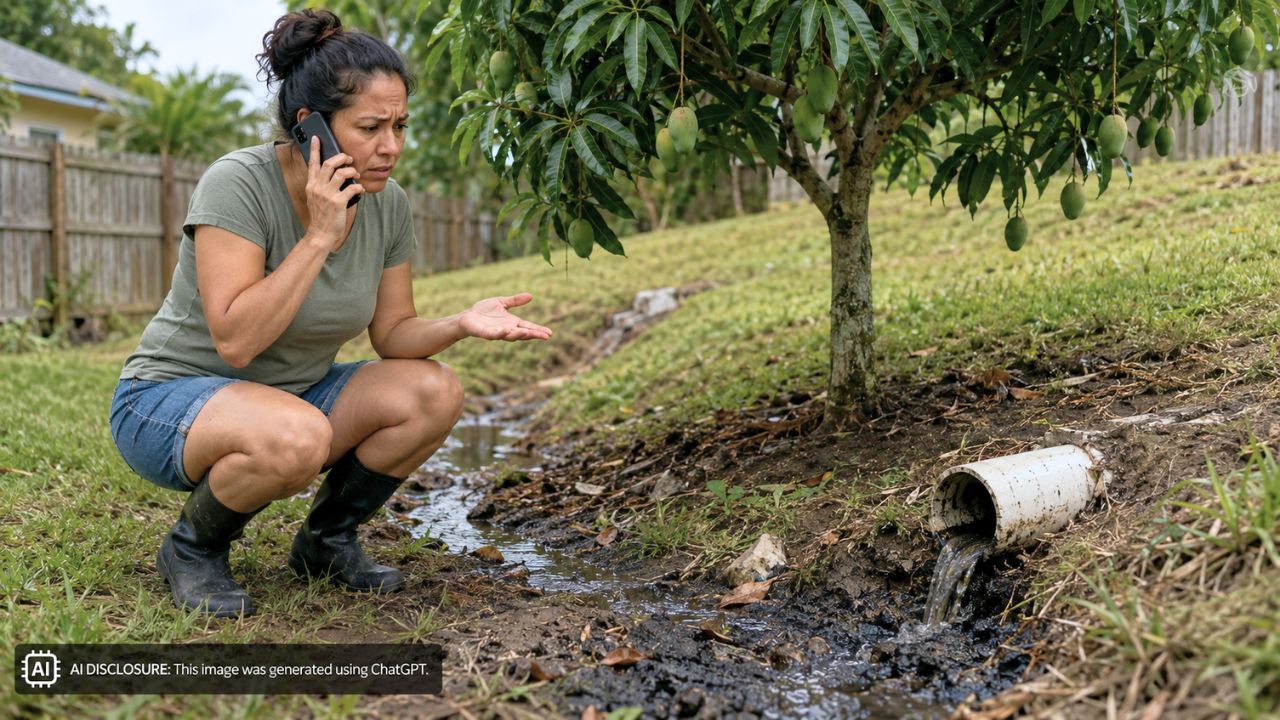
Photo credit: AI-generated image created using ChatGPT. Illustrative only.
She didn’t notice it right away. By the time she found the hose threaded through a gap in her fence, it had already been pumping for more than an hour—long enough for the worst of it to soak in, spread out, and turn from obvious sludge into a thin, foul liquid disappearing into the grass.
In the original post, the homeowner described realizing a neighbor had emptied septic waste into her backyard. The discharge point sat near the top of an inclined yard, meaning gravity could do the rest, pulling contamination downhill toward the rest of her property.
A hose through the fence, and a smell that wouldn’t leave
The detail that makes this feel especially invasive isn’t just the waste—it’s the method. The neighbor didn’t accidentally overflow a line at the property edge. The homeowner said a hose was run through a gap in her fence, aimed into her yard, and left pumping.
She found it 1 hour and 20 minutes after it began. By then the contents looked mostly liquid, but the smell lingered all day, the kind of odor that sticks to patio furniture and hangs in the air even after you’ve convinced yourself it’ll blow over.
What she did have, though, was a timestamp. Her patio camera caught the top of the person’s head above the fence, which is how she knew when pumping started.
The part that hit hardest: where it landed
This wasn’t a forgotten corner of the yard behind a shed. The homeowner laid out the distances like someone mentally mapping a disaster zone: about a foot from a fully grown mango tree, about 10 feet from a fully grown avocado tree that was already fruiting, and about 15 feet from a raised garden bed.
Anyone who grows food at home knows that’s not just landscaping. That’s years of watering, pruning, feeding, waiting. A mature mango tree is a long-term investment, and a fruiting avocado is the kind of thing people brag about because it’s not easy to get there.
Now she was staring at the same ground, wondering if it was permanently off-limits—if her backyard had been turned into a no-go zone for anything edible.
When the yard is sloped, the mess doesn’t stay put
The yard being inclined changed the stress level. A flat patch of grass can sometimes be treated like an isolated spill, at least in your mind. But a slope makes it feel like a slow-moving threat. Even if the discharge happened “up there,” it’s hard not to picture everything traveling “down here.”
That’s where the homestead reality kicks in: drainage patterns, soil saturation, and the fact that what gets dumped at the top of a hill rarely stays at the top. In a yard, downhill is usually where people actually live—where patios are, where dogs run, where garden beds sit, where kids play, where rainwater funnels during storms.
The homeowner’s biggest question was the one most people would ask first: what happens to the land now? Not just the smell, but the soil itself—whether it’s “useless for growing” after a large amount of human wastewater hits it.
Proof mattered, because this isn’t a friendly conversation
This is the kind of neighbor problem that can’t be solved with a casual wave over the fence. The homeowner didn’t describe confronting the neighbor immediately. Instead, she focused on what she could document and what she could do next without making things messier.
The camera footage, even if it only caught the top of someone’s head, gave her a start time. The fact that she found it still pumping gave her a window of duration. And the location—through a gap in the fence—turned it into something that felt deliberate rather than a misunderstanding.
She also admitted a frustrating limitation: she didn’t get a clear view of what came out of the pipe because she discovered it after it had been running long enough that the contents were mostly liquid. That’s a very real homeowner problem—by the time you notice something, the evidence has already changed form.
Calling state agencies was the next escalation
After the initial post, she added an update that shifted the story from shock to action. She said she planned to contact state agencies on Monday, but couldn’t share specifics yet because she was still deciding what path to take.
That pause—knowing you need to report it, but also knowing that once you do, you’re in a different kind of conflict—is familiar to anyone who’s dealt with property disputes. Reporting can be the right move and still feel like stepping into a long hallway of forms, phone calls, and “we’ll get back to you.”
It also signals that this isn’t just a gross-out moment. Dumping septic waste can cross lines that go well beyond neighborly annoyance, especially when it’s discharged onto someone else’s property near food-producing plants.
Readers zeroed in on the practical fallout: soil, fruit, and the long memory of a yard
The homeowner’s post centered on the aftereffects—what to do with land that has absorbed wastewater, and whether the area can safely be used again. That’s the kind of question that spirals quickly because it touches everything: harvesting fruit, letting pets roam, planting seedlings, even just walking barefoot in the grass.
Even without a long back-and-forth included in the source material, the tone of the update hinted at what usually happens next in these disputes: document first, report up the chain, and be careful about saying too much publicly while deciding how to proceed.
And then there’s the homestead anxiety that lingers long after the smell fades. Trees are perennial. Soil is slow to change. When contamination happens close to something you eat from, you don’t just “forget about it” when the grass greens back up.
For now, the yard is still her yard—mango tree, avocado tree, raised bed and all—but it no longer feels fully under her control. She’s left with footage, a timeline, a patch of ground that absorbed something it never should have, and the kind of neighbor boundary violation that doesn’t fix itself with time. The next move, she indicated, is turning it over to state agencies and choosing how far to push from there.
Like Fix It Homestead’s content? Be sure to follow us.