Property Owner Finds a Neighbor Cut Into Her Land to Reroute Water Onto the Property — Then a Room Floods From the Runoff
Photo credit: AI-generated image created using ChatGPT. Illustrative only.
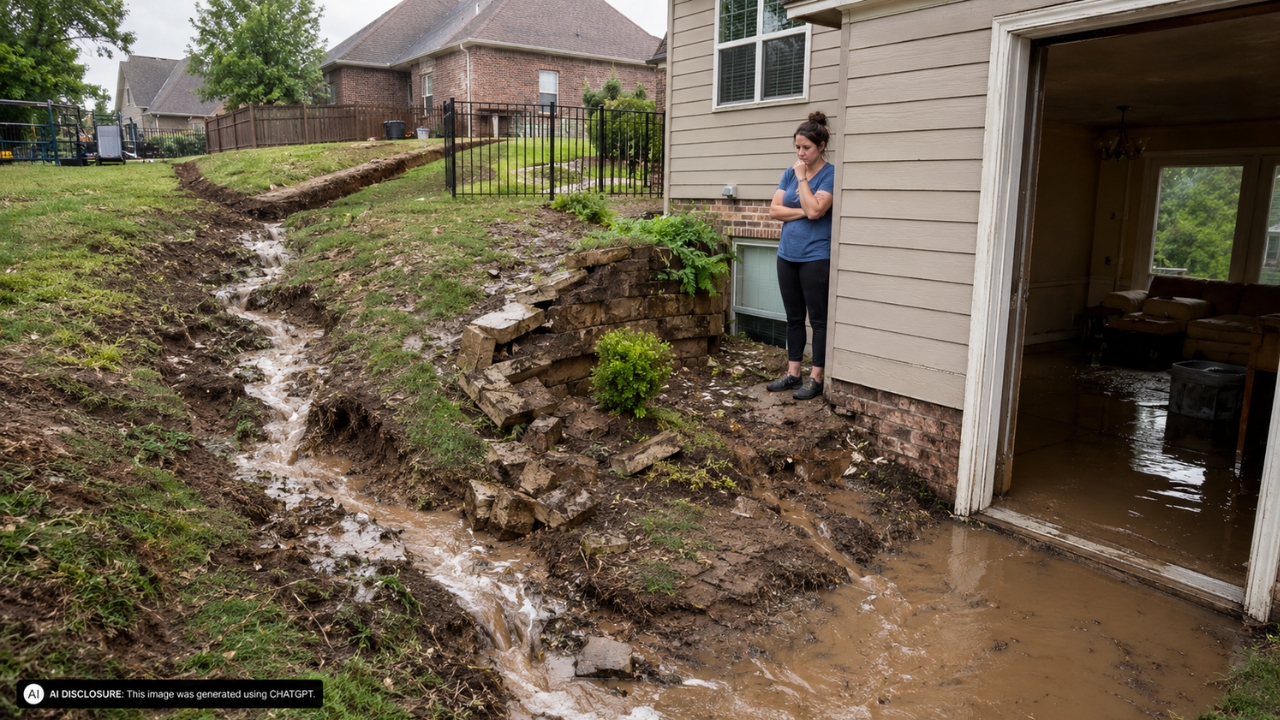
It started as an outside problem—water where it didn’t belong, carving new paths through a yard after every rain. But for one Tulsa homeowner, it didn’t stay outdoors for long. After discovering that a neighbor had cut into their own land in a way that appeared to send water downhill, the homeowner said the runoff escalated into erosion, a failed retaining wall, and eventually a flooded room.
In the original post, the property owner laid out the messy reality: “There are three separate rivers in my yard now and it looks like a shallow lake every time it rains.” The big question wasn’t just how to dry everything out—it was whether the neighbor’s move was legal, and what you do when the damage is already happening.
Water found the lowest point, and that was the house
The homeowner lives slightly downhill, which makes the whole problem feel like a rigged game. They can’t simply “send it back” because gravity is doing what gravity does, and once water chooses a route, it tends to keep taking it.
According to the homeowner, the neighbor altered their own land—cutting into it—to reroute water onto the downhill property. That change didn’t just add a little dampness; it created persistent runoff that now behaves like multiple channels across the yard.
And then the worst-case scenario hit: water built up along the side of the house and a room flooded. That’s the moment where drainage stops being a landscaping headache and becomes an inside-the-walls, flooring-and-drywall kind of emergency.
The retaining wall wasn’t built for a new river system
The homeowner described major land erosion issues, the kind that don’t happen overnight unless something upstream changes. With water pouring in hard and repeatedly, soil moves. Slopes soften. Edges slump.
The retaining wall failing was a turning point. In their words, it was old and “not meant to deal with this much water.” That’s the quiet trap with older retaining walls: they can hold back a normal amount of wet soil for years, then suddenly lose the battle when drainage patterns shift.
Once a wall starts to give, it can change how water pools around a foundation, too. Instead of running past, it lingers. It presses against surfaces it never used to reach. And if the grade aims that pressure toward the house, the water will keep pushing until it finds a way in.
Sticker shock: $8,000 to $15,000, and no promise it ends it
When the homeowner called in help, the quote to address the issue came back at $8,000 to $15,000. It’s the kind of number that makes you sit down, especially when you’re still mopping up a room and staring at a yard that now behaves like a drainage ditch.
What made it worse was the uncertainty. The homeowner said they still weren’t sure the proposed work would actually solve it. That’s a particular kind of stress homeowners know well: paying big money for earthwork or drainage while wondering if the next storm will undo it.
Drainage fixes can be real, but they’re also highly dependent on where the water originates and how it’s being channeled. If a neighbor’s grading change is actively feeding the problem, you can end up in a loop—fixing symptoms on your side while the source keeps sending more.
“Is this legal?” quickly turns into “How do I prove it?”
The homeowner’s post wasn’t written like someone looking for revenge. It read like someone trying to get their bearings. Is it legal for a neighbor to cut into their land and redirect runoff? If it isn’t, what’s the next step—talking to them, calling the city, hiring a lawyer?
That’s where these disputes get tricky. Water issues feel personal because the damage is personal, but they also live in a world of property lines, grades, and “before vs. after.” If you can’t demonstrate that a change was made—and that the change caused measurable harm—it becomes a shouting match between two yards.
The homeowner also added an important note: because they’re downhill, they can’t easily engineer a fix that sends water back. Even if a person wanted to “play defense” by pushing it away, the landscape will always favor the lower property unless a designed system captures and directs the flow somewhere else.
People urged documentation before a blow-up next door
While the post itself focused on the homeowner’s question and the damage they’re seeing, this kind of scenario tends to pull the same practical instincts out of other homeowners: document everything, because water doesn’t stop at the fence and neither do repair bills.
In disputes over runoff, the first moves are often less about confrontation and more about creating a record. Photos after each rain. Videos showing flow direction. Notes on dates and storm intensity. Anything that helps establish that the yard didn’t always behave like “three separate rivers.”
From there, people usually point toward formal proof—property boundaries and grade changes—because drainage arguments often hinge on what was altered and where. When a neighbor’s work is the suspected trigger, the difference between “my yard is wet” and “their cut rerouted water” is the difference between a miserable repair and a potentially shared responsibility.
And when interior flooding enters the picture, many homeowners also think in terms of insurance documentation and damage mitigation, not because it solves the neighbor issue, but because it keeps the homeowner from being stuck with a mold problem on top of everything else.
A yard full of runoff turns into a long-term home risk
There’s a specific dread that comes with water that keeps coming back. You can pump out a room once. You can tear out ruined materials once. But if every heavy rain turns the property into a shallow lake, the house becomes the lowest container on the lot.
Erosion isn’t just ugly; it can undermine structures over time. Pooling against the side of a house can lead to repeated seepage, and repeated seepage tends to invite bigger, quieter problems—materials that never fully dry, hidden damage, and repairs that grow from “patch it” into “open the wall.”
For this Tulsa homeowner, the immediate pressure is obvious: a failed retaining wall, active erosion, and a room that already took water. The harder part is that the fix isn’t just a project—it’s a standoff with physics, cost, and a neighbor’s choices uphill. And until the water’s route is changed for good, every forecast has the power to turn that yard into a lake again.
Like Fix It Homestead’s content? Be sure to follow us.