Raleigh Homeowner Finds a Hired Contractor Tore Down the Chain-Link Fence and Cut Down Most of the Backyard’s Privacy Trees — Then Learns the Neighbor Never Sought Approval First
Photo credit: AI-generated image created using ChatGPT. Illustrative only.
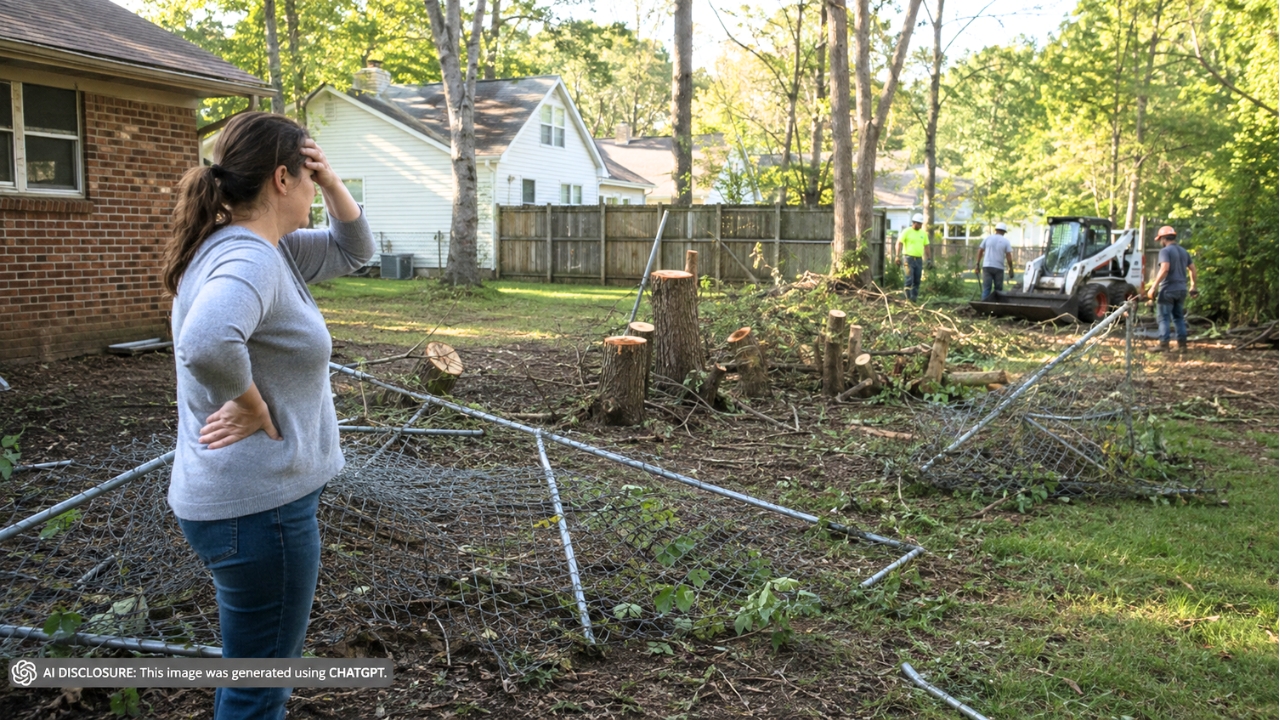
You don’t usually buy a home for the chain-link fence. You buy it for what the fence protects—like the quiet, green privacy that makes a backyard feel like your own. That’s why one Raleigh homeowner says they were stunned to step outside and realize a contractor had been in their fenced-in yard, the fencing was gone, and the trees that created their privacy were suddenly missing.
In the original post, the homeowner describes a neighbor hiring a contractor who allegedly “without approval, willfully trespassed on fenced-in property,” tore down chain-link fences, and cut down most of the trees on the homeowner’s land. The homeowner says they’re now trying to move quickly and find a firm to pursue civil litigation.
The backyard was the whole point
The homeowner explains that the privacy trees weren’t a nice bonus—they were one of the main reasons they bought the house in the first place. A yard buffered by trees changes everything: fewer sightlines, less noise, and that feeling that you can let your guard down.
Then, suddenly, that buffer was gone. The homeowner describes losing a “significant amount of that privacy” after the neighbor’s contractor cut down most of the trees on the homeowner’s property.
Not just trees: the fence came down, too
What makes this especially jarring is that it wasn’t a trimming dispute or a branch-over-the-line argument. The homeowner says the contractor tore down their chain-link fencing to get access—inside a fenced area that should have made the boundary obvious.
They also clarified an important detail: a fence shown in an image wasn’t the one that was removed. According to the homeowner, their property line extends 60 to 100 feet beyond that fence, and that farther area was also fenced with chain-link—meaning there were “2 sets of fences.”
That detail matters because it suggests this wasn’t a simple misunderstanding at the edge of a shared boundary. In the homeowner’s telling, there were multiple physical cues marking “not yours,” and the contractor still went in.
The part that makes homeowners’ stomachs drop: “without approval”
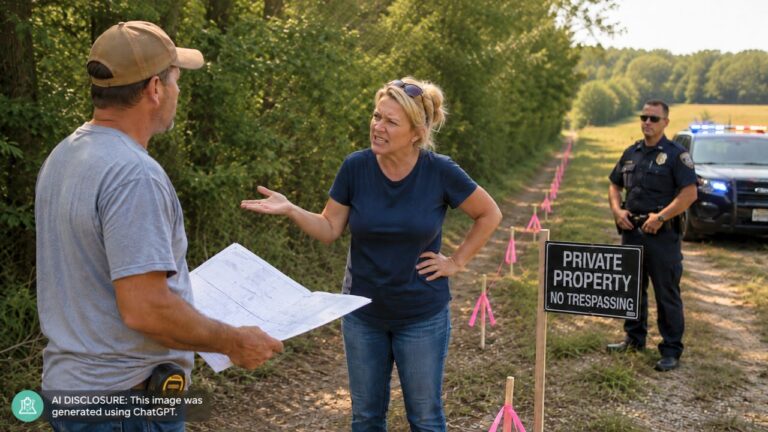
If you’ve ever hired out work near a property line—tree work, grading, fence replacement—you know the normal rhythm. Somebody talks to somebody. Flags or stakes go down. There’s at least a quick “hey, we’re doing this tomorrow” conversation.
Here, the homeowner says the neighbor’s contractor did the opposite: no approval, then entry onto fenced property, then removal of fencing, then the trees. For a homeowner watching their privacy disappear in a day, that sequence doesn’t feel like a mistake—it feels like someone decided permission was optional.
And once mature trees are cut, there isn’t an easy undo button. You can plant replacements, but you can’t buy back years of growth. Even the yard’s microclimate can change—more sun, more wind, less noise buffering—right when you’re also staring at an open boundary where a fence used to be.
When they called police, the answer didn’t match the damage
After the initial shock, the homeowner tried the route many people would: documenting the harm and filing a report. In an update dated Jan. 6, 2026, they wrote that they filed a police report and were connected to a detective.
The detective, the homeowner says, spent “5 minutes” telling them there was nothing criminal about what the neighbor or contractor did, even though the homeowner believed the actions were clear violations of North Carolina statutes. The homeowner also shared one line that stuck with them: the detective allegedly called it “it’s a criminal civil act,” then suggested they get an attorney.
That’s a rough moment for any homeowner. You’re looking at missing trees and a torn-down fence—real, physical changes you didn’t authorize—and the message you hear is: this isn’t going to be handled the way you expected. It pushes the whole mess into the slower, more expensive lane.
People zeroed in on the same thing: proof and paper trails
Even without a long comment thread included in the source material, the direction of the homeowner’s post is clear: they were immediately looking for a tree attorney and civil litigation options. That alone tells you what they think matters next—documentation, boundaries, valuation, and accountability.
In these neighbor-versus-neighbor property disputes, the practical chatter tends to converge fast on a few basics: where the property line actually is, what exactly was removed, and who authorized the work. The homeowner already seems keyed in on boundaries, emphasizing that their land extended well beyond a pictured fence and that there were two sets of chain-link fences marking enclosed space.
That kind of specificity is often what keeps a case from turning into a shrug. Fences, photos, timestamps, contracts, and any “before” images of the tree line can become the backbone of what happens next—especially when a contractor is involved and the question becomes who told them they could enter.
Lawyered up, but the clock moves slow
In a later update dated April 3, 2026, the homeowner says they found a lawyer and started preparing for “next steps.” They were also told the process could take 12 to 18 months “from start to finish once things kickoff.”
That timeline is its own kind of frustration. Backyard privacy isn’t something you can pause. If your fence is down, you may feel exposed every day. If your trees are gone, you live with the loss through every season—no shade in summer, less screening in winter, and a yard that no longer feels like the one you bought.
And there’s the practical, annoying middle ground: what do you fix right now, versus what do you leave alone so you don’t muddy the record of what was damaged? Homeowners can end up stuck between wanting their space back immediately and worrying that quick repairs could complicate a claim later.
The Raleigh homeowner’s post reads like someone trying to get ahead of that trap—move fast, get representation, and treat the torn-down fence and removed trees as more than a neighborly disagreement. Because when your “private” yard gets opened up by someone else’s contractor, it stops feeling like a simple dispute and starts feeling like a line was crossed on purpose.
Like Fix It Homestead’s content? Be sure to follow us.