Homeowner Wakes to the Neighbor Installing a Septic Tank Twenty-Three Inches Above Grade Right at the Property Line — Then Realizes Gravity Will Send It Downhill Into Their Yard
Photo credit: AI-generated image created using ChatGPT. Illustrative only.
He didn’t wake up to birds or a lawnmower. He woke up to the sound of work next door—and the uncomfortable realization that what was being installed could change how his entire backyard smells, drains, and feels.
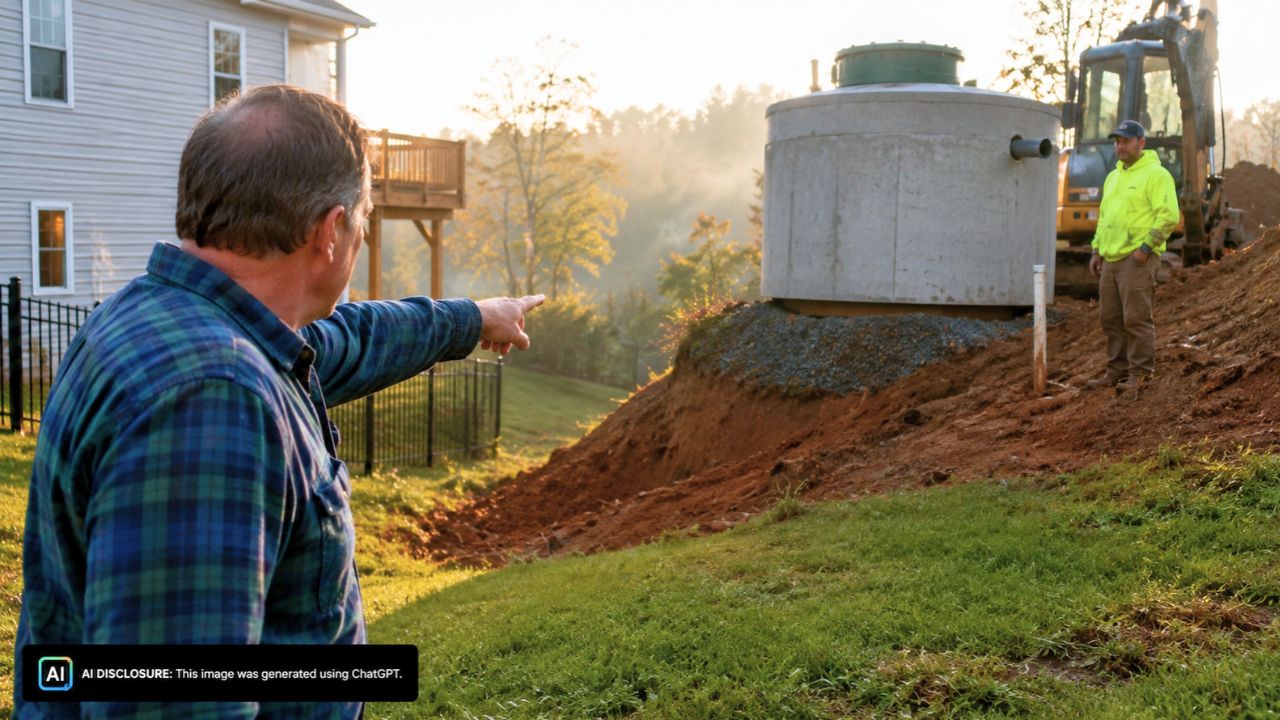
In the original post, a homeowner described watching a next-door neighbor install a septic tank roughly 23 inches above grade right at the property line. The homeowner’s immediate worry was simple and hard to un-think: everything runs downhill, and if anything goes wrong, it won’t be the neighbor dealing with it first.
A giant house close to the line set the tone
The septic surprise didn’t come out of nowhere. The homeowner said the neighbor bought the lot next door and put up a large house just 12 feet from the property line, a choice that already made the two homes feel uncomfortably close.
That kind of build can change the whole rhythm of a property—where water sheds, where equipment has to fit, and how much buffer there is between “their project” and “your problem.” Add an existing history of friction—“I’ve already had some issues with him,” the homeowner wrote—and every new construction decision starts to feel like it’s aimed straight at the fence line.
Then came the septic work. Seeing a tank positioned above the surrounding grade, and right up near the boundary, pushed this from annoyance into panic.
The moment it clicked: gravity doesn’t take sides
The homeowner didn’t pretend to be an engineer. He didn’t talk about pipe diameters or baffle tees. He pointed to what every rural and suburban homeowner learns early: water moves.
“Shit flows downhill,” he wrote, worried that whatever leaves the neighbor’s system—whether from a failure, overflow, or improper drainage—could end up in his yard. It’s not just about smell. It’s about soggy ground that never dries, mystery puddles after a rainless week, and the kind of contamination that can make a backyard feel unusable.
What made it worse was the placement: “23” above grade from my property line.” That measurement reads like someone standing there, looking at the build, and realizing the elevation difference is exactly what would send liquids in one direction if the system ever misbehaves.
Property lines are one thing—setbacks and approvals are another
The homeowner’s fear wasn’t only about physics. It was about whether this install should be happening there at all.
Septic systems are usually tied to permits, inspections, and setbacks from boundaries, wells, and surface water. Homeowners who’ve lived near septic know the basics: you can’t always put components wherever it’s convenient, and you typically can’t “just raise it up” without a plan for how effluent is handled and where it disperses.
That’s why a tank sitting notably above grade, so close to the property line, sets off alarm bells. Even if the neighbor is doing everything correctly, it looks wrong to anyone standing on the downhill side of it. And if the neighbor isn’t doing everything correctly, the downhill neighbor is the one staring at the consequences first—soft ground, runoff, and a lingering question of what’s actually in that water.
For the homeowner, there was also the human factor: he said the neighbor “doesn’t give a rats” about prior issues. When you believe the person next door won’t respond to a polite conversation, the stress shifts fast from “let’s talk this out” to “how do I protect my property?”
The real nightmare isn’t a one-time mess—it’s the slow damage
Most homeowners imagine septic problems as a dramatic moment: a backup, a stink, a service truck, and then it’s fixed. But living next to a questionable install brings a different fear—slow damage that doesn’t show up as one clear event.
If runoff repeatedly crosses into a yard, it can change soil conditions. It can create persistent wet spots that attract insects. It can kill grass in weird streaks. It can make it hard to tell whether a swampy corner is “just bad drainage” or something more serious.
And once that kind of problem starts, it’s hard to prove exactly when it started, where it started, and who caused it. That uncertainty is expensive in its own way. Even before there’s visible damage, the homeowner is stuck watching and waiting, trying to decide whether to act now or risk acting too late.
There’s also the daily-life angle people don’t talk about until they’re living it: you don’t want your kids playing near the property line. You don’t want to mow through a patch that looks suspicious. You don’t want to host anyone in the backyard if you’re worried the wind might carry a reminder of what’s uphill.
Most reactions focused on proof first, not a shouting match
When neighbor problems involve something as sensitive as sewage and drainage, the instinct is to confront immediately. But the smarter impulse—especially with a neighbor who “doesn’t give” much consideration—is usually to document and verify first.
In disputes like this, homeowners tend to zero in on a few practical steps: confirming exactly where the property line is, making sure the work is permitted, and keeping a record of what was installed and where. The homeowner’s post itself reads like a moment of looking for that next step—“Any advice?”—before the build becomes permanent and buried.
That’s often the turning point in these neighbor stories. Once a tank is in and the ground is graded, the visual evidence disappears. If there’s ever a future problem, the person downhill is left trying to reconstruct what happened from memory and frustration. That’s why people push so hard for photos, dates, and measurements while the equipment is still visible.
Living next door to “I don’t care” is its own kind of stress
The septic concern is the concrete issue, but the emotional weight comes from the relationship. The homeowner didn’t describe a friendly neighbor who’d talk through a plan or show permits and diagrams. He described someone who already built a huge house close to the boundary and has a track record of not caring about how his choices affect others.
That kind of neighbor changes how you live in your own home. Every new delivery truck sounds like a new project. Every excavator bucket feels personal. And every improvement next door feels like it might quietly shift the burden—more water, more runoff, more noise—onto the person who didn’t ask for it.
In the end, the homeowner was left staring at a raised septic tank near the line and doing the math that no one wants to do: if something leaks, if something overflows, if something is graded wrong, gravity will choose a direction. And it probably won’t be uphill.
For now, the install next door is the kind of thing you can’t unsee once you’ve noticed it. The homeowner’s yard hasn’t been described as damaged yet—but the worry is already there, hanging over the fence line, waiting for the first big rain or the first sign that “downhill” has become his problem.
Like Fix It Homestead’s content? Be sure to follow us.