Landowners Find Their Septic System Failing and Driveway Washed Out by the Blasting Next Door — Then Flying Rubble Hits a Guest in the Eye
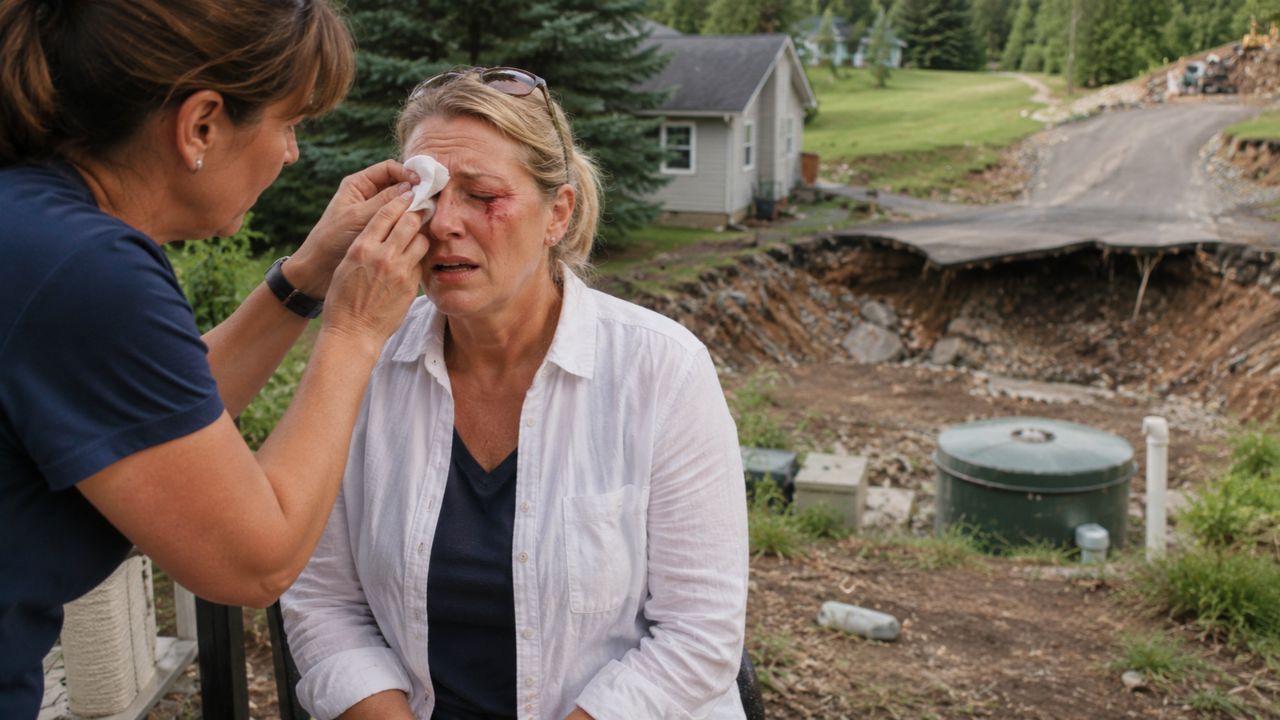
Photo credit: AI-generated image created using ChatGPT. Illustrative only.
You know that sinking feeling when you buy your first home and finally exhale… then something basic stops working? For Tony Dalton in Edgewood, Kentucky, it wasn’t a squeaky floor or a leaky faucet. It was the entire path his home’s wastewater takes to leave the property.
Dalton says that in June, construction next door for a new school parking lot ended with his sewage line accidentally cut—leaving him with “no connection to sanitation,” and a repair path that could run into the tens of thousands. The details were reported in the source post, and they read like a homeowner nightmare that doesn’t have a clean villain, just a lot of expensive reality.
He bought the house in April — and by June the plumbing was basically useless
Dalton purchased his first home in April, expecting the usual new-home learning curve. Instead, two months later, he says workers with Webbs Excavation—hired by the Kenton County School District—cut the sewage line serving his house while building a parking lot for Hinsdale Elementary next door.
At first, Dalton thought it would be a straightforward fix. The home is about 25 years old, and he said the line had “always been there.” That’s the kind of assumption most homeowners make: if it’s been working for decades, it must be legitimate, permitted, and protected.
Then he was told the part you don’t discover until you’re already standing in the mess: the line apparently crossed property without a formal easement.
The real gut punch was the easement problem
Dalton’s account turns on one phrase that can separate “their contractor broke it so they fix it” from “sorry, that’s your problem”: no formal easement.
An easement is the written, recorded permission that lets one property use part of another—like a driveway, a utility run, or, in this case, a sewer lateral. Dalton said he was told there was no agreement allowing his sewage line to cross the neighboring property where the parking lot is going.
That detail flips the story from a simple repair into a full-blown property problem. If there’s no easement, the neighbor (or the property owner building the lot) may not be obligated to keep that line in place. And it means the “fix” might not be repairing what was cut, but rerouting everything to somewhere else.
Dalton called it “unfair” and “unethical,” because he’s the one stuck holding the bill for something he didn’t knowingly create.
Once the line was capped, the house couldn’t use running water
Dalton said the school district agreed to hold off on capping the line for a few weeks, but that it has since been capped. That’s the moment where this stops being a frustrating neighbor dispute and becomes unlivable.
He said he can’t use running water because it has nowhere to go. Not “it drains slowly.” Not “we can’t run the dishwasher.” More like: if you run water, you’re gambling with backups and damage because the exit route is gone.
This is the part that people who haven’t dealt with sewer issues often miss. A broken water line is urgent. A broken sewer line is urgent and relentless. Every normal activity—shower, laundry, toilet—becomes a decision with consequences.
The estimate that made it feel impossible: up to $35,000
In Kenton County, sewage lines are overseen by Sanitation District No. 1 (SD1). Dalton said SD1 gave him options for reconnecting to other sewage lines, but those lines are hundreds of feet away.
Distance is money. Digging is money. Permissions are money. Restoration—driveways, landscaping, possibly cutting across awkward terrain—is money. Dalton said he got an estimate that could be as high as $35,000 to connect to a new line.
He described it as “tens of thousands of dollars” that he’s left paying himself. And if you’ve ever priced major underground work, you know how estimates like that happen: long runs, deep trenches, unknown obstacles, and the kind of labor that doesn’t get cheaper because you’re stressed.
Meanwhile, the school district’s attorney, Jeremy Deters, told the reporter they sympathize but don’t believe they’re responsible because there was no formal easement.
SD1’s explanation: private laterals, multiple parcels, and no written permissions
SD1’s spokesperson drew a clear boundary around what the agency handles and what it won’t. SD1 said it isn’t responsible for private sewer laterals; its responsibility generally begins where private flow enters the public system.
And then the explanation gets even messier. SD1 described a chain of connections across parcels without express easements: one parcel had a private lateral connecting to an SD1 pipe across another parcel (the parking lot area) without an easement, and then a second parcel (Dalton’s) connected into that neighbor’s private lateral—again without an express easement.
That means Dalton isn’t just dealing with “my pipe crossed their land.” He may be dealing with a legacy layout that relied on handshake arrangements, old assumptions, or work done long ago without paperwork. It worked—until someone started digging and the missing documentation suddenly mattered.
How people react when they hear “no easement” and “sewer line cut”
Stories like this tend to split homeowners into two immediate camps: the “law is the law” crowd and the “this is why people hate construction next door” crowd.
The practical-minded reactions usually sound like: get everything in writing, document the timeline, pull every record you can find, and don’t rely on verbal assurances when utilities are involved. People also tend to point to surveys, recorded plats, and title work—because if an easement exists anywhere, it’s often buried in paperwork most buyers never read line-by-line until it’s too late.
And then there’s the hard-earned homeowner instinct: don’t assume a 25-year-old setup is properly documented just because it’s been functioning. Plenty of houses operate on “it’s always been like that” infrastructure until a major project forces it into the light.
Dalton said he isn’t pointing the finger at one specific party. What he wants is for someone involved to “step up” and work toward “a civilized, mutual solution.” But when sewage is capped and the alternative is a massive reroute, “mutual solution” starts to look like a question of who pays—and who has the leverage to say no.
For now, Dalton is left staring at the worst kind of homeownership surprise: a house that can’t be used normally, a fix that could cost as much as a car, and paperwork gaps he didn’t create but may have to finance anyway.
Like Fix It Homestead’s content? Be sure to follow us.