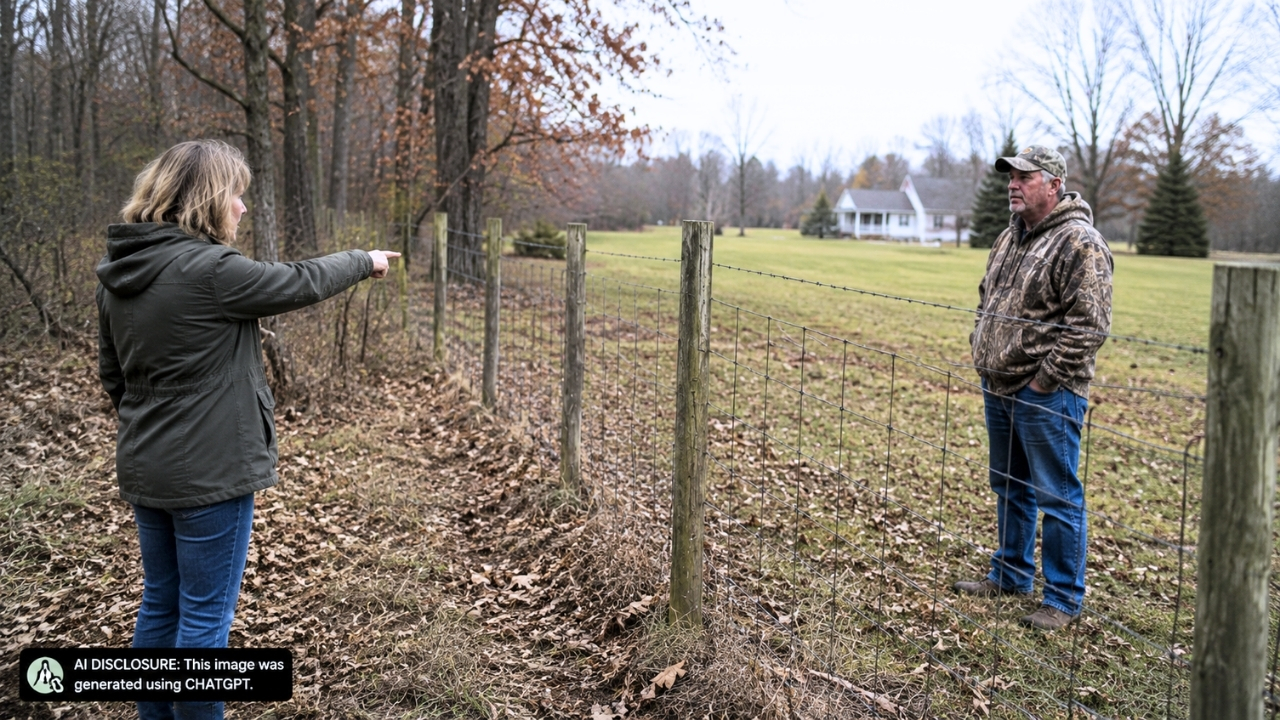
Landowner Tells a Hunter the Fence Marks Her Property Line on Her Two Acres — Then the Neighbors Sue Her Over Where the Line Really Runs
Photo credit: AI-generated image created using ChatGPT. Illustrative only.
It started the way a lot of rural-ish neighbor disputes start: with an old fence line, a “good enough” understanding of where the property ends, and someone using the land the way they always thought they could. Then a deer got shot, crossed the line anyway, and suddenly the boundary wasn’t just about grass and trees—it was about trespass, safety, and who’s responsible when things spill over.
In an Indiana case that reads like every homeowner’s “please don’t let this happen to me” scenario, neighbors ended up in court after a hunter entered adjacent land to retrieve a wounded deer. The dispute and the legal back-and-forth are laid out in the source post, and the details are a reminder that “my land, my rules” gets complicated fast when fences, zoning, and human behavior collide.
A fence line, a hunting permission, and a deer that didn’t cooperate
Staci Reuer owned a roughly two-acre property. She allowed a hunter, Justin Trumble, to hunt there. Like many small-acreage landowners, she knew there was a fence between her place and the neighbors—Kenneth and Laura Nirenberg—and she even warned Trumble that the Nirenbergs “probably would not appreciate him on their property.”
That warning matters, because it shows she had the same concern most homeowners have: whatever you do on your side can turn into a fight the moment someone steps over the line. In this case, the deer that was shot didn’t stay neatly contained to the property where the hunting was allowed.
After the shot, the deer ran onto the Nirenbergs’ land. The next day, Trumble went onto the Nirenbergs’ property to retrieve it. That’s where the human part of this story boils over—Laura Nirenberg encountered him and said she felt threatened.
The moment it turned from “neighbor issue” to “legal issue”
When someone is on your property without permission, it doesn’t matter how polite they seem or how good their explanation is. People get protective fast, and they should. The Nirenbergs didn’t just treat it as an annoying one-off—they sued Reuer, the neighbor who granted the hunting access in the first place.
The claims weren’t limited to “that guy trespassed.” They went after Reuer on multiple theories, including ordinary negligence and a claim that she could be responsible for Trumble’s alleged wrongful conduct. In plain homeowner terms: the argument wasn’t only about what the hunter did, but about whether the person who let him hunt created the conditions for it to happen.
And if you’ve ever had a property-line dispute, you know how quickly the conversation shifts. One day it’s, “The fence is the line.” The next day it’s, “Get a survey, call your attorney, don’t speak to them without a witness.”
The trial court tossed the case—then the appeals court brought key parts back
At first, Reuer won big at the trial level. The trial court granted summary judgment and threw out all claims against her. A major reason: Indiana’s Recreational Use Statute, which is designed to encourage landowners to let others use their land for recreational purposes (like hunting) without automatically taking on liability.
But the Indiana Court of Appeals didn’t let it end there. It revived two major claims: ordinary negligence and liability tied to the alleged tortious acts of another. That doesn’t mean Reuer was found liable—it means the neighbors had enough evidence to keep going, and a factfinder should decide the disputed issues rather than having a judge end it early.
For homeowners, this is that uncomfortable middle ground: you can do something that feels normal—like giving a friend permission to hunt—and still end up in extended litigation because the chain of events becomes messy and foreseeable in hindsight.
Zoning turned out to be the trapdoor under the “recreational use” shield
The appellate court focused on something a lot of property owners don’t think about until they’re staring at paperwork: zoning. Reuer’s property was zoned residential, and the county zoning ordinance did not permit hunting there.
That mattered because the recreational-use protections aren’t a magic “no liability ever” card. The statute specifically doesn’t protect a landowner from injuries caused by the landowner’s “malicious or illegal” acts. The appeals court said Reuer’s decision to allow hunting on residentially zoned land could fall into that exception.
This is where the fence-line talk and the “it’s only two acres” talk stops being casual. If a use isn’t allowed where you live, it can change how courts view your choices—even if you thought you were just giving someone permission to do something outdoorsy and ordinary.
Foreseeability: the deer, the return trip, and the predictable confrontation
The other major issue was foreseeability—basically, whether it was predictable that letting someone hunt could lead to exactly this kind of spillover onto a neighbor’s land and a heated face-to-face moment.
The trial court had treated the Nirenbergs’ injuries as unforeseeable. The Court of Appeals disagreed, pointing to evidence that Reuer knew a wounded deer could run onto neighboring property and knew Trumble hadn’t recovered the deer when she allowed him to return. Those details created real factual questions: Did she breach a duty of care? Was the confrontation a foreseeable result of giving permission and then allowing the hunt/recovery efforts to continue?
Homeowners don’t need to speak legalese to understand the gut-level logic here. If you know something you set in motion can easily cross a property line—whether it’s runoff, a falling tree, a loose dog, or a wounded deer—you don’t get to act surprised when the neighbor’s front-yard instincts kick in.
What people latched onto: boundaries, documentation, and “don’t guess where the line is”
Stories like this tend to split readers into two practical camps. One group focuses on landowner responsibility: if you invite someone to do something risky on your property, you’re not just lending your land—you’re lending your judgment. The other group focuses on the neighbor’s right to control access: no one wants a stranger stepping over their line, whatever the reason.
And then there’s the third camp—usually the people who’ve already paid for a survey once—who fixate on the “apparently did not know the precise property boundaries” detail the appellate court mentioned. Because that’s the quiet accelerant in so many disputes: a fence that looks official, a corner marker that’s missing, and years of assumptions that dissolve the moment there’s an actual conflict.
The underlying homeowner instinct is the same either way: document first, don’t improvise boundaries, and don’t let guests “figure it out” when a neighbor relationship is already tight.
The appeals court sent the case back for further proceedings on those two revived claims, and that’s where this leaves everyone: not with a clean winner, but with a long, expensive argument still alive. A fence may look like a simple line in the grass, but once a trespass claim, a hunting permission, and a zoning rule get tangled together, that line turns into a legal problem you can’t just walk away from.
Like Fix It Homestead’s content? Be sure to follow us.