Landowner’s Thirty-Five Acres Begin Flooding After the Tract to the North Changes Its Drainage — Then a Court Rules He Waited Too Long to Sue
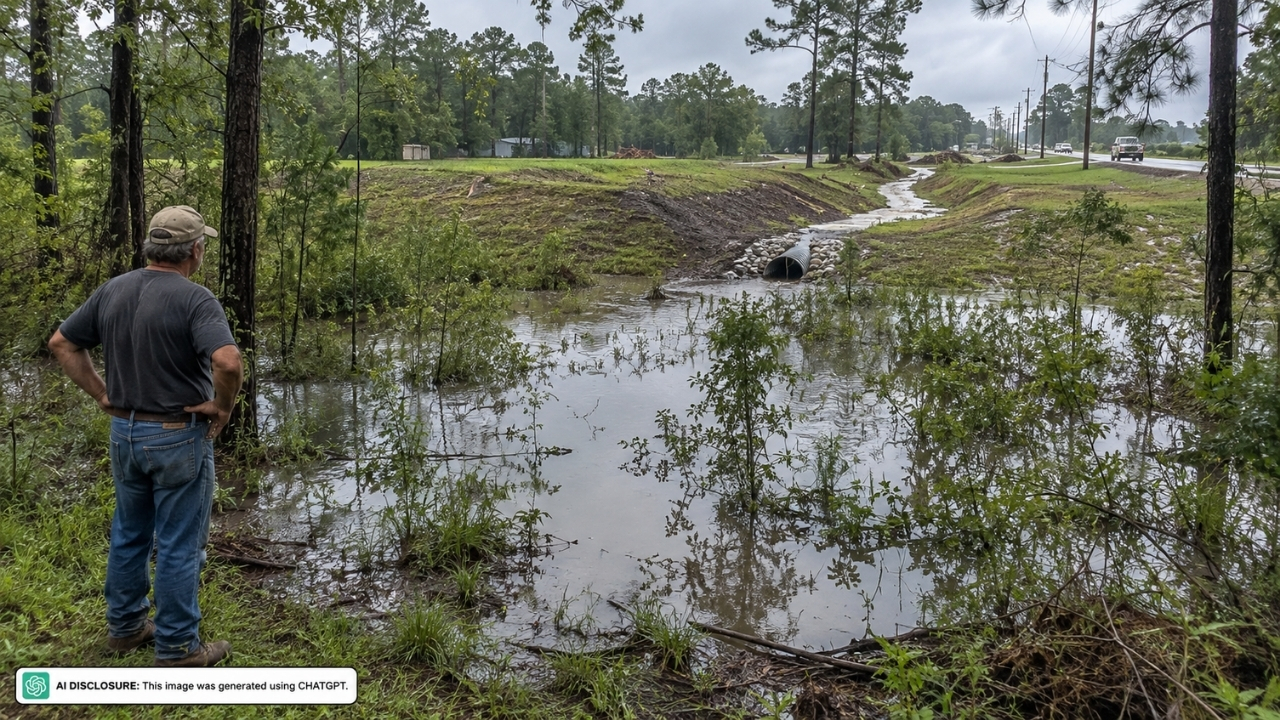
Photo credit: AI-generated image created using ChatGPT. Illustrative only.
Anyone who’s lived on rural-ish land near a highway knows the quiet anxiety that comes with water: one heavy rain can turn a “natural low spot” into a recurring headache. In Harris County, Texas, one landowner says that’s exactly what happened—except he blamed it on changes made uphill, on the tract directly north of him.
The dispute shows how a property problem can be both completely real on the ground and still dead on arrival in court if the timing’s off. The full opinion is laid out in the source post, but the short version is: he said his 35 acres kept flooding after the neighbor’s drainage changed, and the court said he waited too long to sue.
Thirty-five acres of “woods” doesn’t stay simple when water starts moving
Pat Black Properties owned a densely vegetated 35-acre tract in Crosby near Highway 90. The kind of place that can look like it takes care of itself—until it doesn’t. When surface water starts cutting new paths, “natural” land can become a bowl, and the damage isn’t always a dramatic washout. It’s standing water that won’t leave, saturated soil, and slow destruction that’s hard to pin on one storm.
Black’s claim was that the properties to the north had been altered over time in a way that pushed runoff onto his land. Not just “more water because development happens,” but water being concentrated and directed where it didn’t used to go. That distinction matters, because in drainage fights, everybody has a different definition of what’s “just nature” versus what’s an engineered problem.
Old maps, newer drainage, and a berm that bought time
To make the case, Black hired an engineer who compared historical drainage patterns from the 1970s and 1980s with modern conditions. The engineer’s conclusion: runoff used to flow west toward Highway 90 and south toward Kennings Road, rather than being funneled onto Black’s property. Over the decades, the engineer said, changes in the area led to deeper flooding on the tract.
There was also a practical, boots-on-the-ground detail that will sound familiar to anyone who’s ever tried to “solve” water with dirt: a berm. Black said a berm on the neighboring property helped for a while and the flooding stopped temporarily. But berms don’t stay perfect without maintenance, and he said the water began overflowing again as the berm eroded.
At that point, the problem wasn’t theoretical anymore. Once a water path re-establishes itself, it can keep coming back—especially if the fix is basically a wall of soil fighting gravity and repeated storms.
“We’ll rebuild it when it dries out” turned into years of waiting
Black contacted Lindall Murff about the berm and the overflow. According to the case summary, Murff responded that another berm could be built once conditions dried out enough. That’s one of those neighbor-to-neighbor answers that sounds reasonable in the moment, and then turns into a calendar problem: how long is “once it dries out” when you’re in a place that gets regular rain events?
Eventually, Black got tired of waiting. In 2018 he sued, alleging negligence, breach of contract, and a violation of Texas Water Code section 11.086, a law that generally prohibits diverting or impounding the natural flow of surface water in a way that damages someone else’s property.
But that first case didn’t carry through to a final ruling. Black voluntarily dismissed it in March 2021. Then he filed a new lawsuit in March 2021, this time focused primarily on fraud—arguing that the statement about rebuilding the berm amounted to an actionable promise—and he also asked for a permanent injunction ordering the defendants to stop diverting surface water onto his property.
The court fight became less about water and more about the calendar
The defendants moved for summary judgment and argued that the claims were barred by Texas’ two-year statute of limitations for injury to real property. The trial court agreed and ruled that Pat Black Properties recover nothing.
On appeal, Black dropped the fraud claim and focused on the injunction request. The pitch was straightforward: if the flooding is a continuing nuisance, a court should still be able to order the neighbor to stop it, even if the window for money damages had closed.
That argument wasn’t coming out of nowhere. There had been an appellate decision (out of Fort Worth) suggesting limitations might not necessarily bar an injunction aimed at stopping a continuing nuisance. But while this case was pending, the Texas Supreme Court reversed that Fort Worth case in a different dispute, Family Dollar Stores of Texas v. JLMH Investments.
That reversal mattered here. The Texas Supreme Court clarified that there isn’t a standalone cause of action to simply “abate a nuisance.” Nuisance describes a type of injury, not a free-floating claim you can file whenever you want. If you need an underlying wrongful act to get the injunction, the statute of limitations for that underlying claim still controls.
He had evidence on diversion—but still lost on timing
Here’s the part that will make homeowners grit their teeth: the appeals court actually found something important in Black’s favor on the substance. His petition alleged the defendants continued to divert surface water onto his land, and the court said that allegation could amount to a Water Code section 11.086 violation. Black’s testimony and his engineer’s comparison work were enough to raise a factual question about whether the natural drainage had been altered.
In other words, the court didn’t wave off the idea that the drainage might have changed. It didn’t declare the flooding “no big deal” or say there was definitely no diversion. The problem was the clock.
Black acknowledged learning about the flooding before March 2017. The lawsuit at issue was filed in March 2021—more than four years later. Because the underlying nature of the case was still an injury-to-real-property claim, the two-year limitations period applied. And after the Texas Supreme Court’s nuisance ruling, requesting an injunction didn’t create a separate, limitations-free route around that deadline.
The First Court of Appeals affirmed the summary judgment against Pat Black Properties. The result: no recovery, and no court-ordered fix, not because the water story was impossible, but because it was brought too late.
The reactions are predictable: document early, and don’t let “we’ll get to it” run out the clock
This is the kind of neighbor drainage story that usually triggers the same practical reactions from property folks: start documenting the moment you see a pattern. Photos after each major rain. Notes on dates. Any communications in writing, even if they’re friendly. And if you’re relying on a berm, ditch, or culvert on someone else’s land, treat it like a fragile truce, not a permanent solution.
It also highlights a hard reality: verbal assurances can feel like progress, but they can also become the reason nothing gets filed until it’s too late. “We’ll rebuild it when it dries out” can stretch across seasons, then years. Meanwhile, the water keeps doing what water does.
For Black, the land is still the land—35 acres that don’t stop flooding just because the courthouse doors closed. And for anyone watching from the sidelines, the warning is plain: drainage disputes aren’t only about dirt and elevation. They’re also about timing, and once you’re outside the statute of limitations, even strong evidence can end up not being enough.
Like Fix It Homestead’s content? Be sure to follow us.