Bowie Homeowner Is Out of Town When Nine Large Trees Vanish From Her Yard — Then a Jury Hands Her Maryland’s Largest Tree-Cutting Verdict at $933,000
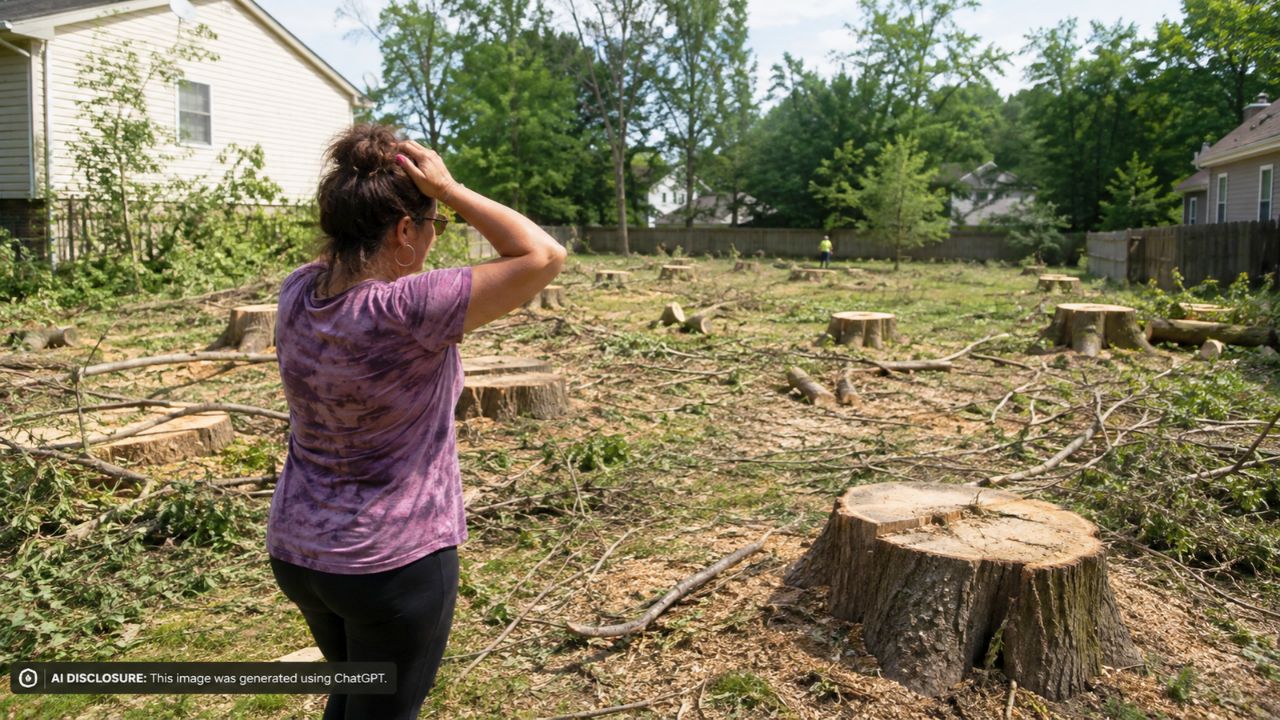
Photo credit: AI-generated image created using ChatGPT. Illustrative only.
She left town for work for a few days. When she came back to her Bowie yard, nine large trees were simply gone—cut down while she was away, leaving bare ground and a shocked homeowner trying to figure out how something that big could happen without her knowing.
The fallout turned into a courtroom fight that ended with what’s being described as Maryland’s biggest tree-destruction verdict. Details of the case were reported in the original post, including how the jury reached a total of $933,000 in damages and why the tree service company, not just the neighbor, ended up on the hook.
A work trip, a mailbox note, and a yard that didn’t look like home anymore
According to the report, the homeowner traveled to San Diego for work in February 2024. While she was gone, her neighbor arranged for Unlimbited Tree Service to do work on his property.
Before the trees came down, the neighbor left a note in her mailbox saying he intended to cut them. That was it—no conversation, no signed permission, no confirmation that she’d actually seen it. She didn’t find the note until she returned, and by then the trees were already cut.
If you’ve ever walked a property line in the woods, you know how quickly “my side/your side” can get fuzzy when it’s just grass and trunks. But this wasn’t one sapling. The report says many of the trees were mature, over 30 inches in diameter.
It wasn’t just “tree removal”—it was instant, expensive damage
A lot of homeowners don’t realize how courts look at trees until they’re gone. It’s not only the value of the wood or the cost of cleanup. The big money is in what it takes to restore the property to what it was.
The jury awarded $783,000 specifically to restore the property to its original condition, plus $150,000 in noneconomic damages. That’s how the total hit $933,000.
The homeowner’s attorney, Matt Skipper, said the money was enough to plant mature trees rather than starting over with small replacements. He put the cost at nearly $90,000 per tree for that kind of mature replanting—numbers that sound unreal until you consider the equipment, transportation, site work, and the fact that you’re trying to replace something that took decades to grow.
And beyond the dollars, there’s the immediate livability change: loss of privacy, more sun and heat on the house, altered drainage patterns, and the feeling that somebody can walk onto your land and “re-landscape” it without permission.
The jury didn’t buy the “we thought it was fine” explanation
On Feb. 27, a Prince George’s County jury found Unlimbited Tree Service liable for trespass and negligence. That part matters for anyone who hires contractors: the company wasn’t treated like a neutral bystander that simply followed instructions.
Skipper’s statement in the report was blunt. He said the defense couldn’t get away from photos and video showing the “devastation,” and he called it hard to believe it happened at all.
He also described it as “outrageous” that a licensed company would take that action without ever speaking with the property owner or getting written permission. In his view, basic due diligence would have shown consent was needed.
The tree company’s owner, Chuck Preslipsky, offered a different angle. He said they believed the trees belonged to the neighbor who hired them and that they believed both neighbors wanted the trees removed. He also said tree companies don’t usually check property lines—and that he intended to trust the client when the client says the trees are his.
Preslipsky called the verdict “extremely unreasonable” and said he intends to appeal. He also acknowledged the human part: “It sucks for her, it sucks for (her neighbor), it sucks for me.”
How the neighbor’s settlement changed the math (but not the total harm)
The homeowner sued both Unlimbited and the neighbor in January 2025 in Prince George’s County Circuit Court. But shortly before trial, the neighbor settled and exited the case.
Skipper said an insurance company paid $500,000 as part of that settlement. After the jury returned the $933,000 total verdict, the company moved to reduce the amount by the $500,000 already paid. The homeowner consented, bringing the requested reduction to $433,000.
That detail is the kind of thing that confuses people watching from the outside: why would a verdict get “cut” after the jury speaks? Skipper explained it in practical terms—because the wrong was committed by two parties, the jury had to decide the total damages suffered by the homeowner, not slice up the exact percentage caused by each defendant.
In homeowner terms, it’s like this: if two people back a truck into your fence, the fence is still crushed. The repair cost doesn’t change just because more than one person contributed to the damage.
The homeowner reactions were predictable: “Get it in writing” and “prove the line”
The report itself doesn’t include a comment thread, but it reads like the kind of story that sparks the same advice every time it comes up in neighborhood groups: don’t rely on friendly assumptions when property and contractors are involved.
Homeowners tend to focus on the practical “how did this get this far?” questions. If you’re hiring work near a boundary, people want to see a survey, a flagged line, and something in writing—because once a mature tree is down, you can’t un-cut it. Even if everyone apologizes, you’re still staring at stumps.
On the contractor side, people usually say the quiet part out loud: if a company is licensed and insured, folks expect them to slow down when a job involves trees that could plausibly be on someone else’s land. In tight suburban lots, “I thought it was mine” is exactly how neighbor relationships get torched for years.
And then there’s the camera factor. When a yard changes that drastically, photos and video become the whole story—before-and-after images, date stamps, and any footage of trucks or crews. Skipper specifically pointed to pictures and video as something the defense couldn’t escape.
What doesn’t go away after the verdict: a changed yard and a strained street
Even with a giant number attached to it, this isn’t the kind of win that puts things back the way they were overnight. Restoring a yard with mature trees is slow, disruptive, and expensive for reasons that don’t show up on a receipt—equipment access, root balls, soil compaction, and the reality that “mature replacement” still isn’t the same as the original canopy.
And on a block where one neighbor hired a company that cut trees off the other neighbor’s property, the emotional damage is real. You still have to live next to each other, wave at the mailbox, and decide what you do when the next boundary issue comes up.
Preslipsky says he plans to appeal. So the legal stress may not be over yet. But the underlying homeowner lesson is already carved into the landscape: when you’re out of town, a single note in a mailbox is not a safeguard—and once the saws start, the cost of “oops” can reach numbers most people associate with houses, not trees.
Like Fix It Homestead’s content? Be sure to follow us.