First-Time Buyer’s Talk With Surveyors Uncovers a Neighbor’s Rowhouse Extension Built Over the Property Line — Then Learns the Encroachment Was Never Disclosed During Either Sale
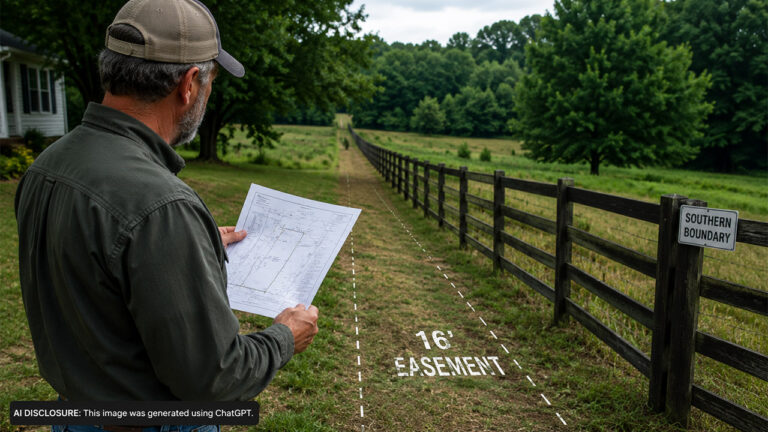
Photo credit: AI-generated image created using ChatGPT. Illustrative only.
The first-time homeowner thought they’d already survived the hardest part: buying a newly remodeled rowhouse that had been flipped earlier the same year. Four years later, the surprise wasn’t a leaky roof or a failing water heater. It was a neighbor’s addition—quietly sitting where it didn’t belong.
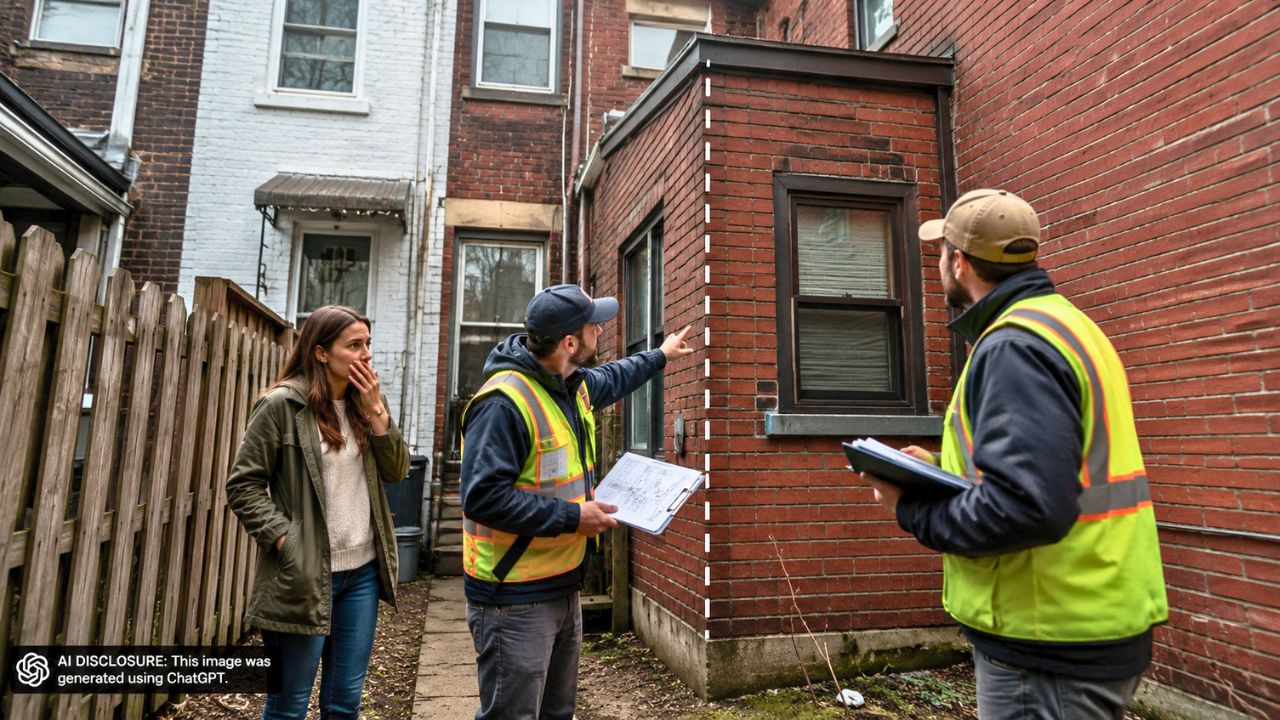
The discovery came in an ordinary, almost accidental way. City surveyors had been “snooping around back there” on and off for a month, and after finally catching one to talk, the homeowner learned the immediate neighbor’s rear “pop-back” extension appeared to run about two inches over the property line, lengthwise. The homeowner laid out the details in the original post, and what makes it sting is the timing: the encroachment seems to have existed before the homeowner ever signed closing papers—and it wasn’t disclosed during either sale.
A flipped house, a long remodel next door, and a line no one mentioned
The home was purchased four years ago, remodeled and flipped earlier that same year. Next door, the neighboring rowhouse had been under renovation for at least five years, maybe longer. The homeowner says the neighbor hasn’t actually lived there during that time; the house has been uninhabited while work dragged on.
Somewhere in that stretch, the neighbor built a “pop-back” extension—essentially a rear bump-out common in rowhouse renovations. Only now, after surveyors started appearing behind the homes, did the homeowner learn that the extension looks to cross the property line by about two inches.
Two inches doesn’t sound like much until you picture it in brick, framing, foundation, and a full-length rear wall. It’s not a shrub that can be trimmed back. It’s part of the structure. And because it runs “lengthwise,” the homeowner isn’t talking about a tiny corner that could be shaved off without major work—this is a ribbon of someone else’s building occupying their land.
The moment it clicked: “This was never disclosed”
The gut-punch wasn’t just that the encroachment existed. It was realizing it had likely been there through multiple owners and never surfaced in paperwork.
The homeowner suspects the extension was built before they bought the property, possibly even before the flipper bought it. That’s important, because it raises a question that haunts a lot of buyers after the honeymoon period ends: Did anyone know and keep quiet, or did nobody look closely enough to catch it?
In the post, the homeowner is careful not to accuse anyone of intentional deception, but the frustration is obvious. They bought as a first-time buyer, trusted the remodel, and only found out years later because they happened to talk to surveyors on-site. No disclosure. No warning at closing. Just a property line that suddenly matters a lot.
The neighbor “played dumb,” but acknowledged there’s a problem
After speaking with the surveyors, the homeowner managed to talk to the neighbor directly. The neighbor acknowledged the issue—while also “playing dumb about it.” That mix is familiar to anyone who’s dealt with property disputes: the half-admission that tries to keep options open.
The neighbor’s stance matters because it can shape what comes next. If a neighbor is cooperative, these things sometimes get resolved with paperwork, boundary agreements, or compensation. If a neighbor is evasive, it can turn into a slow grind of letters, surveys, attorneys, and hard feelings that poison day-to-day life.
There’s also the practical complication that the neighbor hasn’t been living in the home. A vacant renovation can feel like dealing with a ghost property—work happens when it happens, decisions get made off-site, and communication becomes sporadic. Meanwhile, the homeowner lives with the consequences in real time.
It’s not just a “line” problem—it’s a future sale problem
Once the homeowner understood what the surveyors were seeing, the questions came fast: What do you do when someone else’s structure is on your land? Is the neighbor in trouble? Does the city have to notify the homeowner formally? Does the extension have to be removed? Is there a financial settlement? Does it end up in court?
But one worry sits under all the others: resale. The homeowner asks, plainly, whether this will affect property value and make selling more difficult later. That’s the kind of anxiety that keeps people up at night, because the home isn’t just shelter—it’s a huge chunk of net worth.
Even when an encroachment is “only” a couple inches, it can complicate financing, title questions, and buyer confidence. It can also complicate the simplest homeowner tasks. Want to build a fence, redo a patio, add drainage, or repair a shared wall area? Suddenly you’re asking: whose land is this, really?
What people zeroed in on: proof, paperwork, and not winging it
Although the post is mainly the homeowner’s description and questions, the shape of the problem points readers toward a familiar set of priorities: get clarity before escalation. In property-line disputes, emotion is easy; proof is everything.
The homeowner’s discovery came from talking to surveyors—not from guessing based on where a garden bed ends. That detail alone hints at the next likely step: making sure the boundary is documented in a way that stands up beyond a backyard conversation.
People who’ve been through similar messes tend to push the same themes: document what you’re seeing, keep communication in writing when it matters, and don’t rely on a neighbor’s casual reassurance when the “fix” could involve structural work. When there’s a permanent addition involved, you’re not arguing over aesthetics. You’re talking about real property rights, future marketability, and who pays if it has to be corrected.
The hardest part: it may have started before either of them owned the place
The timeline is what makes this story so knotty. The homeowner believes the extension was built before they purchased their home—and possibly before the flipper purchased it. That means the person who built the addition may not be the person who sold the adjacent property at the relevant time, and the person who sold the homeowner the flipped home may not have created the problem, even if they failed to mention it.
That uncertainty doesn’t make the encroachment disappear. It just makes responsibility harder to pin down. And in the meantime, the homeowner is left staring at a wall that’s technically not supposed to be there.
For a first-time buyer, it’s a brutal lesson in how a house can be “newly remodeled” and still come with old baggage hiding in plain sight. Permits, surveys, disclosure forms, past renovations—those things don’t feel urgent until one weird detail forces you to care about every inch.
The homeowner’s post ends where many real-life property dramas begin: with a small measurement that suddenly carries big consequences, and a neighbor who admits there’s an issue without offering a fix. Two inches isn’t much—until it’s your two inches, and it’s holding up someone else’s expansion.
Like Fix It Homestead’s content? Be sure to follow us.