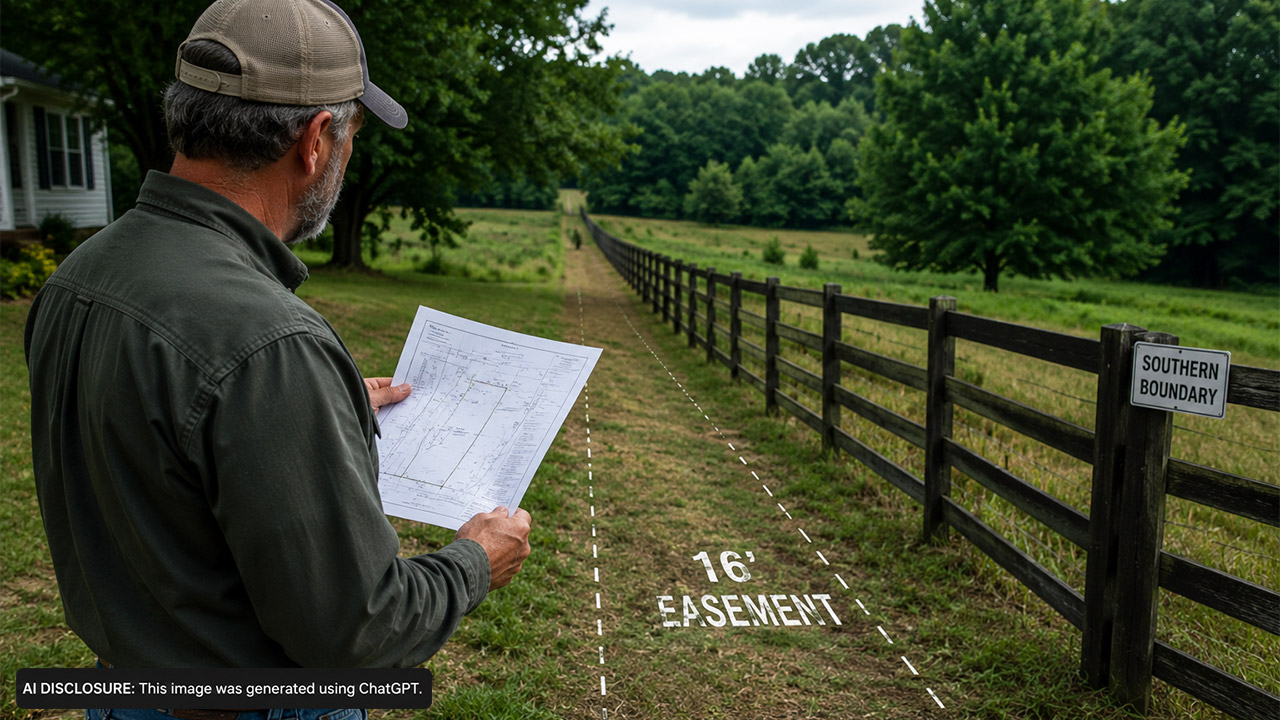
Landowner Finds a Sixteen-Foot Easement Running Along His Southern Boundary — Then the Court Affirms a Boundary by Acquiescence and Denies His Counterclaim
Photo credit: AI-generated image created using ChatGPT. Illustrative only
On rural ground, a fence line can feel like a handshake that’s been honored for generations—until a new survey shows the handshake was over the wrong patch of dirt. That’s what happened in Searcy County, Arkansas, when a landowner hired a surveyor and learned a big strip on the far side of an old fence was technically inside his deeded acreage.
What followed turned into a 5.42-acre fight where paperwork and lived reality collided, and the courts sided with the “this is how it’s always been” version of the boundary. The details come out in the source post, which reads like a warning label for anyone who buys land with an old road, a long-forgotten easement, and neighbors who’ve been treating the same line as “the property line” since before you showed up.
The survey said one thing, the fence and road said another
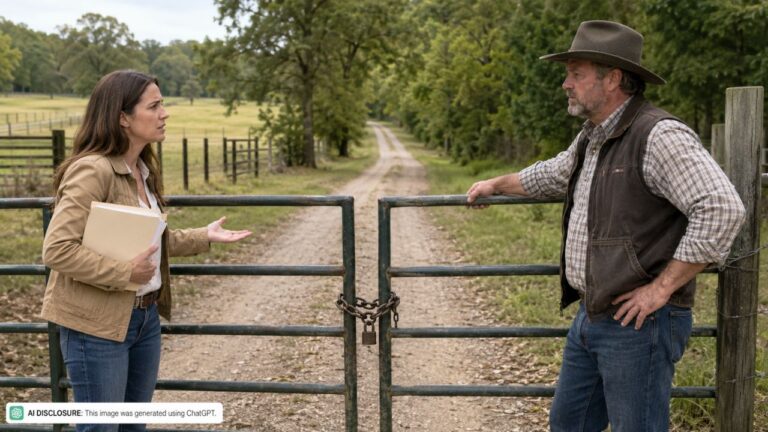
Jerry Arter owned the northern tract; the Pike family owned the southern tract. Between them sat a familiar rural marker: a fence and a roadway running east-west near what everyone assumed was the dividing line.
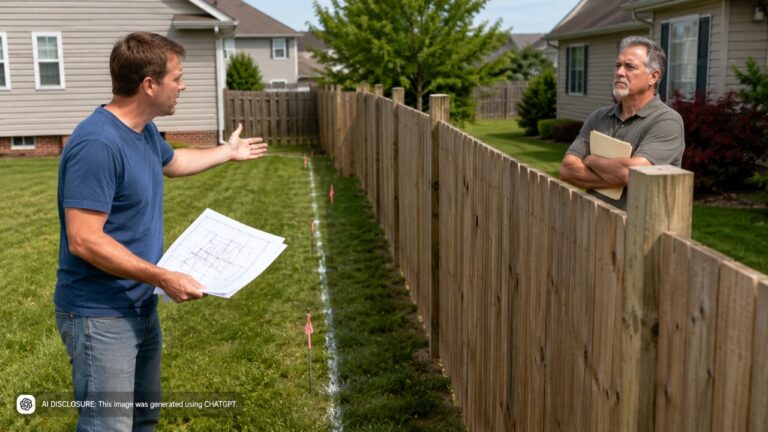
In 2019, Arter had a survey done. It came back with a gut-punch result: about 5.42 acres south of the fence—the area the southern neighbors had been using—showed up as part of Arter’s deeded forty acres.
The Pikes got their own survey. Same outcome. On paper, Arter had the stronger deed description, and in everyday homeowner logic, that should have been the end of it.
Then the easement history walked in and complicated everything
Instead of backing down, the Pikes sued, leaning on a doctrine that shows up in boundary disputes all over: boundary by acquiescence. It’s not the same as adverse possession, and it doesn’t hinge on proving the same kind of “hostile” takeover people picture from TV.
The idea is simpler and scarier: if neighboring owners treat a visible line—like a fence, road, lane, or ditch—as the boundary for many years, the law can eventually treat it as the boundary, even if later surveys say the line is “wrong.” It’s less about one side sneaking land and more about everyone quietly living as if the fence is the truth.
Here, the road mattered as much as the fence. The Pikes’ deed referenced a sixteen-foot road and utility easement running along their northern boundary. That’s the kind of language that sounds boring at closing and becomes explosive later, because it suggests the road area was expected to be associated with the Pikes’ side of the line.
There was also older courtroom history tied to that same road. In a prior dispute years earlier, owners to the west had sued a predecessor after a gate blocked access, and a court required the gate to be removed so the easement could be used. That kind of history is like a fossil record: it shows how people understood and used the road long before Arter’s 2019 survey.
“Everybody knew” is hard to fight when it’s backed by decades
At trial, witnesses stacked up on the “this is how it’s always been” side. One neighbor testified the road had been in the same place his entire life and he’d been told it was the boundary. Another said the road and fence had existed in essentially the same location for more than fifty years.
The Pikes said that when they bought their land in 2005, they believed their property extended north to the fence, including the road area. They said they maintained and used the strip without anyone objecting.
And they weren’t talking about theoretical use. Francis Pike testified to mowing up to the fence, maintaining the road, building firebreaks, keeping a compost pile in the area, and even having a semi-trailer that extended into the disputed space. Other longtime witnesses said they’d seen the Pikes and their predecessors using the strip, but rarely or never saw Arter south of the fence until close to the lawsuit.
In boundary cases, that kind of lived detail tends to land with judges: who mowed it, who maintained it, who treated it like part of their everyday routines, and whether the other side stayed silent for years.
Arter’s “the math doesn’t work” argument didn’t carry the day
Arter didn’t accept the idea that a fence line could erase what his deed and surveys showed. He said he had always treated the disputed acreage as his, paid taxes on his full forty acres, used the strip, and even helped improve the road. In his view, there was never a mutual agreement that the fence was the legal boundary.
He also raised a point plenty of rural owners have made for generations: fences aren’t always built on the line. Sometimes they’re intentionally set inside a property for practical reasons—terrain, cattle, maintenance, or just the habits of whoever built them decades ago.
Arkansas law actually agrees with that as a general principle. A fence by itself isn’t enough. One person privately believing the fence is the boundary isn’t enough either. The court needs mutual recognition, even if nobody ever sat down and said, “We agree this fence is the line.” That mutual recognition can be inferred from years of conduct and silence.
Arter also pointed to the obvious acreage problem: he bought about forty acres, not 34.58, and the Pikes bought about forty, not 45.42. But boundary-by-acquiescence cases aren’t solved like a spreadsheet. They’re solved by how the land was actually treated over long stretches of time.
The judge picked a “real-world boundary,” and the appeals court backed it
The trial court ultimately believed the Pikes’ version of the boundary history. It quieted title to the disputed 5.42 acres in the Pikes’ favor, finding the fence/road line had become the boundary by acquiescence.
The court also rejected Arter’s counterclaim seeking title and his attempt to invalidate a quitclaim deed the Pikes had given their son, John, covering the disputed tract. In other words: not only did the survey not win Arter the land, he couldn’t unwind the Pikes’ internal transfer of the disputed area, either.
On appeal, the Arkansas Court of Appeals affirmed. The appellate court leaned heavily on what boundary fights always come down to: credibility and long-term conduct. Multiple witnesses said the fence and road had been in about the same place for decades. The Pikes used and maintained the area after buying in 2005. And the road easement history supported the idea that the road sat on the Pike side of the accepted line.
The appeals court wasn’t willing to second-guess the trial judge who watched the witnesses testify. It said it was not left with a definite and firm conviction that the trial court made a mistake.
The homeowner reactions: “Don’t wait until the survey to ask the hard questions”
This is the kind of story that gets homeowners talking in practical terms, not legal theory. If you’ve lived rural, you’ve heard the advice: get a survey before you buy, walk the boundary, and don’t assume that an old fence is either (a) correct, or (b) safely “yours” just because it’s been there forever.
What makes this case sting is that Arter did what people tell you to do—he got a survey—and it still didn’t protect him from the weight of decades of neighbor behavior tied to visible markers like a fence and road. Once everyone has treated a line as the boundary for long enough, a survey can arrive like a flashlight after the room’s already been rearranged.
It also shows why easements are never “just paperwork.” A sixteen-foot road and utility easement written into a deed sounds like a footnote until somebody blocks a gate, a court orders it reopened, and that history later gets used as proof of how the neighborhood understood the boundary all along.
In the end, the disputed strip stayed with the Pikes. And Arter’s survey—despite showing the land inside his deed—became a reminder of the toughest lesson in boundary fights: sometimes the line that matters most is the one people have lived with, maintained, and defended for half a century.
Like Fix It Homestead’s content? Be sure to follow us.
- Man Says He Found Out the Fence He Paid For Wasn’t Actually on His Property
- Woman Says Her Neighbor Started Taking Mulch From Her Delivery Pile Before She Could Even Spread It
- I made Joanna Gaines’s Friendsgiving casserole and here is what I would keep
- What Caliber Works Best for Groundhogs, Armadillos, and Other Digging Pests?