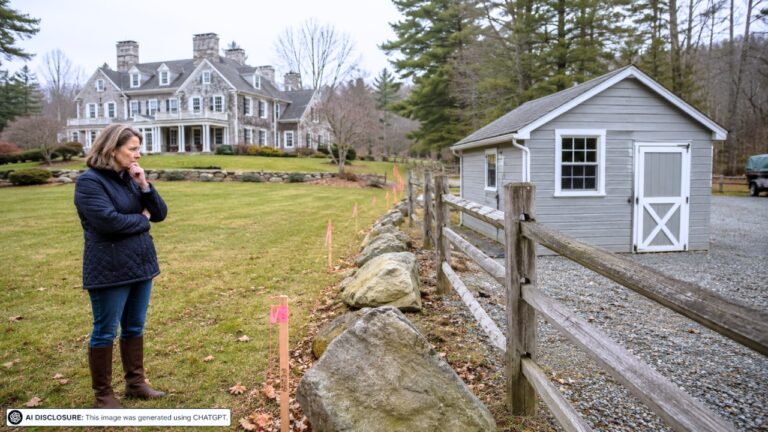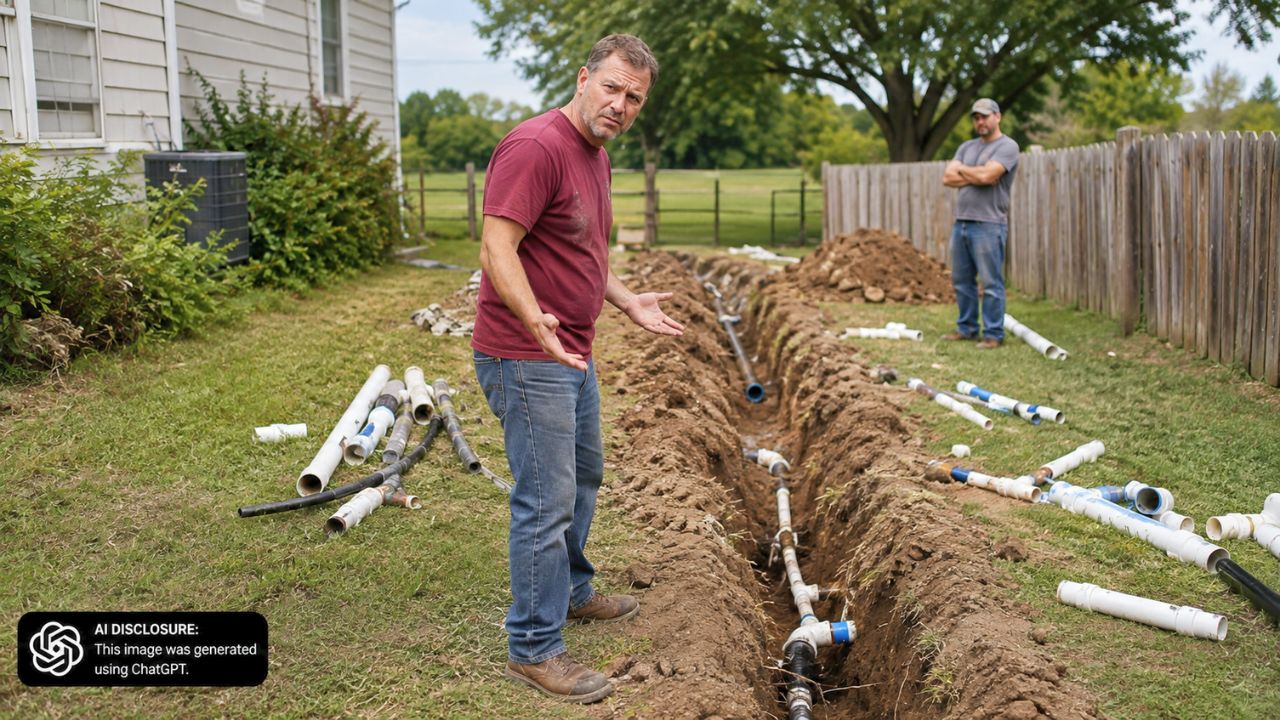
Homeowner Finds the Neighbor Dug Up a Water Line Across the Utility Easement on Their Land — Then Leaves Pipes Scattered Everywhere for Over a Month With No Plan to Finish
Photo credit: AI-generated image created using ChatGPT. Illustrative only.
At first it just looks like a messy project next door that spilled over the property line. Then you realize the digging happened on your side, in the strip of land everyone forgets about until it’s torn open: the utility easement.
That’s where one homeowner says their neighbors dug up the yard to run a water line, and then… stopped. More than a month later, the trench still isn’t backfilled, and water pipes are left scattered around with no clear plan to finish, according to the original post. The homeowner’s question was simple and loaded at the same time: How long do you give them, and what’s the best approach?
They had the right to access the easement — but the yard turned into a storage lot
A utility easement is one of those “yes, but” property realities. Yes, someone may have rights to use that corridor for certain utilities. But that doesn’t mean the rest of the property becomes a long-term staging area for an unfinished job.
In this case, the homeowner acknowledged the neighbors have a utility easement that runs through the property. The part that’s grinding them down is the timeline: it has been over a month, the work isn’t finished, and the debris of the project is now part of daily life. Pipes “everywhere” isn’t just ugly. It’s a constant reminder that the yard isn’t fully theirs to control right now.
And when a trench is left open or half-handled, the mess has a way of spreading. Rain slumps dirt. Foot traffic widens the disturbed area. If you mow, you’re navigating a minefield of materials and uneven ground.
A month of unfinished digging changes the stakes
Day one of a utility dig is annoying. Day thirty-plus starts to feel like abandonment.
Even without any mention of damage in the post, homeowners reading between the lines know how fast this kind of thing can turn from “inconvenient” to “problem.” Open or disturbed soil can become erosion. Gaps and trenches can become trip hazards. Loose pipe sections can attract curious kids, pets, or even just the neighbor’s lawn crew trying to work around it.
There’s also the access issue. If the easement is in a side yard or along a driveway, the homeowner could be dealing with blocked gates, torn-up grass, or an area that’s effectively off-limits until it’s restored. And the longer the materials sit, the more likely someone later claims they were “always there,” or that the homeowner agreed to store them.
That’s the quiet pressure in the homeowner’s question. They’re not just asking how to be polite. They’re asking how to stop this from becoming the new normal.
The hardest part is that “easement” doesn’t mean “do whatever you want forever”
People hear “easement” and assume it’s a free pass. In real life, most easements come with limits: they’re for specific uses, they’re supposed to be exercised reasonably, and they typically don’t include permission to leave an open project sitting indefinitely.
The post didn’t get into paperwork, but many homeowners have learned the same lesson the hard way: there’s a big difference between the right to install or repair a line and the right to occupy the space like it’s a personal construction yard. Restoration matters, too. If digging happened in turf or landscaping, “finish the line” is only half the job; putting the property back into usable condition is the other half.
That’s where this becomes more than neighborly friction. Once the easement is disturbed, the homeowner is stuck living with the consequences whether they approved the schedule or not.
What other homeowners pushed: document first, then demand a plan
When someone asks, “What time frame should I give them?” most homeowners don’t start with a number. They start with leverage: proof, a paper trail, and a clear ask.
Even in a short post, the common-sense reaction is predictable. People tend to urge documenting the current condition of the property—photos of where the digging occurred, where the pipes are sitting, and how much area is affected—before having the next conversation. Not because you want to escalate, but because memory gets fuzzy fast when a restoration question comes up later.
From there, the usual push is to get specifics. Not “When will you finish?” but “What’s your schedule and who is doing the work?” A plan has dates, a contractor name if there is one, and a commitment to restore the ground when the line is in. Without that, “soon” can stretch another month.
Homeowners also tend to stress keeping the conversation calm and direct. This is the kind of dispute that can permanently sour a street if it turns into driveway shouting. A firm boundary delivered in writing—text or email—often lands better than a heated face-to-face exchange.
Why an unfinished water line is more than an eyesore
The post didn’t mention whether water is already flowing or whether the work is stalled mid-install. But “water line” alone is enough to make experienced homeowners uneasy.
If something goes wrong—a leak, a break, a sudden washout—water problems don’t stay contained. They migrate. Saturated soil can undermine nearby areas, and a “temporary” trench can become a channel in a heavy rain. Even if nothing fails, the homeowner is left with an altered yard and the lingering worry that someone will need to dig it up again.
There’s also the liability anxiety that creeps in when another person’s materials are left on your land. If someone trips, if a mower hits something, if a pipe rolls into a driveway—people start pointing fingers. The homeowner didn’t say that’s happening, but the tension comes from knowing it could.
And then there’s the simple daily grind: looking out the window at someone else’s project in your grass, week after week, with no finish line in sight.
Waiting isn’t the same as agreeing — and the clock keeps ticking
After a month, the homeowner’s patience is already doing work it shouldn’t have to do. An easement can be real, and the neighbor’s need for a water line can be real, and it can still be unacceptable to leave the property in disarray with no communication.
What makes this kind of standoff so exhausting is that it sits in a gray zone: the neighbors can say they’re allowed to be there, while the homeowner is left trying to figure out what “reasonable” looks like when the job is clearly not being wrapped up.
For now, the homeowner is still in the question stage—trying to pick a time frame and a best approach before frustration turns into a full-blown feud. But the pipes scattered across the yard are sending their own message: if nobody draws a boundary, unfinished work has a way of becoming permanent.
Like Fix It Homestead’s content? Be sure to follow us.