New Homeowner Finds an Illegal Stormwater Pipe Draining Straight Onto the Driveway — Then the Neighbor Shrugs, Saying ‘Not Much I Can Do About It’
Photo credit: AI-generated image created using ChatGPT. Illustrative only.
It’s one thing to learn your new place has quirks. It’s another to watch rainwater pour out of a pipe and land right where you park, walk, and wheel the bins—like the driveway is the neighborhood’s unofficial drain.
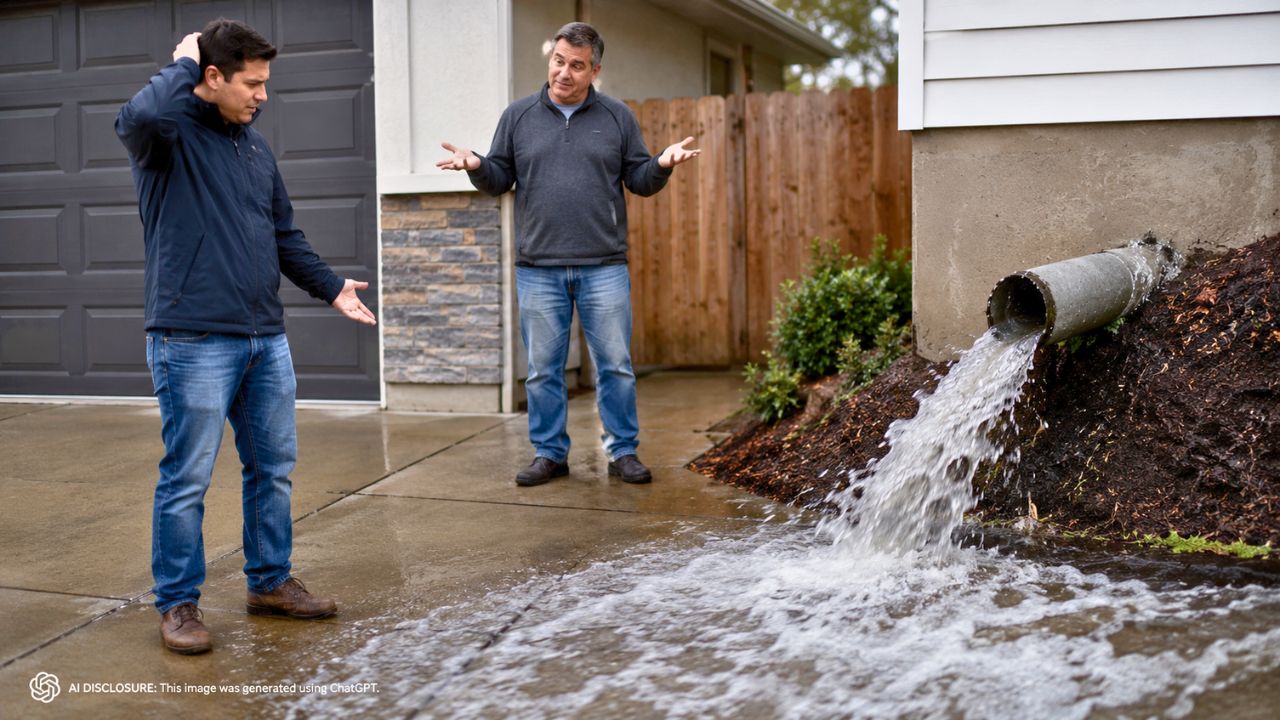
That’s what one Auckland homeowner says they discovered soon after buying their first home, in the original post: a stormwater pipe from the uphill neighbor’s property “pissing rainwater onto our driveway.” A plumber reportedly told them the setup was illegal, and suddenly this wasn’t a minor annoyance—it felt like a ticking damage problem with a property-line wrapper on it.
The first real clue was the driveway doing a job it wasn’t built for
Downhill properties already know the rules of gravity: water goes where it wants, and it usually wants to go down. The homeowner explained they sit below the neighboring section on a slope, so “our drains have to deal with his water.” That alone can be normal—until it isn’t.
What made this different was the pipe. Not runoff meandering across a lawn, but a directed discharge. In heavy rain, the pipe reportedly sends stormwater straight onto the driveway, concentrating flow in one spot instead of letting it spread out and soak in elsewhere.
Driveways aren’t designed to be someone else’s outlet. Even if the surface holds up, the edges, sub-base, nearby retaining, and any adjacent garden beds can start taking a beating. And because it’s stormwater, it’s not just “water”—it’s whatever that water picks up on the way down.
A plumber’s “illegal” comment turned a wet spot into a bigger fear
The homeowner said their plumber told them the discharge was illegal. That single word changes the whole tone of the problem. Now it’s not just about inconvenience; it’s about whether the neighbor’s drainage has been installed in a way that’s allowed, and whether the new owner has inherited a headache that can’t be ignored.
They weren’t looking to blow up the relationship. They said they were on good terms with the neighbor so far, and their first move was simple: ask if he knew about the drain. The neighbor acknowledged it.
From there, the homeowner’s next instinct was research, not retaliation. They asked where to find relevant legislation and whether calling the council would be the better first step. That’s the point where most new homeowners realize how quickly a “small” exterior issue can turn into paperwork, phone calls, and a calendar full of “just one more appointment.”
The neighbor’s response: it was there before he bought, so it’s not his problem
The homeowner later updated the post with the moment that tightened the knot. The neighbor rang them, and his attitude was: “it was put there before I bought the property, not much I can do about it.”
It’s a line people use when they want the benefits of the status quo without the responsibility of changing it. And it’s not always said maliciously—sometimes it’s just denial mixed with cost anxiety. But for the person downhill, it lands like a shrug at someone else’s future repair bill.
Because even if the neighbor didn’t install it, it’s still a pipe serving that property. It still discharges somewhere. And when the “somewhere” is your driveway, the damage doesn’t care who signed the invoice years ago.
The hard part is that this kind of dispute starts out polite. Then you have one more storm, one more puddle, one more day of tracking grit into the garage, and suddenly you’re measuring stains and taking photos like it’s a part-time job.
Why a stormwater outlet aimed at a driveway feels personal
People hear “stormwater” and think it’s harmless because it’s not sewage. But directed stormwater can chew through the practical parts of daily life. Your driveway becomes slippery, mossy, and dirty faster. In colder snaps, standing water can turn into a hazard. And if it’s flowing toward a garage or a low point, it’s one blocked channel away from becoming an indoor problem.
There’s also the awkward ownership question. If your driveway is acting like a drain path, does that change how you maintain it? Are you now expected to keep a channel clear for someone else’s runoff? The homeowner’s phrasing—“our drains have to deal with his water”—captures that uneasy feeling of being assigned a job you didn’t apply for.
Even when the surface looks fine, persistent flow can undermine edges and joints. If there’s any nearby landscaping, it can erode soil, wash mulch into places it shouldn’t be, and keep areas wet enough to encourage unwanted growth. It’s not dramatic in one day. It’s dramatic in the slow accumulation of mess.
Where commenters tend to push homeowners next: council, paper trails, and proof
The post itself focused on two questions: where to find the relevant legislation, and whether ringing the council would be better. That’s usually where online advice threads go practical fast—because drainage fights often turn on documentation more than emotions.
In disputes like this, the typical homeowner playbook starts with evidence: photos in the rain, video showing the flow from the pipe to the driveway, and notes about dates and intensity. Not because you want to “build a case” for fun, but because the moment you involve an outside authority, the first question is often, “What exactly is happening, and when?”
The second push is usually to keep things in writing. Friendly chats are great—until memories differ. A simple message confirming what was discussed can help keep the temperature down while still creating a record that you tried to handle it neighbor-to-neighbor.
And then there’s the council question. For many homeowners, the council is the lever that removes the personal edge. Instead of “I’m accusing you,” it becomes “We need to figure out what’s allowed and what has to change.” That can protect neighbor relationships, but it can also escalate things quickly if the neighbor hears “council” and feels threatened.
A new homeowner’s worst part: the problem existed before, but the consequences are now yours
The neighbor’s defense—“before I bought”—mirrors the homeowner’s own reality. They’re new too. They didn’t design the drainage on either property. Yet they’re the one standing in the runoff, trying to figure out what’s legal, what’s fixable, and what it’s going to cost in time and goodwill.
That’s what makes this kind of discovery so exhausting. You buy a house expecting to learn the light switches and the rubbish schedule, and instead you’re learning how stormwater is supposed to be managed when two properties stack on a slope.
At the center of it is a pipe that points one direction, like a finger. It doesn’t scream. It just drains. And every time it rains, it reminds the new owner that some “old” decisions don’t stay in the past—they show up, full force, on your driveway.
If the neighbor truly won’t act, the homeowner is left balancing three messy options: keep negotiating, involve the council, or live with the runoff and whatever wear follows. None of those feels like the calm first-year-of-homeownership experience anyone hopes for.
Like Fix It Homestead’s content? Be sure to follow us.